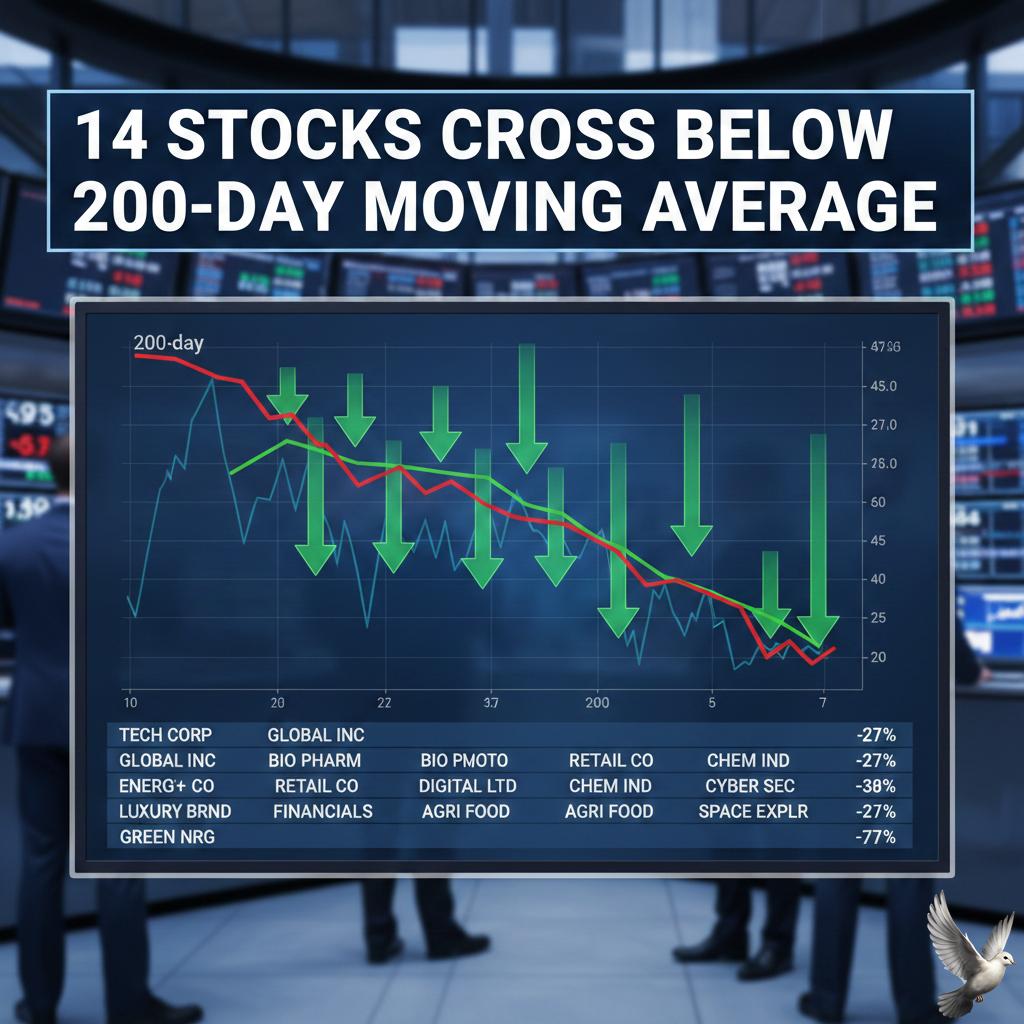
14 Stocks Cross Below 200-Day Moving Average
The Indian equity markets faced significant technical pressure on February 12, as fourteen stocks from the Nifty 500 index slipped below their 200-day moving average (DMA). This breach is a key technical indicator often signaling a shift into a long-term bearish phase.
Major names in the IT and FMCG sectors led the downside movement. Tech Mahindra closed at 1,536.60 against its 200 DMA of 1,550.34, while Hindustan Unilever settled at 2,409.70, falling below its long-term average of 2,435.72. LTIMindtree also saw a sharp breach, finishing at 5,211.50 compared to its 200 DMA of 5,488.30.
Broader market sentiment was weighed down by a massive sell-off in the IT sector, triggered by global concerns over artificial intelligence disruptions. The Nifty IT index plunged 5.51% in a single session. This volatility pushed benchmark indices lower, with the Sensex falling 558.72 points to end at 83,674.92 and the Nifty 50 declining 146.65 points to 25,807.20.
The broader Nifty 500 index reflected this weakness, closing 0.55% lower at 23,651.55. Beyond technology, stocks like Divi's Laboratories, ICICI Lombard, and Pfizer also crossed below their 200 DMA, indicating that the bearish trend is spreading across healthcare and financial services.
Economic cues remained mixed as the Reserve Bank of India recently held the repo rate at 5.25%, signaling an end to the current rate-cut cycle. While the GDP growth forecast for FY27 was raised to 6.9%, rising US bond yields and a strengthening dollar have led to cautious institutional flow.
Other notable Nifty 500 stocks currently trading below their long-term trend lines include Inox India, Vijaya Diagnostic, and Gujarat State Petronet. Traders typically view these levels as major resistance points for any future recovery attempts.
In contrast to the selling pressure, some financial stocks showed resilience. Bajaj Finance and Shriram Finance gained 3.31% and 2.48% respectively, providing a small cushion to the financial index. However, with the India VIX settling at 11.73 and GIFT Nifty signaling further negative openings, the short-term outlook remains sensitive to global tech trends and geopolitical developments.