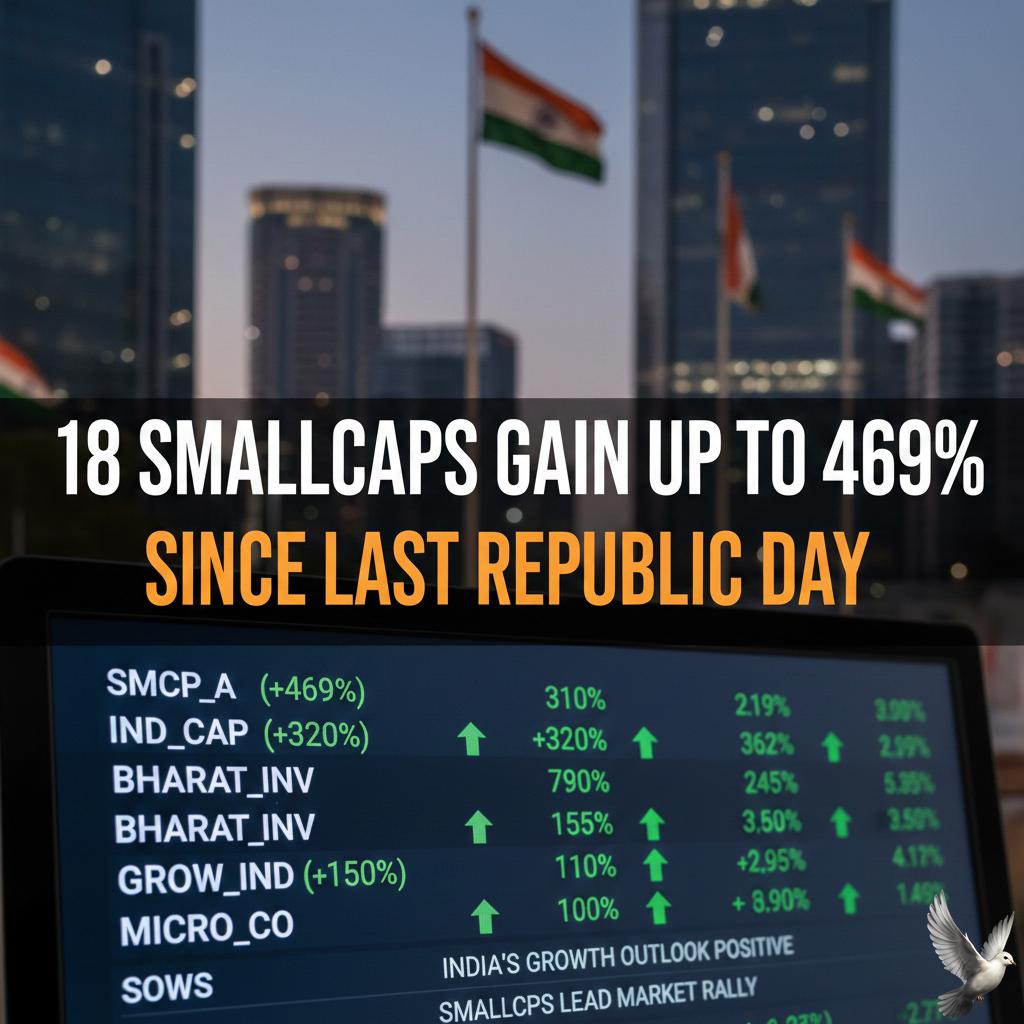
18 Smallcaps Gain Up to 469% Since Last Republic Day
🌎 Global Market Brief: January 2026
The global economy enters **2026** with continued **resilience**, projecting **3.3 percent** growth, a slight uptick from previous forecasts. This stability masks divergent forces, with strong **technology investment** serving as a major tailwind against persistent geopolitical and trade-policy headwinds.
---
📈 Equity & Macro Indicators
Stock markets remain buoyed, particularly by the tech sector's momentum. The **S&P 500 Index** recently closed at **6,915.61**, showing a **13.35%** change over the past 12 months. Developed and Emerging Markets are broadly expected to post **double-digit gains** for the year, supported by anticipated **earnings growth** and an easing monetary policy environment.
In the US, economic growth is expected to rebound to **2.2%** in 2026, driven partly by fiscal stimulus and a forecast of **Federal Reserve** rate cuts. The Fed is expected to ease its policy rate to a range of **3.0% to 3.25%** by year-end, which should further improve financial conditions.
---
🔥 Inflation & Interest Rate Outlook
**Inflation** is proving sticky and is expected to hover above central bank targets for the US. US Core PCE inflation is forecast to average **2.7%** in 2026, still elevated from the Fed's 2% goal. Global headline inflation, however, is broadly projected to decline from an estimated **4.1 percent** in 2025 to **3.8 percent** in **2026**.
The persistence of inflation is partly attributed to the lagged effects of trade tariffs, a weakening US dollar, and tight labor supply. Conversely, falling **crude oil prices** and a gradual convergence of shelter inflation are mitigating factors. For the **Bank of Japan**, officials are expressing greater confidence in reaching the **2%** inflation target, signaling a potential move toward a **higher rate regime** later in the year.
---
💻 The AI-Driven Technology Sector
**Artificial Intelligence (AI)** is the undeniable **backbone** of the 2026 technology landscape, moving from fragmented pilots to core enterprise architecture. This marks the "Year of Truth for AI," demanding a shift from hype to measurable **proof-of-impact**.
Key trends include the rise of **Agentic AI**—autonomous agents handling end-to-end workflows—and the concept of **"AI is Eating Software,"** where development shifts from manual coding to simply "expressing intent." Furthermore, **Physical AI**, including the proliferation of general-purpose **humanoid robots**, is bringing machine intelligence into the physical world and smart infrastructure. These advancements are fueling substantial **technology investment** globally.
---
⛽ Energy Markets & Commodities
The **crude oil market** is facing an oversupply outlook, which is expected to drive prices lower through the year. The **Brent crude oil** spot price is projected to average around **$56 per barrel** in **2026**, down from **$69/b** in 2025. This downward pressure stems from strong **global oil production growth** outstripping consumption.
This supply growth is being driven by producers outside of OPEC+, primarily from countries in South America, who are forecast to increase production by **0.6 million barrels per day** in 2026. While geopolitical tensions and threats of military action in key regions have caused recent price upticks, the overall fundamental picture points to rising global inventories.
---
⚠️ Key Risks on the Horizon
Despite the stable headline growth forecast, risks are skewed to the downside. A significant concern is a **reevaluation of AI productivity expectations**, which could trigger an abrupt financial market correction, spreading from highly-valued **AI-linked companies** to the broader market. The ongoing uncertainty from **geopolitical tensions** and escalating **trade conflicts** also remains a substantial threat to global supply chains and commodity price stability.