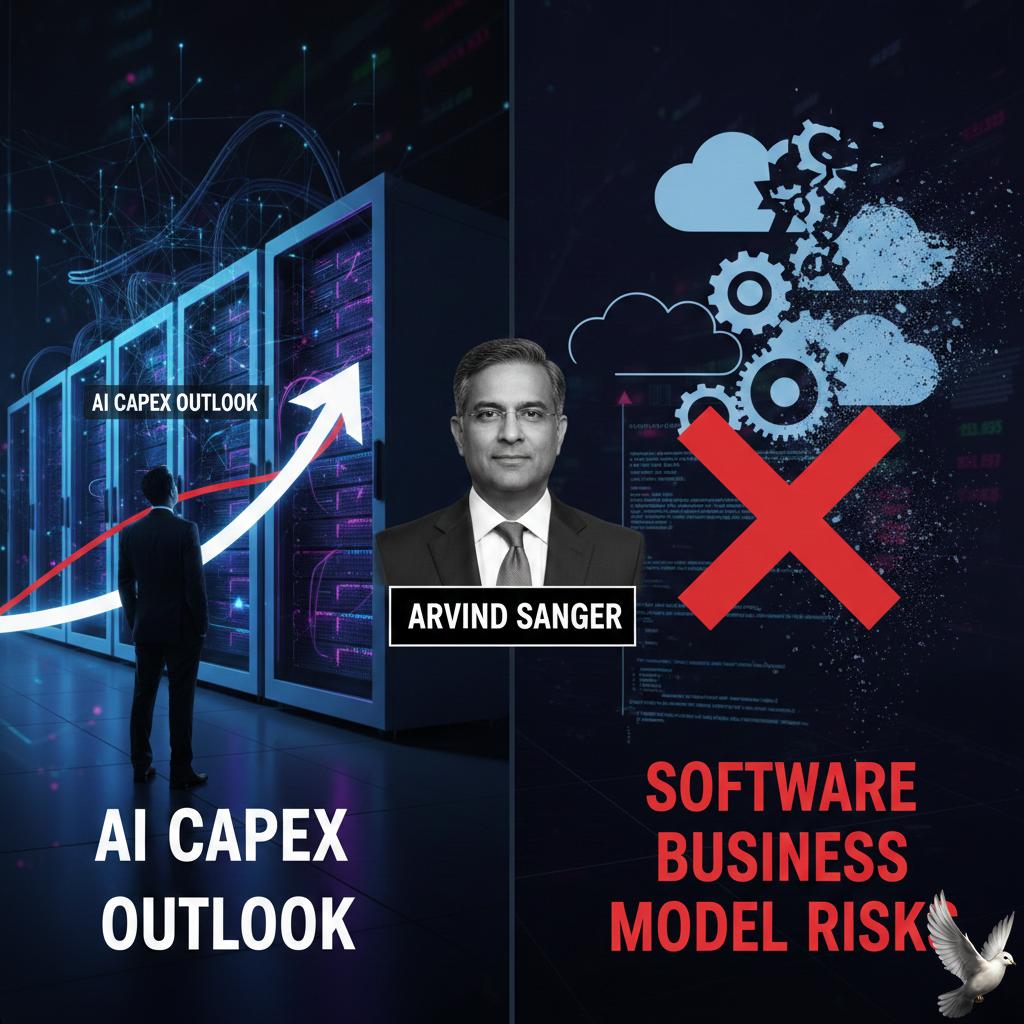
AI Capex Outlook and Software Business Model Risks: Arvind Sanger
The global technology landscape is undergoing a massive structural shift as artificial intelligence moves from the experimental phase to core industrialization. Spending on AI-related infrastructure and services is projected to reach **$1.5 trillion** in 2025, with major US hyperscalers—Alphabet, Amazon, Meta, and Microsoft—accounting for over **$320 billion** in capital expenditures this year alone. Estimates for 2026 suggest this combined investment could soar to **$650 billion**, reflecting a firm belief that AI represents a long-term value creation wave rather than a speculative bubble.
This aggressive capital allocation is driving a divergence in the IT market. While overall global IT spending is expected to grow by nearly **8%** in 2025, the data center and AI-optimized server segments are expanding at double-digit rates, often tripling the growth of traditional hardware. However, this surge in infrastructure is creating immediate pressure on traditional software and IT services firms.
For the Indian IT sector, the risk is centered on business model disruption rather than a lack of demand. High-manpower services, particularly application managed services which account for **22% to 45%** of revenue for major firms, are facing potential revenue deflation. Analysts warn that as AI coding agents and automation tools become more sophisticated, the traditional "per-hour" billing model is under threat. In worst-case scenarios, this could lead to a **14% to 16%** deflation in managed services revenue over the next few years.
Market sentiment reflects these structural concerns. The Nifty IT index has seen sharp declines in early 2025, underperforming broader indices as foreign institutional investors reduced their exposure to legacy outsourcing models. Major players like TCS, Infosys, and HCLTech have seen valuation de-ratings, even as they pivot toward "AI-first" delivery models and outcome-based pricing.
Despite the turbulence, there is a clear path toward renewal. India currently holds roughly **16%** of the global AI talent pool with over **600,000** professionals. Enterprises are shifting their focus to advisory and implementation engagements, where the demand for AI agents and agentic workflows is creating new high-value opportunities. By fiscal 2026, the Indian tech industry is still projected to cross the **$315 billion** revenue mark, driven by a rebound in discretionary spending and the industrial-scale integration of generative AI.
The transition requires a complete overhaul of talent strategies. Firms are moving away from scale-led growth to value-led innovation, upskilling thousands of engineers in large language model deployment and prompt engineering. While the "managed services" segment may shrink, the rise of "consulting and AI-led transformation" is expected to define the next era of profitability, provided firms can successfully navigate the shift from labor-intensive work to intelligent, automated execution.