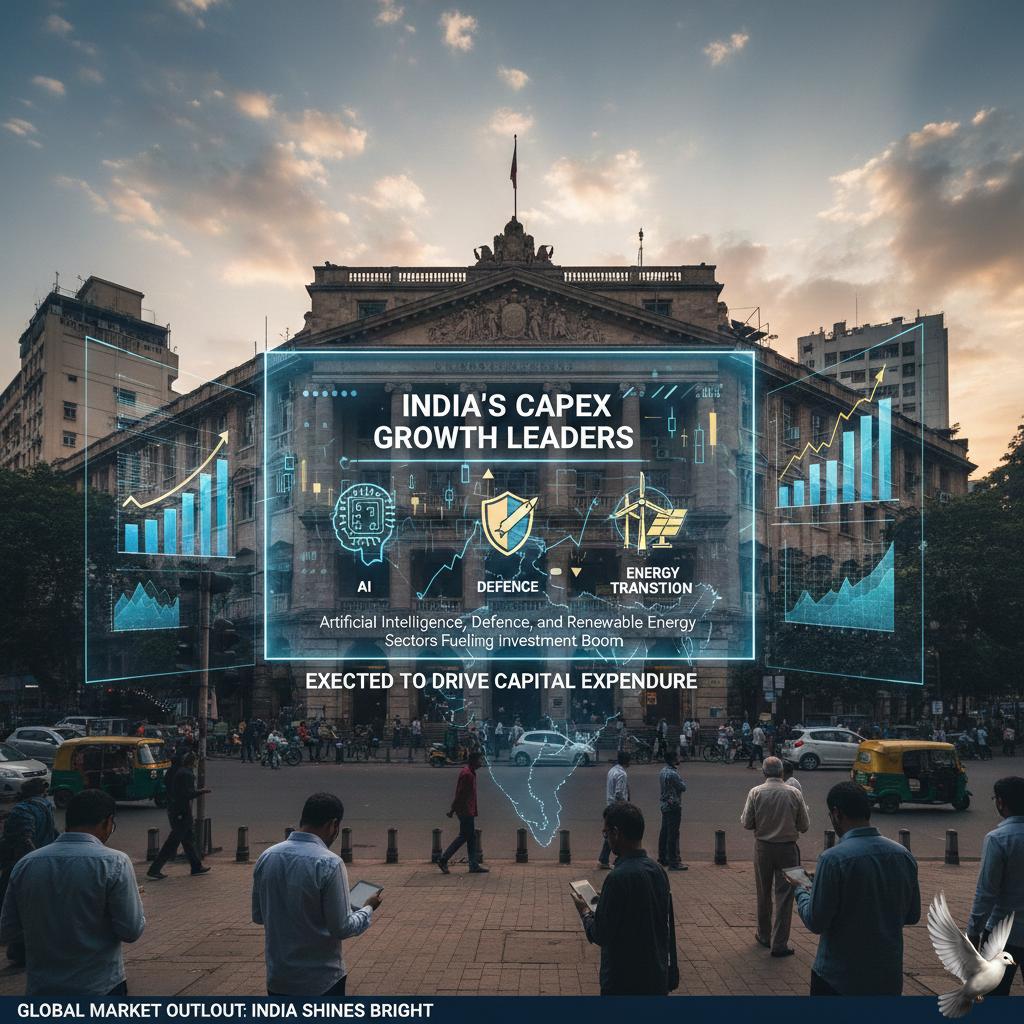
AI, Defence, and Energy Transition Expected to Lead India’s Capital Expenditure Growth
India is entering a phase of significant industrial expansion, characterized by a transition from incremental gains to a period of structural leadership. Recent data confirms a surge in industrial momentum, with the Index of Industrial Production (IIP) hitting a multi-year high of 7.8% growth. This revival is being led by a 8.1% jump in manufacturing, particularly in high-tech sectors like electronics and transport equipment, which are seeing growth rates exceeding 30%.
The market is currently responding to a massive capital expenditure wave. The Union Budget 2026-27 has set a new benchmark by allocating 7.84 trillion INR (85.7 billion USD) to defense, a 15% increase aimed at achieving "Atmanirbharta" or self-reliance. This surge is creating a powerful multiplier effect across the domestic supply chain, especially as 2.19 trillion INR is dedicated specifically to capital outlay for modernizing military hardware through indigenous production.
Artificial Intelligence has shifted from a buzzword to critical economic infrastructure. Under the IndiaAI Mission, a 103 billion INR investment is facilitating the deployment of 38,000 GPUs and the creation of AI Data Labs. This infrastructure is not just powering the tech sector but is being integrated into legacy manufacturing and banking to drive a long-term productivity cycle. Experts, including Morgan Stanley’s Chetan Ahya, view this AI-driven "smart manufacturing" as a key pillar that will sustain growth through the end of the decade.
The energy transition is also attracting massive capital as India moves toward its net-zero goals. The new National Manufacturing Mission is prioritizing clean-tech production, from solar PV modules to green hydrogen. Specific budgetary incentives, such as customs duty exemptions on lithium-ion battery components and critical mineral processing, are designed to localize the clean energy supply chain and reduce import dependency.
On the macroeconomic front, the Reserve Bank of India (RBI) is maintaining a delicate balance. While the central bank recently revised its FY26 inflation forecast slightly upward to 2.1%, the underlying core inflation remains muted at approximately 2.6%. The repo rate has been held steady at 5.25% with a neutral stance. This environment of stable rates and manageable inflation is expected to persist into 2027, providing the low-cost capital necessary to fund ongoing industrial expansion.
India's export engine is also finding new gears. Recent trade agreements, such as the pact with the U.S., have significantly lowered tariffs on industrial goods. This has allowed companies in the tractor and heavy machinery sectors to target 500 million USD in exports over the next three years. As global demand for non-tech exports recovers in 2026, India's improving capacity utilization—currently around 74.8%—is poised to rise further, solidifying its position as a primary global manufacturing hub.
[India's Manufacturing Momentum](https://www.youtube.com/watch?v=4HaSrmqE3mM)
This video provides an expert analysis from Morgan Stanley's Chetan Ahya regarding India's potential to be the biggest economic surprise in Asia for 2026.
http://googleusercontent.com/youtube_content/0