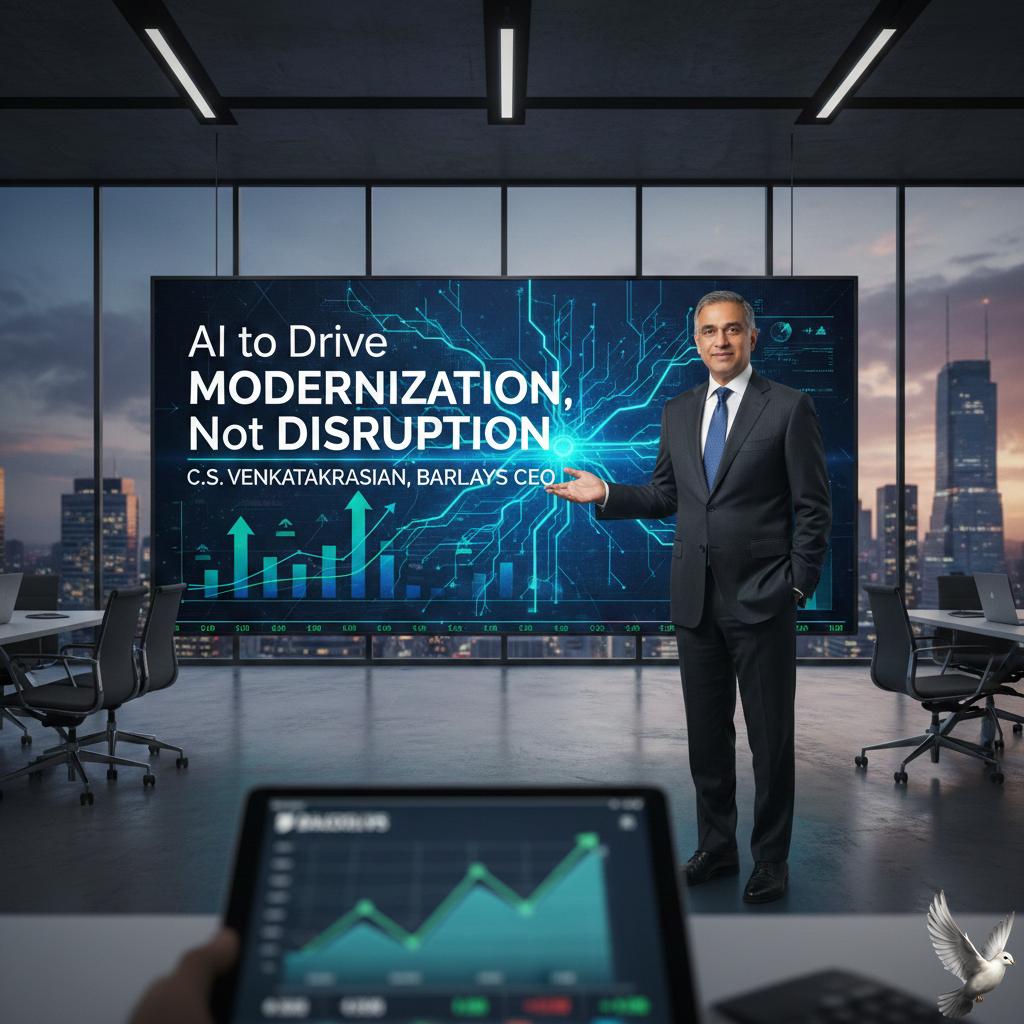
AI to Drive Modernization Rather Than Disruption, Says Barclays CEO C.S. Venkatakrishnan
India is solidifying its status as a premier global growth engine, with recent forecasts projecting real GDP to expand by 8.2% in the current fiscal cycle. This momentum is expected to remain robust, with estimates for 2026-27 hovering between 6.8% and 7.2%.
The nation’s digital economy is scaling rapidly, currently accounting for 10% of GDP and on track to reach 20% by 2026. This shift is headlined by the Unified Payments Interface (UPI), which now processes approximately 49% of all global real-time transactions. In November 2025 alone, UPI recorded over 19 billion transactions valued at 24.58 trillion rupees.
Barclays CEO C. S. Venkatakrishnan emphasizes that India’s digital transformation is moving beyond basic access into a phase of "Intelligent India." AI is viewed as a critical modernizing force rather than a threat to employment. Current data shows AI adoption among Indian firms has surged from 8% in 2023 to 25% by 2024, with generative AI projected to add up to 438 billion dollars to the economy by 2030.
The global credit environment is entering a sensitive phase as the era of cheap borrowing concludes. Market analysts highlight a tightening credit cycle, with global sovereign outlooks shifting toward more cautious territories. Rising debt and funding costs are pressuring developed markets, while emerging economies face increased volatility.
Geopolitical dynamics are increasingly mirroring the structural shifts of the 1970s and 80s. The decline of hyper-globalization has forced nations to prioritize supply chain security and bilateral trade agreements. India’s strategic focus on securing critical minerals and its new trade deals with the U.S. and EU are central to this realignment.
Despite global trade uncertainties and tariff risks, India’s external buffers remain formidable. Foreign exchange reserves stand at approximately 701.4 billion dollars, providing nearly 11 months of import cover. Inflation has also softened significantly, with core figures hitting historic lows near 2% in late 2025.
The infrastructure landscape is also pivoting toward sustainability. India recently achieved 50% of its electricity capacity from non-fossil sources, reaching 262.74 GW. This convergence of green energy and digital infrastructure is creating a resilient foundation for long-term industrial expansion.
Capital markets reflect this optimism, with FDI in computer software and hardware making up over 15% of cumulative inflows. The startup ecosystem has also rebounded, securing 10 billion dollars in funding during recent cycles, signaling a transition from capital preservation to profitable growth.