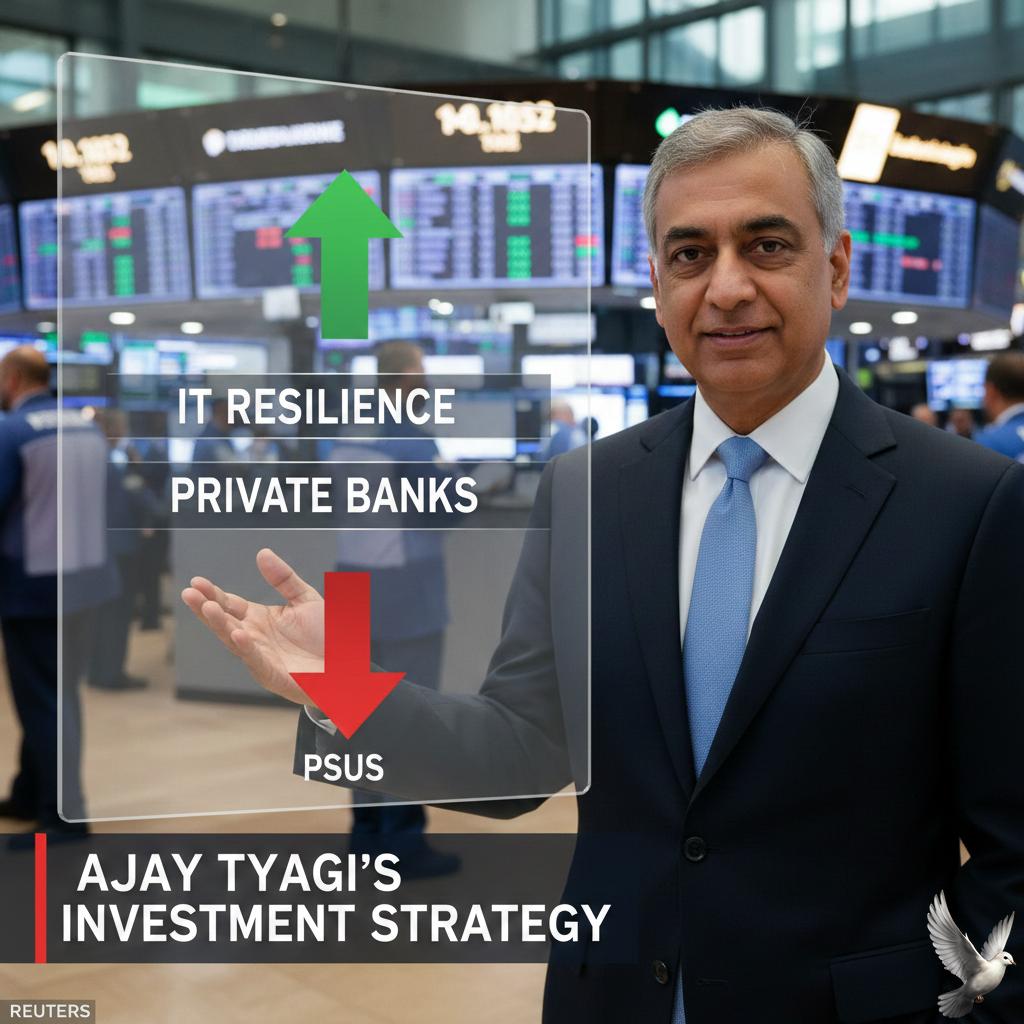
Ajay Tyagi’s Investment Strategy: Favoring IT Resilience and Private Banks Over PSUs
Market Brief: Indian Equities and Sectoral Shifts
The Indian equity landscape is navigating a period of valuation tension. Large-cap indices currently trade **15% to 20%** above their historical averages, despite a recent consolidation phase. This premium persists even as corporate earnings growth for FY26 settled near **6% to 7%**, trailing the traditional trend of **12%**.
IT Services: Resilience Amid AI Volatility
The Nifty IT index has faced significant pressure, retreating nearly **30%** from its late 2024 peaks. February 2026 alone saw a sharp **16%** decline as markets reacted to fears of AI-driven disintermediation. However, valuations have now cooled to a P/E ratio of **22.1x**, aligning closely with the 10-year average of **21.6x**.
Contrarian views suggest the threat of AI is overextended. Historical data shows the sector delivering a **15.5% CAGR** over rolling five-year periods. While automation may reduce billable hours in the short term, the transition is viewed as an "upgrading of the toolkit" rather than a total replacement of service models.
Quick Commerce: Hyper-Growth and Consolidation
The quick commerce sector has transformed into a **$7.1 billion** industry by fiscal year 2025. Market leaders are now focused on SKU depth, expanding beyond groceries into electronics and beauty to increase average order values.
Blinkit maintains a dominant market share of over **50%**, followed by Zepto and Swiggy Instamart. While the sector is projected to reach **$35 billion** by 2030, profitability remains a challenge due to high last-mile delivery costs, which are **3 to 5 times higher** in Tier-2 and Tier-3 cities compared to major metros.
Banking: The Private vs. PSU Divide
A significant divergence has emerged in the banking sector based on liquidity metrics. Many large private banks are operating with Credit-to-Deposit (CD) ratios near **90% to 92%**, leaving little room for further credit expansion without raising high-cost deposits.
In contrast, Public Sector Banks (PSUs) maintain healthier CD ratios around **74% to 75%**. This liquidity buffer allowed PSBs to report a combined profit of **₹52,603 crore** in Q3 FY26, an **18%** year-on-year increase. Despite this, some investors maintain a preference for top-tier private banks, citing superior return on assets and better long-term underwriting quality.
Market Outlook
The Reserve Bank of India has maintained the repo rate at **5.25%**, signaling a neutral stance. While geopolitical tensions and high U.S. interest rates remain external risks, the domestic focus is shifting toward sectors with mean-reversion potential, specifically IT and well-capitalized private lenders.