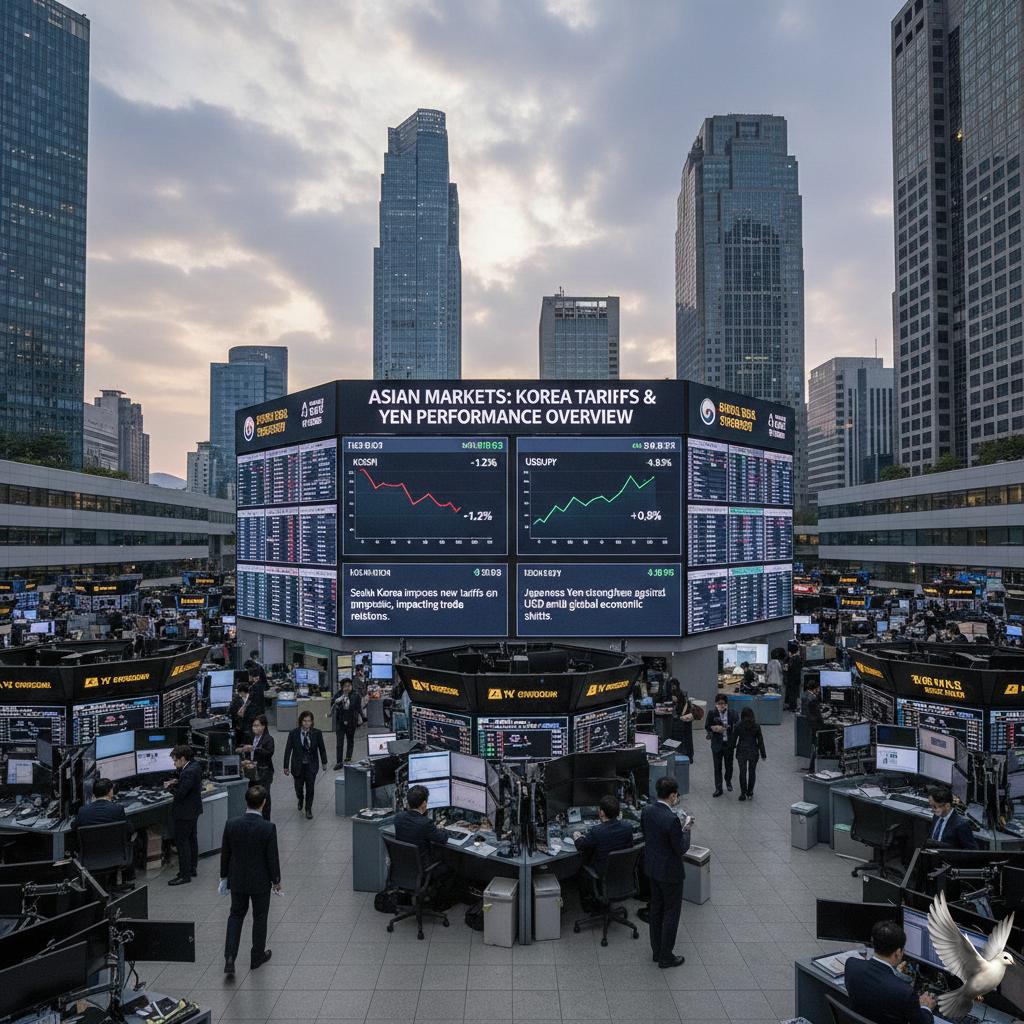
Asian Markets, Korea Tariffs, and Yen Performance Overview
Global market sentiment remains pressured
as geopolitical trade fears resurfaced,
triggering volatility in Asian equity sessions.
A sharp focus on upcoming mega-cap technology earnings
will determine the immediate trajectory
of the current AI-driven stock rally.
***
Asian Markets Under Tariff Pressure
The primary catalyst for regional friction is the renewed threat of US tariffs
targeting South Korean imports.
On Monday, President Trump announced plans
to raise duties on South Korean goods,
including automobiles, lumber, and pharmaceuticals,
escalating the tariff rate from **15% to 25%**.
This move is explicitly tied to the assertion
that the South Korean legislature has failed
to ratify a major bilateral trade agreement.
The immediate impact was severe in Seoul.
The benchmark **KOSPI Index** registered a pullback,
closing recently near **4,949.59**,
reflecting a decline of approximately **0.81%**
following the announcement.
Key South Korean stocks were immediately affected.
Shares of major automakers saw losses,
with one leading manufacturer falling by as much as **4.8%**
in early Tuesday trading.
The South Korean **won** weakened in currency markets,
reflecting investor anxiety over trade disruptions
in critical export sectors like autos,
which account for a significant portion of South Korea’s trade with the US.
***
Currency Volatility and Japanese Equities
In Japan, markets continue to grapple with currency direction.
The Japanese **yen** recently experienced rapid appreciation,
a move that fueled concern over its impact
on the nation's massive export-oriented corporate profits.
This currency strength exerted significant selling pressure
on the **Nikkei 225**, which closed down
by approximately **1.53%** in recent action.
The index settled near **53,023.28** points.
Investors are highly sensitive to any policy signals
that might curb speculative moves in the yen,
given the currency’s ability to overshadow
otherwise positive local corporate developments.
Asian stocks overall exhibited a mixed session
as traders digested the tariff news
while also factoring in residual strength from the tech sector.
***
The Critical AI Earnings Test
Attention now shifts decisively to the United States,
where the sustainability of the long-running technology rally,
powered by enthusiasm for Artificial Intelligence,
faces its most crucial test of the year.
Wall Street indices finished Monday higher,
with the **S&P 500** gaining **0.50%** to reach **6,950.23**,
and the **Nasdaq Composite** adding **0.43%** to **23,601.36**.
However, the market’s caution is palpable
as a wave of mega-cap technology earnings approaches.
Investors are specifically scrutinizing these results
to identify concrete evidence of measurable returns
on the enormous capital expenditure dedicated to AI infrastructure.
The consensus belief is that the AI enthusiasm
must translate into substantial, defensible revenue growth
to justify current high valuations.
The earnings calendar is exceptionally dense this week:
**Microsoft, Meta Platforms, and Tesla**
are all scheduled to report results on Wednesday.
**Apple** follows closely on Thursday.
Any weakness in cloud spending growth,
or disappointing guidance regarding AI monetization,
could lead to a major market reset
for the entire technology complex.
Concerns persist over capital expenditure plans,
particularly for companies like Meta,
where investors are wary of massive investment projects
following prior shifts in corporate strategy.
Simultaneously, the broader macro environment looms large.
The Federal Reserve’s upcoming policy meeting is expected to conclude on Wednesday,
providing the latest guidance on interest rates and the economic outlook,
further shaping market risk appetite in the near term.