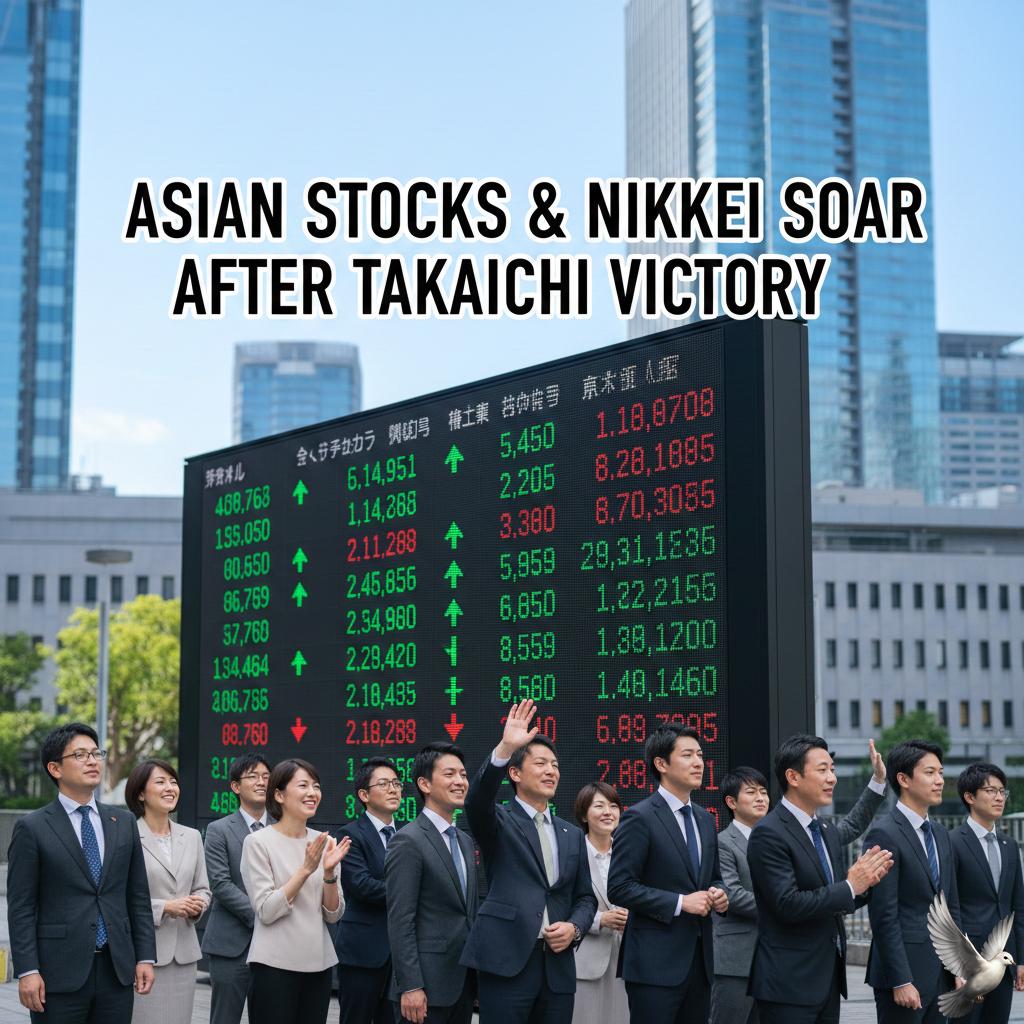
Asian Stocks and Nikkei Rise Following Takaichi Victory
Asian markets are displaying a decisive upward trend this morning, following a strong recovery on Wall Street. Investors have begun rotating capital away from the high-growth technology sector, which has dominated for years, and into "old economy" cyclical stocks. This shift is driven by a critical reassessment of artificial intelligence valuations as the market moves from speculative excitement toward practical corporate adoption.
In Japan, the Nikkei 225 remains in technical bull market territory, having crossed a 20% gain threshold in recent weeks. Despite some near-term stalling around the 38,940 level, the index continues to anchor regional sentiment. Similarly, the Hang Seng in Hong Kong has outperformed expectations, entering a bull market with a rally of 27.8% since its April lows, recently clearing a key resistance level at 23,770.
The broader market rotation is particularly evident in the United States, where the Russell 1000 Value Index recently outperformed its growth counterpart by a significant 400 basis points. While the tech-heavy Nasdaq shed 1.84% during a recent volatile stretch, the Dow Jones Industrial Average has consistently hit new records. Sectors such as energy, real-asset businesses, and regional banks are now taking the lead.
The focus on artificial intelligence has shifted toward companies that apply the technology to boost productivity rather than just infrastructure providers. While leaders like Nvidia have seen sharp corrections, the "old economy" sectors—including oil and gas, chemicals, and transportation—are benefiting from more attractive valuations and accelerating earnings.
Economic indicators are also playing a major role in shaping this new dynamic. U.S. manufacturing activity recently expanded at its highest level since 2022, with the ISM PMI jumping to 52.6. This signals a potential rebound in factory demand that supports cyclical stocks. Conversely, a softening labor market and declining job openings are fueling expectations for continued interest rate adjustments by central banks.
Looking ahead, the week is defined by a "great rebalancing." Markets are navigating a complex mix of geopolitical tensions and evolving trade policies, with a particular focus on how new tariffs might impact global supply chains. Despite these headwinds, the transition toward a broader range of market leaders is viewed by many as a healthy normalization of the global bull run.