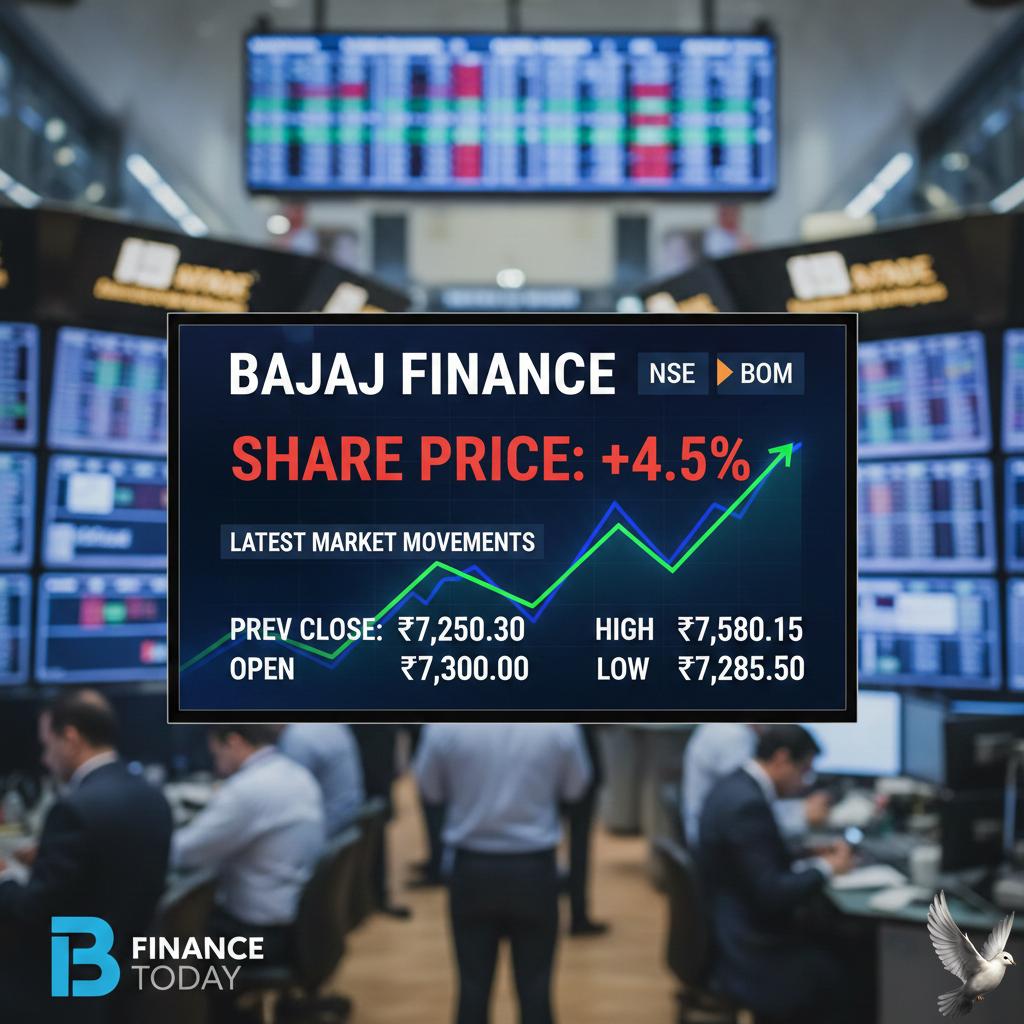
Bajaj Finance Share Price: Latest Market Movements
The global economic landscape in February 2026 is characterized by a "steady but divergent" growth trajectory. Global GDP is currently projected to expand by 3.3% for the year. While recession risks have moderated, a 35% probability of a downturn remains a focus for major financial institutions.
The "Goldilocks" era of low inflation and easy money has largely transitioned into a period of "sticky" inflation. Most developed market central banks have paused their easing cycles, holding interest rates at levels significantly higher than pre-2020 norms. In the United States, the Federal Reserve is expected to maintain rates until a leadership transition in May, with potential cuts later in the year aimed at reaching a 3.0% target.
Equity and Digital Asset Performance
Financial markets are showing a cautious mood as of mid-February. U.S. equity-index futures recently trended downward, with S&P 500 contracts dropping 0.4% and Nasdaq 100 futures slipping 0.8%. This follows a period of high concentration in the technology sector, leading some investors to rotate into Asian and emerging markets.
The digital asset market has faced a sharp correction. Bitcoin is currently trading near $68,489, a significant decline of 21.7% since the start of the year. This represents a 45.7% retreat from its all-time high of approximately $126,272 reached in October 2025.
Technology and Infrastructure Shifts
The "Big Tech" sector has experienced a valuation contraction, losing an estimated $1.3 trillion in 2026. This decline is largely driven by investor fatigue over massive AI capital expenditures and fears that immediate returns may not justify the spending.
Despite the stock market volatility, physical AI infrastructure continues to expand. Data center capacity is seeing unprecedented investment, particularly in emerging hubs like India, where capacity is expected to reach 10 gigawatts by 2030. Enterprises are shifting focus from experimental AI models to "agentic" and "physical" AI—systems that can autonomously execute real-world tasks.
Energy and Commodity Trends
Energy markets are grappling with a supply-demand imbalance. Brent crude oil prices averaged $67 per barrel in January but are forecasted to decline toward $58 per barrel by the end of 2026. This downward pressure stems from global production exceeding demand, despite short-term spikes caused by geopolitical tensions in the Persian Gulf.
Natural gas prices have seen a different trend, with Henry Hub spot prices surging nearly 40% in early 2026 due to weather disruptions. Meanwhile, renewable energy is gaining a larger share of the power mix, with solar generation expected to increase by 17% this year.
Trade Policy and Global Competition
Global trade is being redrawn by aggressive tariff shifts. New restrictive measures have created a highly uneven landscape for exporters. For instance, relative tariff positions for certain agricultural goods have shifted by as much as 17 percentage points in just two years.
These policy changes are forcing corporations to adopt "scenario-driven" supply chain strategies. While some exporters in South America and Southeast Asia are finding new opportunities, others are facing significant market access barriers that are reshaping global sourcing and investment flows.