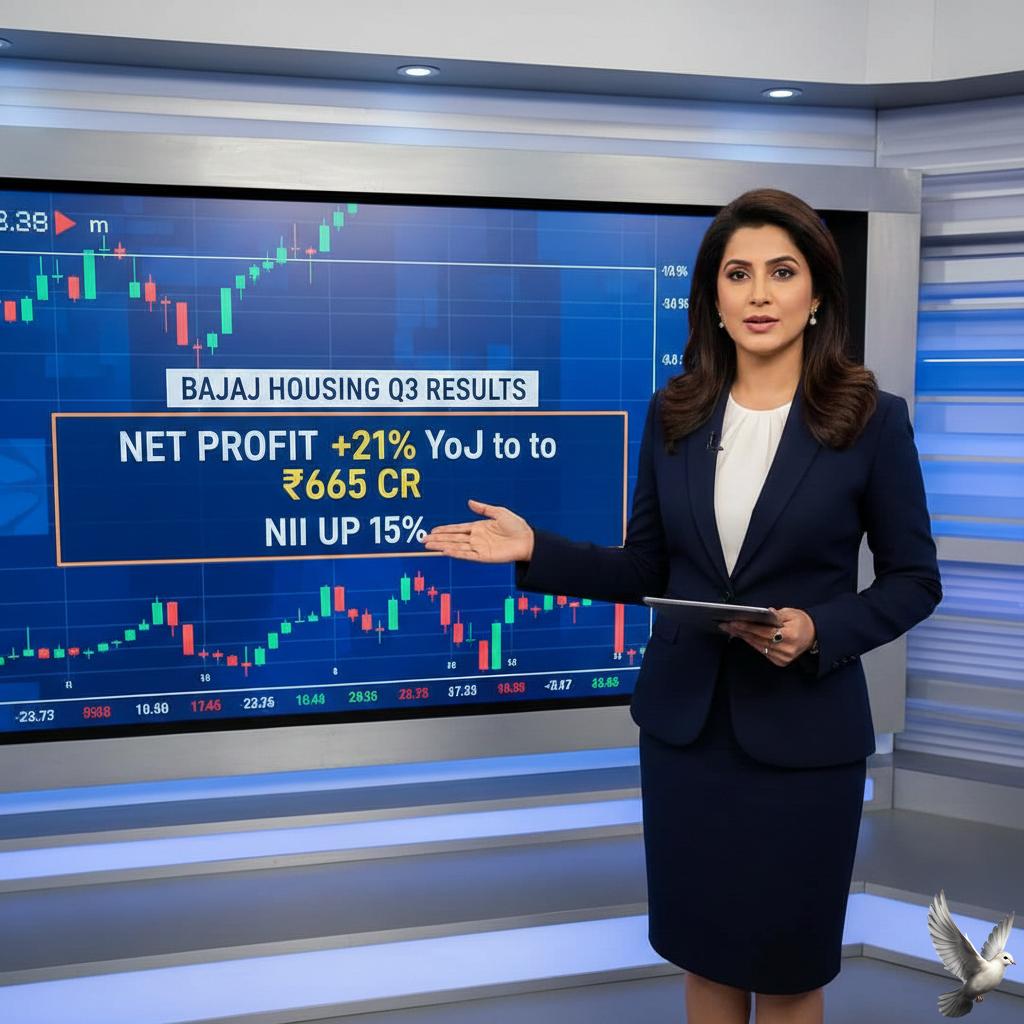
Bajaj Housing Q3 Results: Net Profit Rises 21% YoY to Rs 665 Crore, NII Up 15%
**Market Brief: Bajaj Housing Finance Q3 FY26 Performance**
**Overview**
Bajaj Housing Finance has delivered a robust set of numbers for the quarter ended December 31, 2025 (Q3 FY26), demonstrating strong growth momentum despite a challenging macro environment. The company reported a **21%** year-on-year (YoY) increase in net profit, supported by healthy loan disbursements and sustained momentum in Assets Under Management (AUM). While the bottom line was impacted by a one-time exceptional charge, core operating metrics remained resilient with improved asset quality and controlled operational costs.
**Financial Highlights**
The company’s Net Profit (Profit After Tax) climbed to **₹665 crore**, marking a **21%** rise compared to **₹548 crore** in the corresponding quarter of the previous fiscal year. This growth was driven principally by a strong expansion in the loan book and stable margins.
* **Net Interest Income (NII):** The core income stream grew **19%** YoY to **₹963 crore**, up from **₹806 crore** in Q3 FY25.
* **Total Revenue:** The company posted a revenue of **₹2,886 crore**, registering an **18%** growth.
* **Net Total Income:** Rising **24%**, this metric stood at **₹1,153 crore**, reflecting the company’s ability to scale its income faster than its interest expenses.
* **Profit Before Tax (PBT):** PBT grew **21%** YoY to **₹865 crore**.
**Business Growth & AUM**
Bajaj Housing Finance continues to aggressively expand its market footprint. Assets Under Management (AUM) surged **23%** YoY to cross the **₹1.33 lakh crore** milestone (up from **₹1.08 lakh crore** in Q3 FY25).
Loan assets followed a similar trajectory, growing **23%** to stand at **₹1.17 lakh crore**. The sustained growth in AUM highlights the company's strong origination capabilities across its core segments—home loans and loans against property—despite competitive intensity in the housing finance sector.
**Asset Quality & Provisions**
The lender demonstrated commendable discipline in credit quality, reporting improvements in key asset quality ratios:
* **Gross NPA (GNPA):** Improved to **0.27%** as of December 31, 2025, down from **0.29%** a year ago.
* **Net NPA (NNPA):** declined to **0.11%** from **0.13%**, underscoring the high quality of the loan book.
* **Provisioning:** The Provisioning Coverage Ratio (PCR) on Stage 3 assets stood at approximately **59%**. However, loan losses and provisions for the quarter increased to **₹56 crore** (versus **₹35 crore** in Q3 FY25), indicating a prudent approach to risk coverage.
**Exceptional Item**
The quarter’s profitability included the impact of a one-time exceptional item amounting to **₹13.14 crore**. This charge was attributed to an increase in gratuity liability necessitated by changes in the "New Labour Codes" issued by the Government of India in November 2025. Despite this charge, the company maintained a **20%+** profit growth trajectory.
**Operational Efficiency**
Cost discipline remained a key strength. The cost-to-income ratio (Operating Expenses to Net Total Income) improved to **19%** for the quarter, down from **20%** in the previous year, reflecting operating leverage kicking in as the AUM base expands.
**Market Reaction & Stock Performance**
Following the earnings announcement, the market reaction was muted. The stock closed the trading session slightly lower at **₹89.68**, down **0.06%**.
* **Valuation Context:** The company maintains a strong capital adequacy ratio of **23.15%**, providing ample runway for future lending without immediate dilution risks.
* **Analyst Sentiment:** Market observers are closely watching the net interest margin (NIM) trajectory and the impact of the new labor code regulations on long-term employee costs.
**Summary**
Bajaj Housing Finance’s Q3 FY26 scorecard reflects a "growth with quality" strategy. With AUM growing at **23%**, profit up **21%**, and asset quality at best-in-class levels (Net NPA **0.11%**), the company remains well-positioned to capitalize on the housing demand cycle, even as it navigates regulatory transitions and competitive pricing pressures.