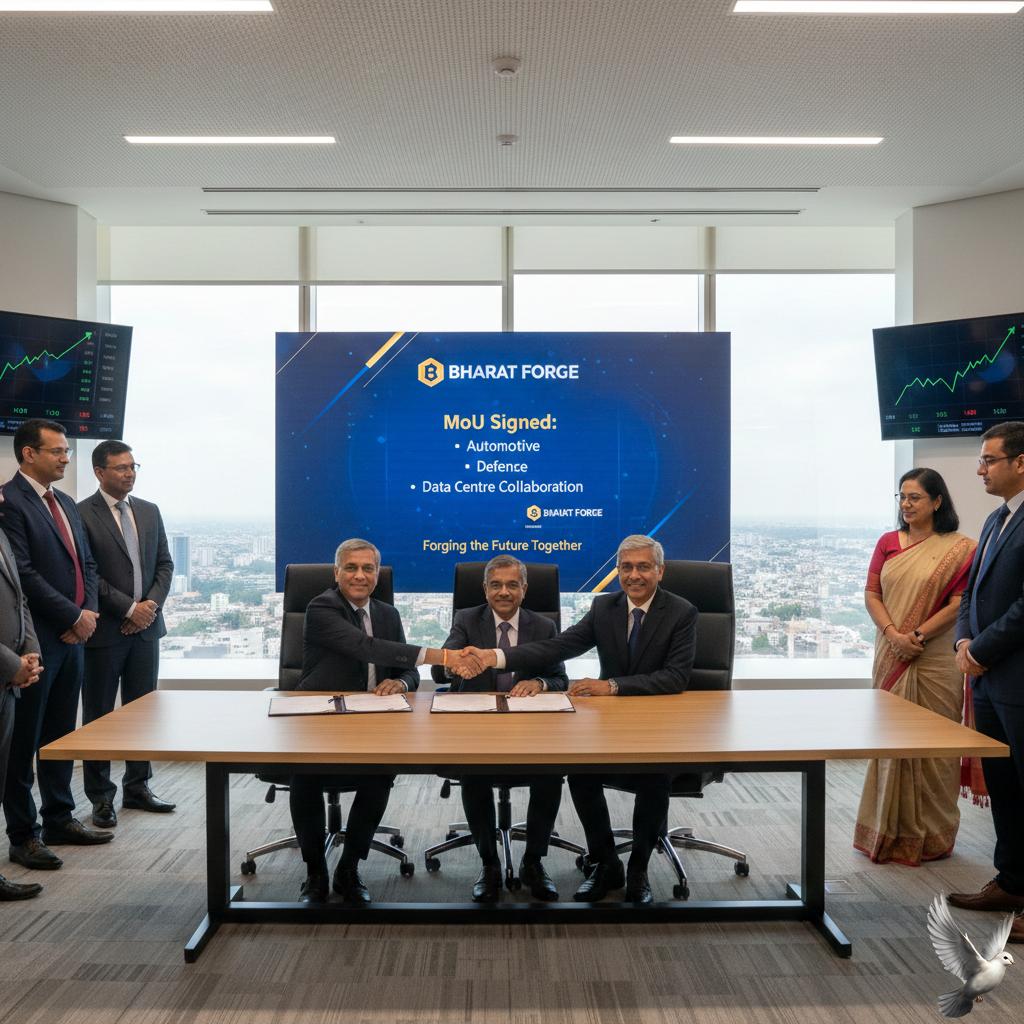
Bharat Forge Signs MoU for Automotive, Defence, and Data Centre Collaboration
Bharat Forge has entered into a strategic Memorandum of Understanding with VVDN Technologies to pioneer next-generation solutions across the automotive, defense, and data center sectors. This partnership combines Bharat Forge’s global leadership in precision manufacturing with VVDN’s expertise in electronics design and AI-driven system integration.
The collaboration comes as Bharat Forge reports a strong financial trajectory. In the quarter ended December 31, 2025, the company saw its consolidated revenue jump 25% year-on-year to 4,342.93 crore. Net profit for the same period climbed 28.2% to reach 272.80 crore, demonstrating robust operational resilience despite global supply chain fluctuations.
The defense segment remains a critical growth engine. Bharat Forge’s defense order book has expanded to a record 11,130 crore, bolstered by a significant recent contract with the Ministry of Defence for the supply of 250,000 carbines. The new alliance with VVDN is expected to further enhance these capabilities by integrating advanced AI and autonomous systems into military platforms.
In the automotive space, the partners are targeting the rise of software-defined vehicles. Recent market data indicates that nearly 95% of Indian consumers are now willing to pay for advanced digital vehicle features. The collaboration focuses on developing AI server platforms and high-compute electronics to meet this surging demand for intelligent mobility.
The market has reacted positively to these developments. As of February 19, 2026, Bharat Forge’s stock is trading near its 52-week high of 1,784.20, with a current price of approximately 1,771.85. The company’s market capitalization has surged to approximately 84,712 crore, reflecting investor confidence in its diversification strategy.
To reward shareholders, the board has declared an interim dividend of 2 per equity share. The partnership with VVDN is strategically timed to capitalize on the government's push for domestic electronics manufacturing and the rapid adoption of generative AI in industrial applications.
By merging heavy engineering with high-tech electronics, the two entities aim to create a scalable ecosystem for sustainable compute infrastructure. This synergy is designed to shorten development cycles and deliver future-ready products to a global client base increasingly focused on autonomous and digital-first technologies.