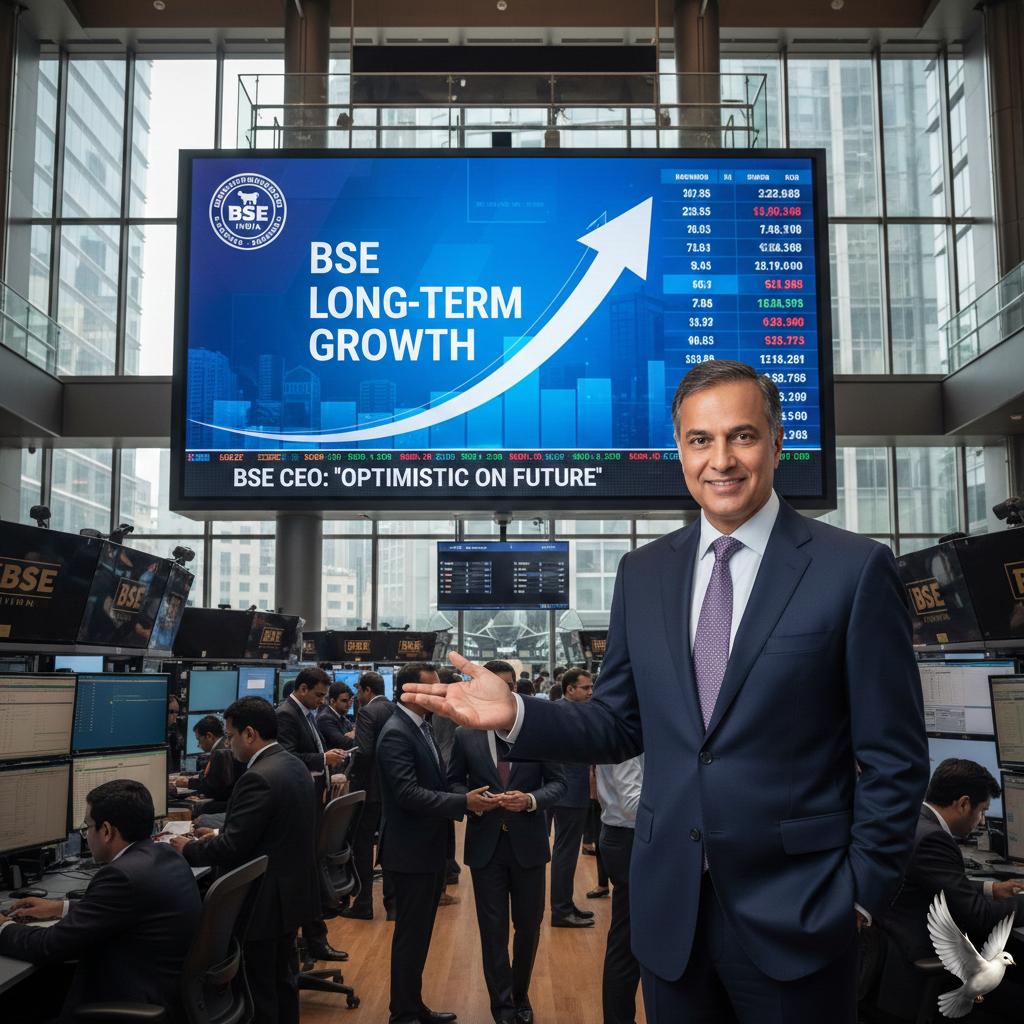
BSE CEO Expresses Confidence in Exchange’s Long-Term Growth Prospects
The BSE (Bombay Stock Exchange) is pivoting its strategic focus toward long-term capital formation, signaling a departure from the intense pursuit of derivatives market share. Managing Director and CEO Sundararaman Ramamurthy emphasizes that the exchange is in an early growth phase, with a roadmap centered on deepening the equity ecosystem rather than chasing short-term trading volumes.
The financial performance of the exchange reflects this momentum. For the quarter ending December 2025, BSE reported a consolidated net profit of 602 crore, a massive 174% increase year-on-year. Revenue surged 62% to reach 1,244 crore, driven by a doubling of transaction charges. Operating margins have expanded significantly, climbing to 59% from 31% a year ago, showcasing strong operational leverage as the platform scales.
Recent policy shifts from the Union Budget 2026 are actively reshaping the market microstructure. The government has introduced a steep hike in the Securities Transaction Tax (STT) on derivatives. The tax on futures has increased from 0.02% to 0.05%, while the tax on options has jumped to 0.15%. These measures are designed to curb excessive retail speculation and redirect capital toward long-term equity delivery.
Further regulatory changes by SEBI, including the removal of calendar spread margin benefits on expiry days, are expected to adjust trading behaviors. These rules, effective from May 2026, aim to reduce systemic risk and operational gaps during volatile sessions. Ramamurthy views these adjustments as necessary steps to align the market with the broader goals of national capital formation.
Foreign participation remains a key pillar of future growth. Currently, only about 470 Foreign Portfolio Investors (FPIs) are active on the BSE platform, suggesting vast untapped potential. New budget provisions have simplified access for Persons Resident Outside India (PROIs), doubling individual investment limits from 5% to 10% and raising the aggregate cap for foreign investors to 24%.
As of February 2026, the BSE Sensex reflects a resilient market environment, trading near the 84,225 level. The exchange continues to invest in technology, recently upgrading systems to handle a nine-fold increase in trade capacity. With 99 new equity listings raising nearly 98,000 crore in the last quarter alone, the exchange is positioning itself as the primary engine for India's corporate fundraising and investor wealth creation.