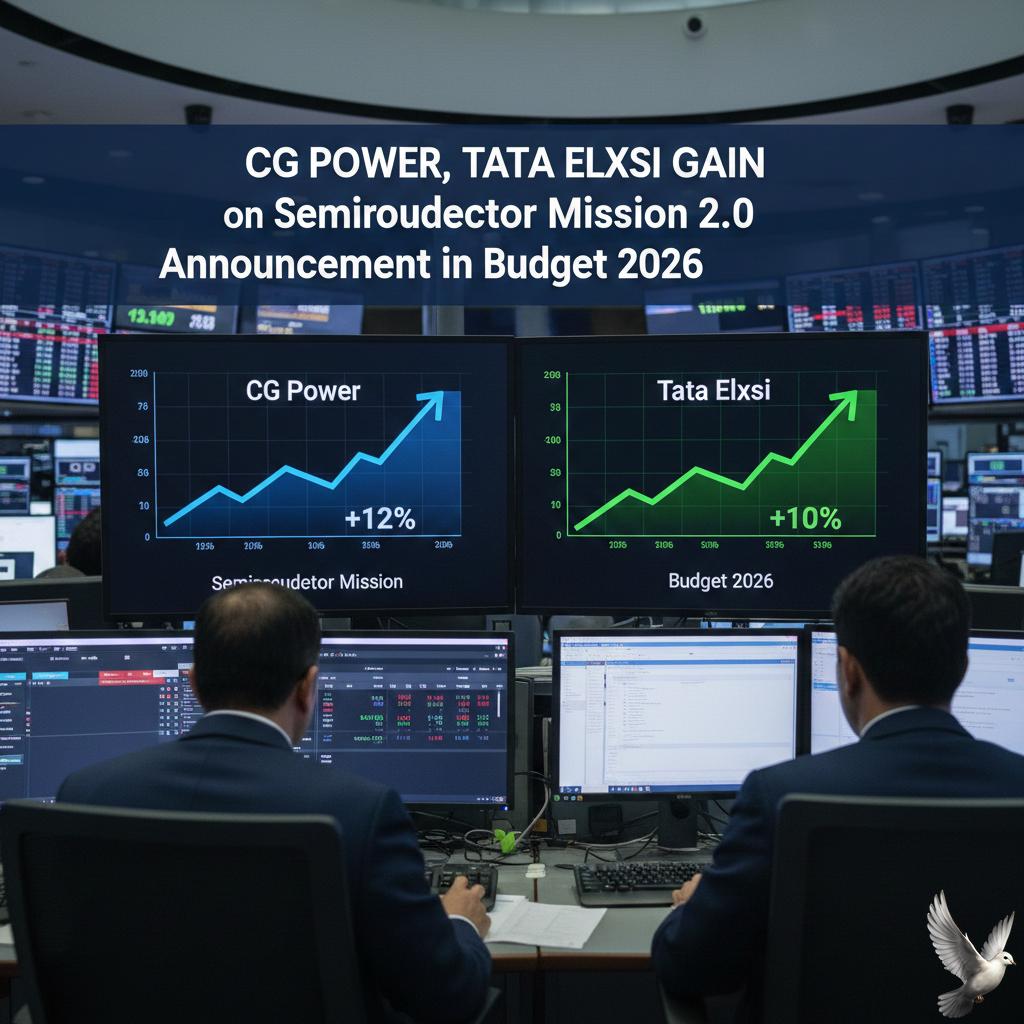
CG Power, Tata Elxsi Gain on Semiconductor Mission 2.0 Announcement in Budget 2026
**MARKET BRIEF: INDIA SEMICONDUCTOR MISSION (ISM) 2.0**
**Policy Update: Launch of ISM 2.0**
Finance Minister Nirmala Sitharaman formally unveiled **India Semiconductor Mission 2.0** during the Union Budget 2026-27 presentation today. While ISM 1.0 focused on establishing the initial fabrication units, the second phase pivots toward creating a comprehensive ecosystem. The new mission prioritizes three key pillars: manufacturing semiconductor equipment/materials, developing full-stack indigenous Intellectual Property (IP), and fortifying domestic supply chains.
**Financial Allocations & Incentives**
To support this expanded scope, the government has introduced specific funding streams:
* **₹1,000 crore** allocated specifically for ISM 2.0 in FY27 to kickstart the new initiatives.
* **₹40,000 crore** outlay aimed at the Electronics Components Manufacturing Scheme (ECMS), a significant increase to deepen the value chain beyond mere assembly.
* **₹900 crore** earmarked for the modernization of the Semi-Conductor Laboratory (SCL) in Mohali, signaling a renewed focus on state-led R&D capabilities.
**Market Data & Projections**
The Indian semiconductor market is currently valued at approximately **$59.8 billion** (2025 estimates). Industry forecasts project the market to cross **$100 billion** by 2030, growing at a CAGR of roughly **12-13%**. This demand is driven heavily by the automotive, industrial automation, and consumer electronics sectors, which are increasingly localizing their supply chains.
**Operational Momentum**
Execution remains the central theme for 2026. Commercial chip production is on track to commence this year, validating the timelines set under ISM 1.0. Recent approvals include **four new projects** (SiCSem, CDIL, 3D Glass Solutions, and ASIP) with a combined outlay of **₹4,600 crore**, spreading the manufacturing footprint to states like Odisha and Punjab. Major private players like Tata Electronics and Micron continue to advance their respective facilities in Dholera and Sanand.
**Strategic Shift**
The launch of ISM 2.0 marks India's transition from an entrant to a serious contender in the global chip war. By targeting the "upstream" ecosystem—raw materials, specialty gases, and design IP—the policy aims to reduce dependency on foreign inputs for the fabs already under construction. The strategy is now clearly defined: move beyond back-end assembly (ATMP) and mature node fabrication into high-value design and equipment manufacturing.