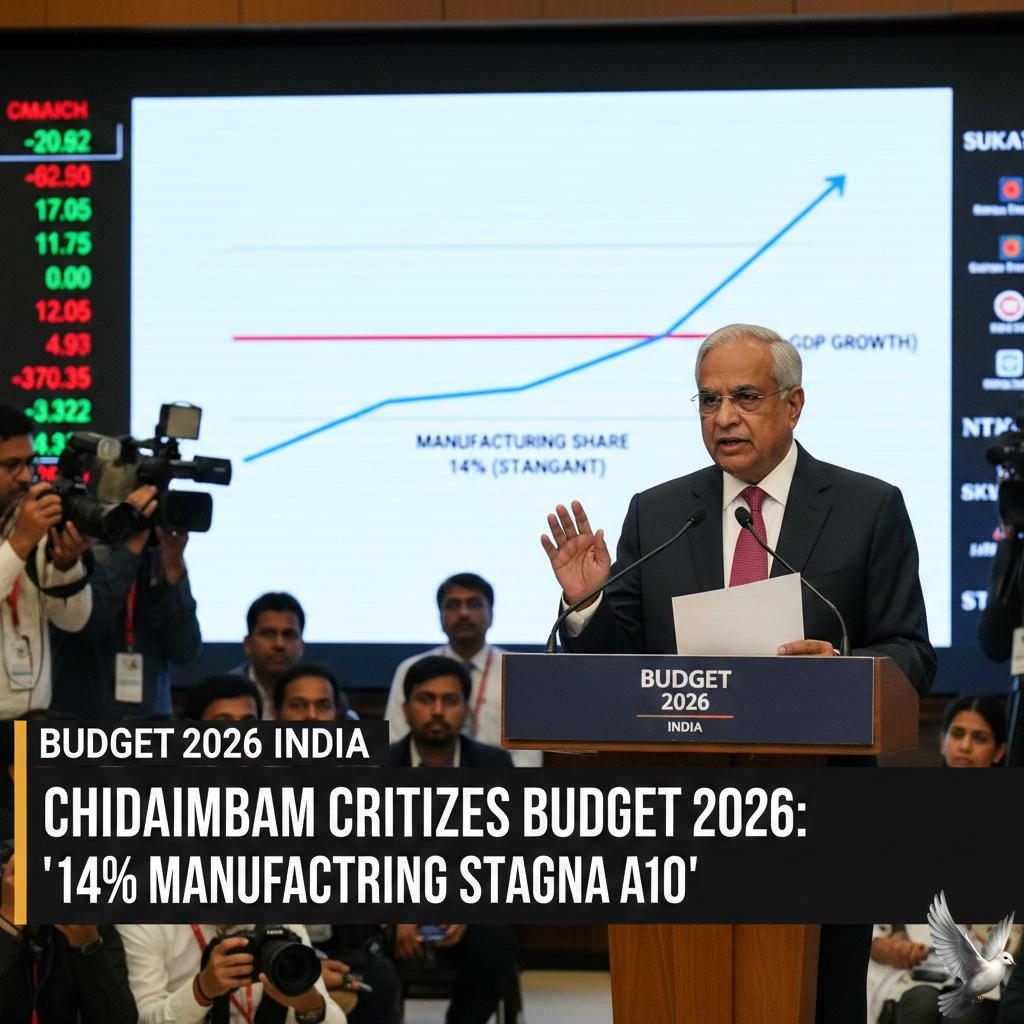
Chidambaram Cites Stagnant 14% Manufacturing Share in Critique of Budget 2026
**Market Brief: Union Budget 2026-27 Analysis & Opposition Critique**
**Executive Summary**
The Union Budget 2026-27, presented on February 1, 2026, has triggered a sharp divide between government projections and opposition analysis. While Finance Minister Nirmala Sitharaman positioned the budget as a blueprint for sustained growth with a **₹53.5 lakh crore** expenditure plan, former Finance Minister P. Chidambaram has labeled it a "failed test of economic strategy."
**Fiscal Consolidation: Ambition vs. Reality**
The government has pegged the fiscal deficit target at **4.3%** of GDP for FY27, a marginal improvement from the revised **4.4%** in FY26. However, critics argue this pace violates the Fiscal Responsibility and Budget Management (FRBM) targets.
Chidambaram highlighted a discrepancy in the headline numbers, noting that despite the nominal increase in capital expenditure to **₹12.2 lakh crore**, the Centre’s effective capex as a percentage of GDP has actually declined from **3.2%** to **3.1%**. He further pointed out a shortfall of over **₹1 lakh crore** in total expenditure for the outgoing fiscal year (2025-26), questioning the credibility of the new targets.
**Manufacturing Sector: Growth Narrative Under Fire**
Official data estimates a nominal GDP growth of **10%** for FY27, bolstered by recent Index of Industrial Production (IIP) figures showing manufacturing growth at approximately **5.4%** to **8%** in recent months.
Contrasting this, Chidambaram argues the sector remains stagnant structurally, citing the Economic Survey 2025-26. He emphasized that the budget fails to address "stress on manufacturers" caused by penal tariffs from the United States and low Gross Fixed Capital Formation, which hovers around **30%**. The disconnect between official industrial optimism and the reported closure of MSMEs remains a key point of friction.
**Trade Deficit & China Exposure**
A critical vulnerability highlighted in the post-budget analysis is India's widening trade deficit, particularly with China. Despite "Make in India" initiatives, dependency on Chinese imports for critical components remains high.
The opposition flagged this as a strategic failure, noting the budget offered no concrete roadmap to reduce this reliance or address the ballooning deficit. This concern is amplified by global trade conflicts that threaten to weigh heavily on domestic investment and export competitiveness.
**The Employment Crisis**
While official unemployment rates have reportedly eased to near **5%**, the opposition has termed the job market situation "precarious," particularly for youth. Chidambaram criticized the budget for ignoring the distress in the MSME sector, which is a primary engine for job creation. The cut in allocation for flagship social schemes like the *Jal Jeevan Mission*—reportedly slashed in revised estimates—was cited as evidence of the government disconnecting from ground-level economic realities.
**Market Reaction & Investor Sentiment**
Market response to the budget has been mixed. Volatility in gold prices and a muted reaction in equity markets suggest investors are cautious. The hike in Securities Transaction Tax (STT) on Futures & Options (F&O) has been introduced to curb speculative trading, but it has also dampened sentiment among retail traders.
**Key Takeaways for Investors**
* **Fiscal Math:** Watch for slippages; the **4.3%** deficit target relies heavily on optimistic revenue receipts.
* **Capex Realities:** The **3.1%** Capex-to-GDP ratio suggests government spending may not be the aggressive growth driver previously anticipated.
* **Sector Watch:** Manufacturing incentives are present, but structural headwinds (tariffs, logistics) persist.
* **Risk Factors:** The ignored trade imbalance with China and potential global trade wars remain significant external risks.