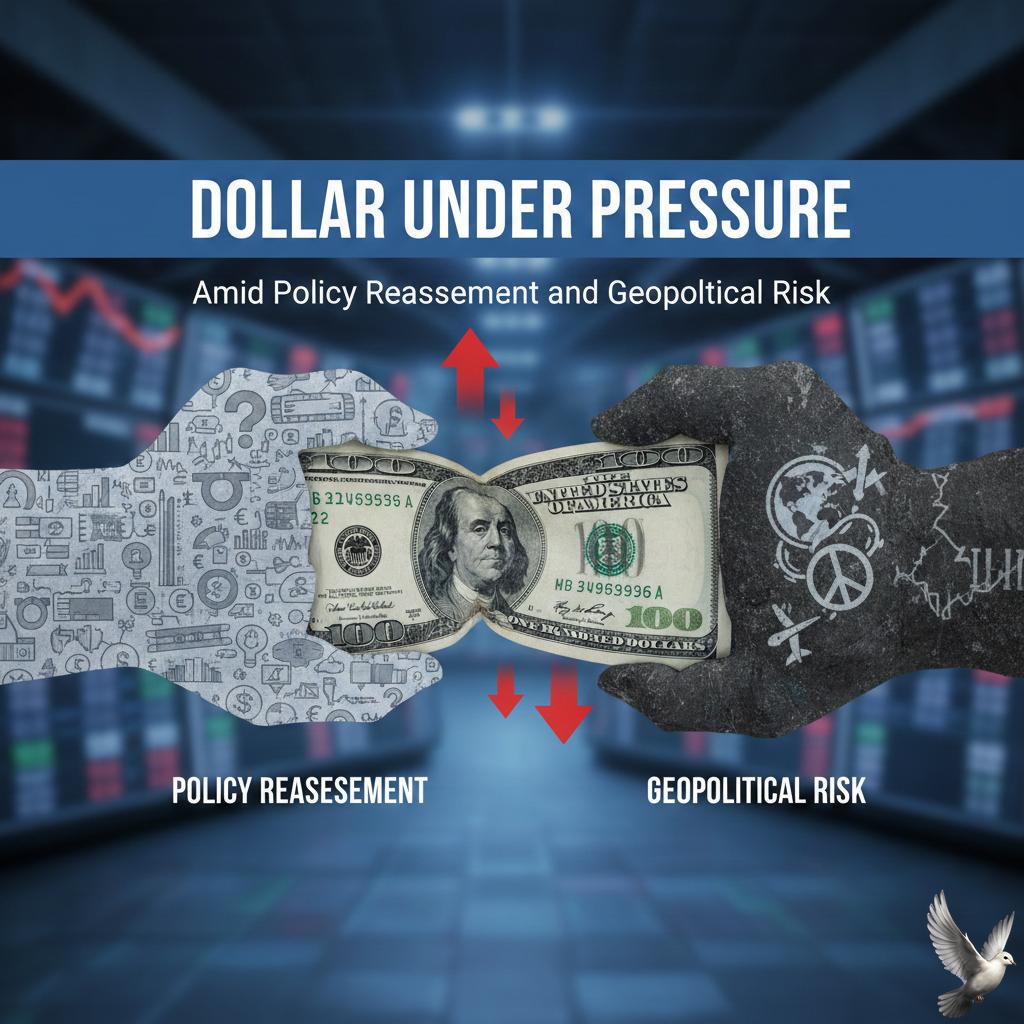
Dollar Under Pressure Amid Policy Reassessment and Geopolitical Risk
**US Dollar Plunges to Multi-Month Lows Amid Extreme Policy Uncertainty**
***
The U.S. dollar is facing a brutal selloff in late January 2026, driven by an acute breakdown of confidence in domestic policy stability. Investors are rapidly shedding long positions, pushing the U.S. Dollar Index (DXY) toward key support levels last seen in 2025.
The DXY is currently trading around **97.11**, marking a sharp decline of approximately **2.50%** across the month. This weakness continues the trend from last year, when the index suffered nearly a **10%** annual drop against major currencies. The dollar’s slide against the Euro and other G10 currencies reflects shifting capital flows away from the Greenback, amplified by extreme pre-FOMC positioning.
The primary immediate catalyst remains the volatile relationship between Washington and the Federal Reserve. President Trump’s administration has consistently advocated for a significantly weaker currency and lower borrowing costs to fuel domestic growth. This political tension threatens the central bank's institutional autonomy and monetary policy framework.
The Federal Reserve’s policy-setting committee is meeting this week, with the Federal Funds Rate currently held in the **3.50%–3.75%** range following three cautious cuts in late 2025. Despite market pricing for aggressive easing, officials have signaled a higher bar for further reductions. The official Fed projection calls for only **one** additional **25 basis point cut** throughout 2026. This disconnect between central bank signaling and political desire heightens market risk.
Economic data presents a highly complex picture for the Fed. While the economy continues to show resilience—with the 2026 growth forecast recently upgraded to a strong **2.3%**—the labor market has cooled, and inflation remains sticky, hovering near **3.0%**. This combination complicates the path to the Fed’s **2%** target, making rate decisions fraught with political fallout.
The President’s unpredictable policy moves continue to drive currency outflows. Renewed rhetoric on tariffs and aggressive posturing with allies, including controversial moves like the "Greenland theme," have contributed directly to the dollar's recent steep descent. The looming nomination of a new Fed Chair, expected in the coming weeks, further introduces high-level uncertainty, with candidates widely seen as favoring accommodative, lower-rate policies.
This climate of domestic instability is accelerating a global shift away from U.S. assets. The trend of de-dollarization is visible across sovereign balance sheets. The US dollar’s share of global foreign exchange reserves has dropped to a **30-year low of 58.5%**. Foreign entities are actively diversifying away from U.S. debt holdings due to geopolitical pressures and concerns over America’s fiscal health.
The flight to safety is evident in the commodities complex. **Gold** has surged to historic highs, recently trading above **$5,000 per ounce**. This rally reflects investors' preference for hard assets over currency exposure as a hedge against global uncertainty and the debasement of the U.S. dollar.
While the technical picture suggests the DXY’s sharp descent is stalling near the **96.80 to 97.00** support zone, the underlying policy risk remains unresolved. Long-term confidence in the currency is being eroded by the combination of vast U.S. public debt, persistent inflationary pressures, and continued political interference in monetary management. The dollar is facing a period of high volatility, characterized by short-term resilience but a persistent, longer-term bearish bias.