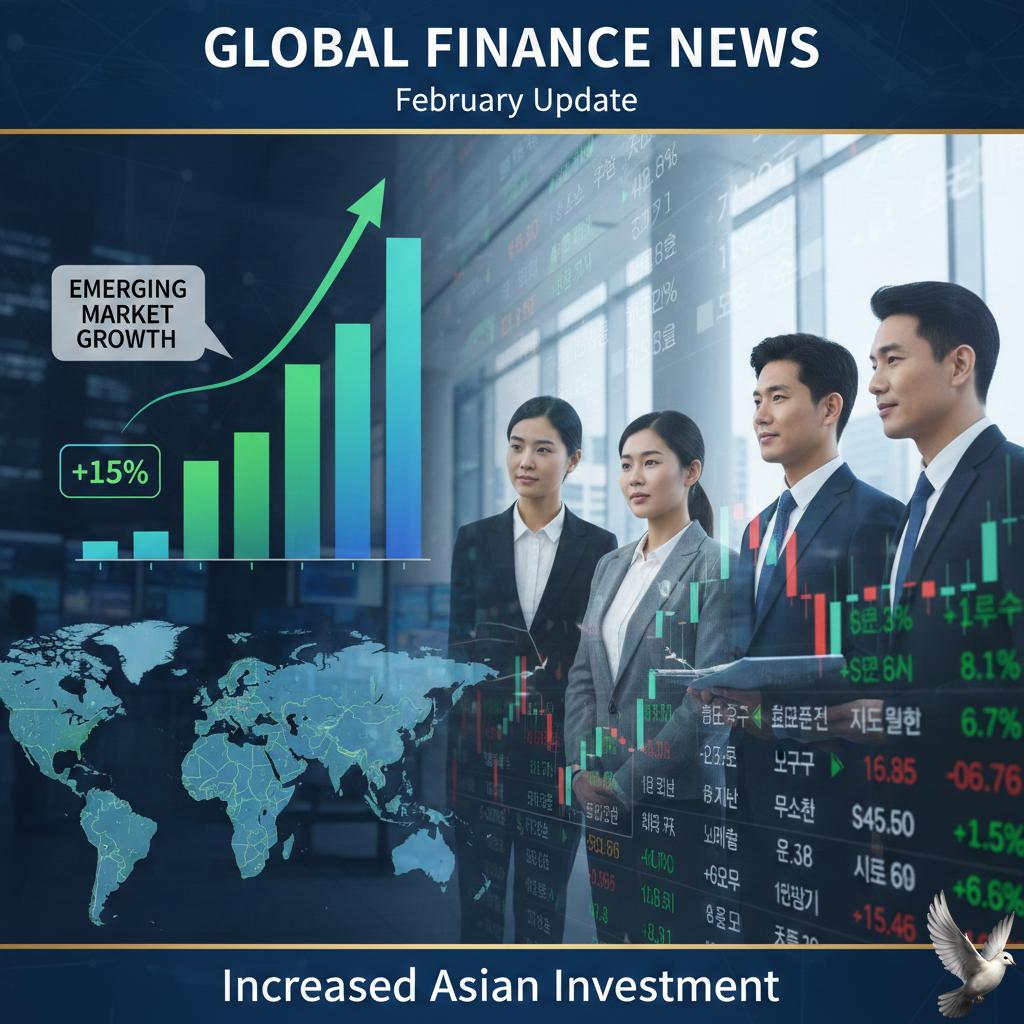
Emerging Market Growth and Increased Asian Investment: February Update
Asian markets closed February 2026 on a historic high, marking the region's strongest performance for the month since 1998. The MSCI Asia Pacific Index surged 6.3% throughout the month, consistently outperforming the S&P 500 for the third consecutive period.
Global capital has aggressively rotated into the region, driven by a massive build-out in artificial intelligence infrastructure. Asset managers overseeing more than 20 trillion dollars have increased their long positions in emerging markets, viewing Asian firms as the primary providers of the "picks and shovels" for the global AI supply chain.
South Korea emerged as the global standout. The KOSPI index shattered records by crossing the 6,000-point milestone on February 25, just 18 trading days after it first breached 5,000. This representative gauge has gained 20% in February alone and is up 46% year-to-date. The rally is supported by a 37% upward revision in operating profit estimates for the KOSPI 200, primarily fueled by semiconductor giants Samsung Electronics and SK Hynix.
Japan also reached unprecedented levels, with the Nikkei 225 climbing 4.5% this month to trade above 57,000. Investor confidence has been bolstered by Prime Minister Sanae Takaichi’s 135 billion dollar monetary easing package and a landslide election victory. Despite trade tensions with China, Japanese tech stocks continue to attract significant inflows, outperforming the S&P 500 by over 200% on a 12-month trailing basis.
China’s market sentiment is showing signs of recovery through innovation in high-tech manufacturing and AI. For the first time, Chinese AI model usage surpassed that of the United States in February, with token call volumes reaching 5.16 trillion. Major indices like the Hang Seng and Shanghai Composite remain focal points as the MSCI China Index undergoes quarterly adjustments to include new AI and technology-driven listings.
The broader emerging market rally is supported by softening US inflation and a stabilizing dollar, which have encouraged hedge funds to increase Asian stock purchases at the fastest rate since 2016. Buying volume from institutional investors has outpaced short covering by a ratio of 8.4 to 1, indicating a high-conviction shift toward regional growth.
While momentum remains strong heading into March, some caution remains. Analysts are monitoring potential profit-taking following the vertical ascent in Seoul and Tokyo. Additionally, the 10-year Treasury yield hovering around 4% and ongoing geopolitical discussions between the US and Iran may introduce volatility. However, the current trend suggests that any pullbacks are being treated as entry points by global allocators.