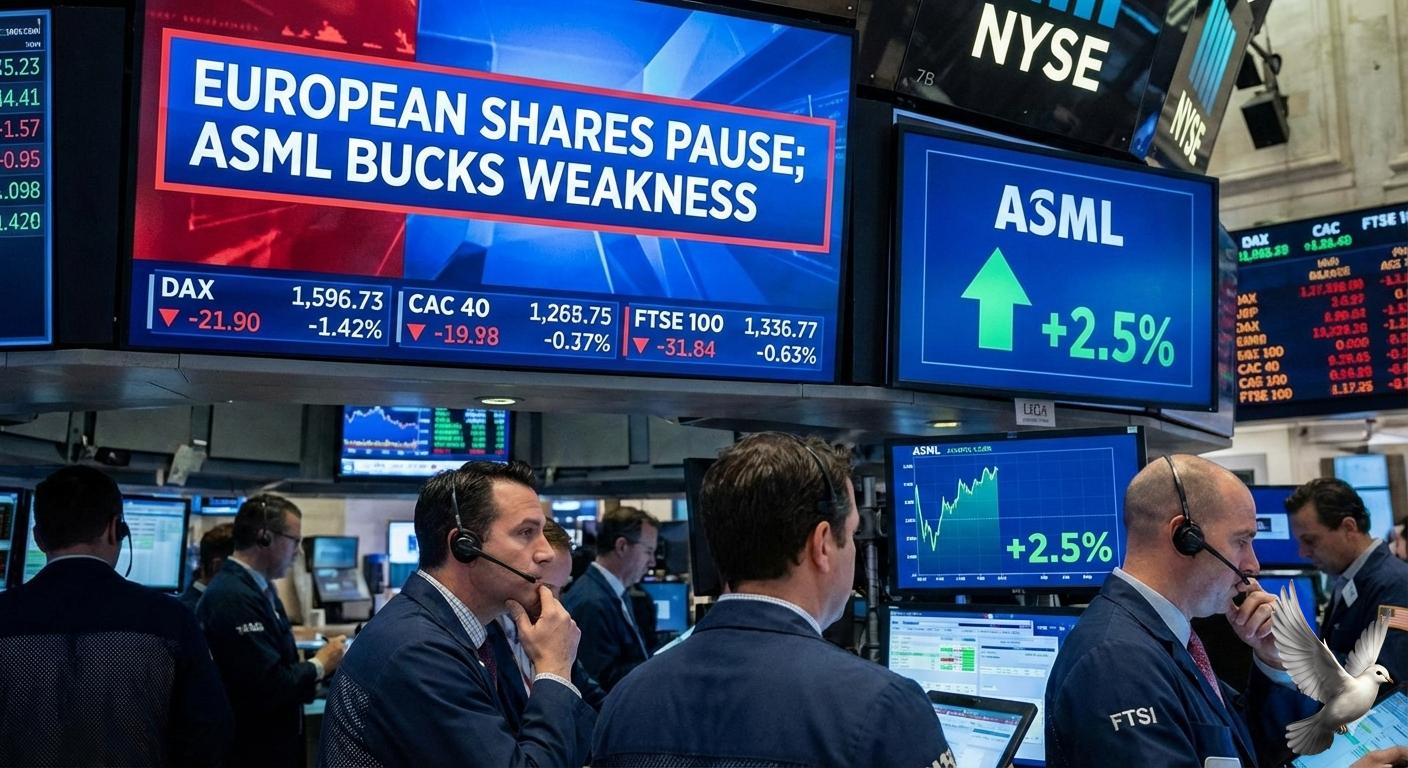
European Shares Pause; ASML Bucks Weakness
The pan-European equity surge stalled midweek as attention shifted sharply from broader market momentum to a crucial round of corporate earnings and forward guidance. Investors took profit after two consecutive days of gains, resulting in a widespread dip across continental indices.
The benchmark **Stoxx 600 Index** fell approximately **0.7%**, closing the session at **608.51 points**. This retreat was characterized by defensive positioning ahead of key macroeconomic events, most notably the impending rate decision from the US Federal Reserve.
**Luxury Sector Collapse Weighs Heavily**
Sectoral performance was highly divergent, with luxury goods stocks acting as the primary drag on the overall market. The luxury sub-index experienced its fourth straight day of losses, tumbling **3.8%**.
This severe sell-off was triggered by cautious commentary from key executives in the industry regarding the outlook for consumer demand in the year ahead.
**LVMH**, the industry behemoth and owner of brands like Louis Vuitton, saw its shares plummet by **7.9%**. Other major players followed suit, with Gucci-owner Kering and Hermes also posting significant declines. This caution highlights investor sensitivity to slowing global demand signals, particularly from key markets in Asia.
Meanwhile, national benchmarks reflected the broader weakness. The **FTSE 100** in London slipped **0.35%** to **10,172**, while key markets in France and Spain each recorded drops exceeding **1%** on the day.
**ASML: An AI-Fueled Record**
In contrast to the overall subdued mood, the technology sector showed initial robust strength, climbing over **2%** early in the session, largely fueled by the performance of European chip equipment maker **ASML Holding NV**.
ASML, the central figure in global semiconductor manufacturing, provided a massive positive surprise to the market. The company reported record-breaking net bookings for the fourth quarter of 2025, totaling **€13.2 billion**. This figure was more than double the consensus expectation from analysts, signaling a sharp rebound in chipmaker capital expenditure.
The company's full-year 2025 results showed total net sales reaching **€32.7 billion** and net income hitting **€9.6 billion**. The strong order flow was directly attributed by management to robust demand linked to the build-out of artificial intelligence infrastructure globally.
ASML's record orders initially sent its stock surging to a **new record high**, confirming the original market sentiment. However, the gains proved unsustainable as broader market caution set in. The stock eventually closed the session down **1.9%** from its previous close, despite the stellar results, reflecting concerns over its already high valuation multiples.
**Global Indicators and Geopolitical Risk**
Beyond Europe, global macro-financial conditions remained a significant factor. The market continues to operate under the cloud of geopolitical risks, which supervisors across the UK and EU have listed as top priorities for 2026, stressing the need for banks to strengthen resilience.
Investor attention was also fixed on the United States, where the S&P 500 briefly broke the **7,000** threshold for the first time, buoyed by AI optimism. However, the impending earnings reports from major US tech giants, including Microsoft and Meta, maintained a high level of nervousness regarding the sustainability of corporate spending.
Currency markets saw the **US dollar** hover near a four-year low against a basket of peer currencies. This ongoing dollar weakness fueled a flight to traditional safe-haven assets. As a result, spot **gold** experienced a strong upward trajectory, crossing the significant **$5,300** per ounce level momentarily and settling higher at **$5,275** an ounce by the session close.