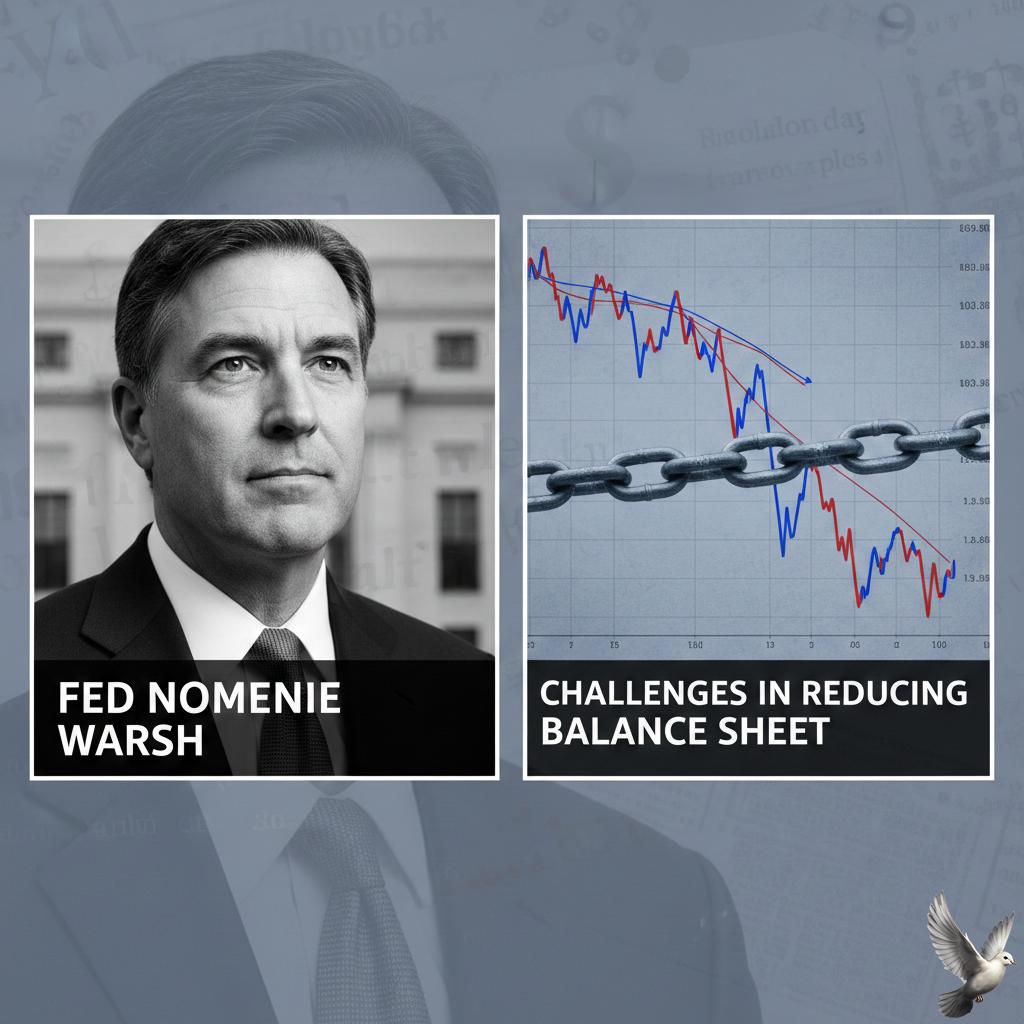
Fed Nominee Warsh Faces Challenges in Reducing Balance Sheet
**Market Brief: Federal Reserve Leadership & Balance Sheet Outlook**
**Nomination & Strategic Shift**
President Donald Trump has officially nominated **Kevin Warsh** as the next Chair of the Federal Reserve, signaling a potential pivot in monetary policy management. While Warsh has historically criticized the central bank's bloated asset holdings—advocating for a significant contraction of the **$6.59 trillion** balance sheet—his recent alignment with the administration suggests a complex dual mandate: aggressive balance sheet reduction paired with politically demanded interest rate cuts.
**Execution Challenges & Liquidity Realities**
Financial experts warn that simultaneously shrinking the balance sheet and cutting rates presents a mechanical contradiction. The Fed’s balance sheet has stabilized near **$6.6 trillion** after post-pandemic normalization, but aggressive Quantitative Tightening (QT) risks draining necessary liquidity from the banking system. Implementing Warsh’s vision could spike overnight lending rates and disrupt credit markets, making the goal of a "leaner Fed" slow and operationally hazardous.
**Market Reaction & Volatility**
Markets reacted swiftly to the nomination with volatility across asset classes as of **February 2, 2026**.
* **Precious Metals:** Gold and Silver saw sharp sell-offs, with Silver plunging over **13%** and Gold dropping nearly **5%** immediately following the news, as investors priced in a potentially higher real-rate environment.
* **Bonds & Currency:** The U.S. Dollar strengthened against major peers, while the 10-year Treasury yield ticked higher into the **4.0%–4.5%** range, reflecting uncertainty over the long-term inflation outlook under a new regime.
* **Equities:** U.S. indices including the S&P 500 and Nasdaq traded with unease, dipping **0.2%–0.6%** as traders digested the implications of a hawkish Chair enforcing a dovish rate agenda.
**Outlook**
Investors are now bracing for a period of policy friction. While the administration pushes for easing to stimulate growth, Warsh’s structural preference for a smaller central bank footprint introduces headline risk. The consensus suggests that "financial realities"—specifically the need to maintain ample reserves to avoid a repo market crisis—will likely force a far more gradual reduction pace than the incoming Chair’s rhetoric implies.
Fed's Miran Weighs In on Warsh, Rate Cuts and Balance Sheet: [https://www.youtube.com/watch?v=BBWQVRG28AA](https://www.youtube.com/watch?v=BBWQVRG28AA)
This video is relevant because it features a current Federal Reserve Governor discussing Kevin Warsh's nomination and the specific challenges of managing the balance sheet alongside interest rate policy.
http://googleusercontent.com/youtube_content/0