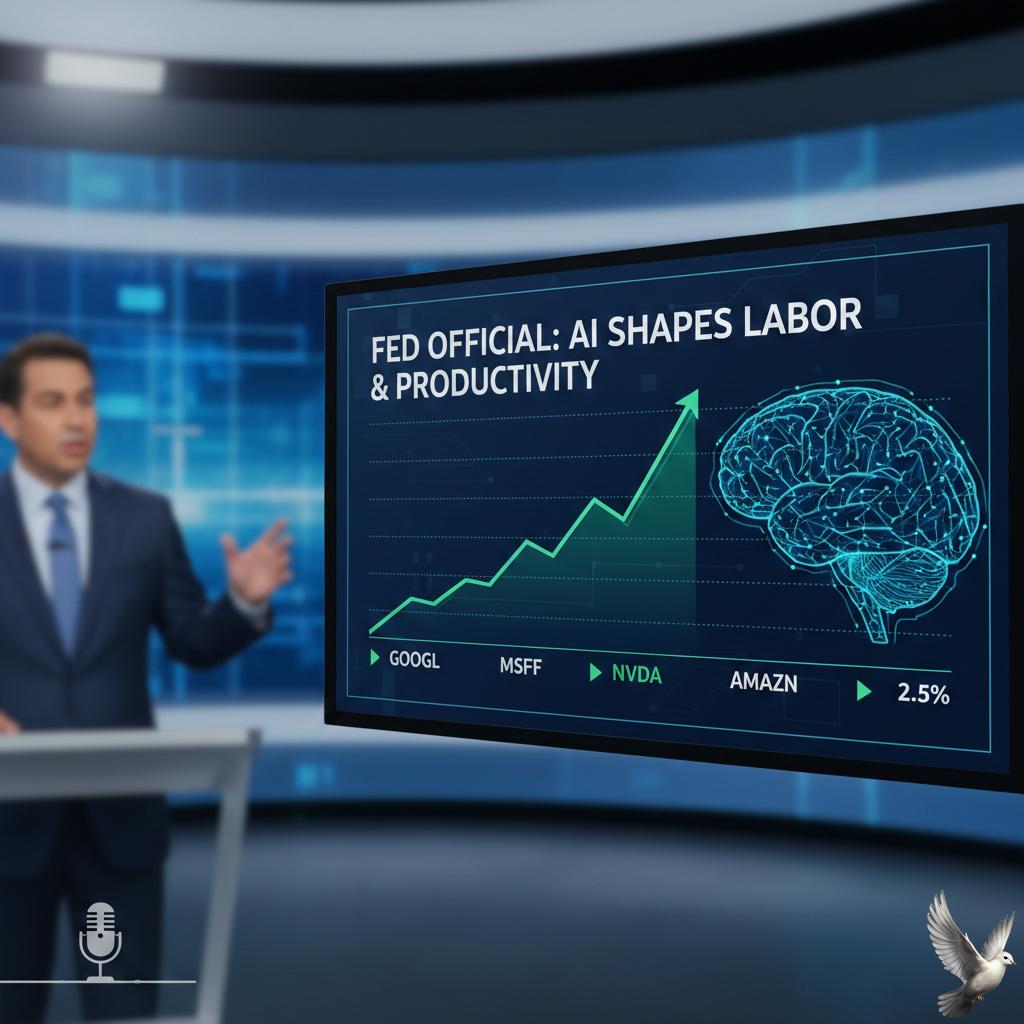
Fed Official Cites AI Impact on Labor Market and Productivity
Federal Reserve Governor Lisa Cook highlighted a generational transformation in the U.S. labor market this Tuesday, driven by the rapid adoption of artificial intelligence. Cook warned that this shift could create a structural rise in unemployment that traditional monetary policy might struggle to resolve.
The U.S. unemployment rate currently sits at **4.3%** as of January 2026. While this remains low by historical standards, the central bank is monitoring "churn" in specific sectors. Entry-level hiring and professional fields like coding are already seeing reduced demand as firms deploy AI for routine tasks.
A key concern for the Fed is that AI-driven job displacement may occur before new roles are created. If the unemployment rate rises because of a productivity-driven reorganization of work rather than a drop in consumer demand, lowering interest rates could prove ineffective.
Standard demand-side tools—like cutting the federal funds rate, which is currently held between **3.5%** and **3.75%**—might actually stoke inflation if the labor market issues are structural rather than cyclical. This presents a difficult "trade-off" for policymakers trying to balance employment with the Fed’s **2%** inflation target.
Current data shows that while overall hiring has cooled, AI-related job postings have grown to represent **4.2%** of all listings. Employers are increasingly willing to pay a premium for AI skills, with some roles commanding salaries **8.5%** to **23%** higher than non-AI counterparts.
Investment in AI infrastructure remains aggressive despite elevated borrowing costs. Business spending on data centers and advanced chips has surged, suggesting that the "neutral" interest rate—the level that neither stimulates nor slows the economy—may be higher than in previous decades.
Governor Cook noted that the "most significant reorganization of work in generations" is underway. In this environment, non-monetary solutions such as workforce retraining and education policy may become more critical than interest rate adjustments in supporting displaced workers.