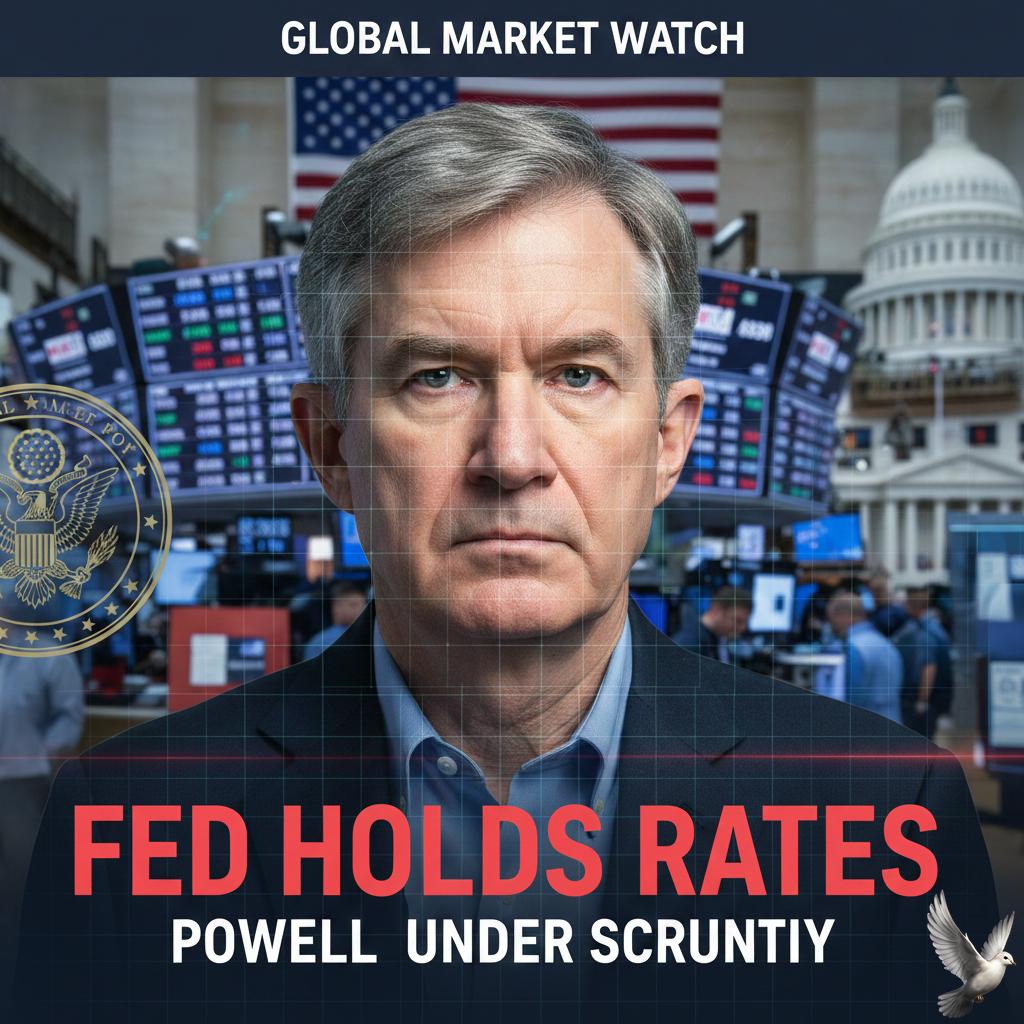
Federal Reserve Holds Rates Amidst Political Scrutiny of Chair Powell
**Market Brief: Federal Reserve Monetary Policy Outlook**
The Federal Reserve is signaling a definitive **pause** in its recent interest-rate-cutting cycle, choosing to hold policy steady following three consecutive reductions in late **2025**. This decision arrives as officials convene for their first meeting of **2026**, placing the focus squarely on assessing the cumulative impact of prior easing moves.
The current federal funds rate target stands firm at **3.5% to 3.75%**. This range reflects the Federal Open Market Committee’s (FOMC) judgment that borrowing costs are currently positioned at an appropriate level to fulfill its dual mandate of maximizing employment and achieving price stability. The consensus is building for the central bank to maintain this holding pattern for the immediate future.
***
The primary justification for the halt stems from a resilient labor market and sticky price pressures.
The most recent data showed the **Unemployment Rate** ticking lower to **4.4%** in December, a figure near what the Fed considers full employment. This strength alleviates immediate pressure for deeper cuts to support job growth.
Simultaneously, the battle against inflation remains unfinished. The latest reading for headline Consumer Price Index (CPI) inflation was **2.7%** year-over-year in December, with Core CPI at **2.6%**. Although well below the highs of the past two years, these figures still sit persistently above the Fed’s long-term **2.0%** target.
Policy makers are now wary that further easing could reignite inflationary pressures, particularly given forecasts for U.S. economic expansion. The Fed has significantly upgraded its projection for Gross Domestic Product (GDP) growth for **2026** to **2.3%**, a substantial jump from earlier estimates. Stronger growth typically argues against rapid rate reductions.
***
Deep divisions within the central bank continue to define the path forward.
The Fed’s own internal “dot plot” suggests that the median expectation among policymakers is for only **one more 25-basis-point cut** over the remainder of **2026**. This expectation is notably more cautious than market pricing, which is currently factoring in the potential for two to three additional cuts this year.
This divergence in outlook highlights the rift: one side of the FOMC views current rates as sufficiently restrictive, while a more dovish faction continues to signal concern about economic fragility and seeks further accommodation.
***
The political dimension adds significant uncertainty to the monetary policy landscape.
The focus on the Fed’s core mandate comes as it faces intensifying external scrutiny, particularly from the executive branch. With the term of the current Fed Chair expiring in May, the administration is expected to nominate a replacement who is openly supportive of lower interest rates.
This dynamic sets up a complex political environment where the Fed’s carefully guarded independence could be tested. Any perception that policy is being swayed by political demands rather than economic data could undermine the credibility of the committee’s decisions, making the path of monetary policy even harder to predict for the rest of the year.
For the bond market, the current uncertainty translates to upward pressure on longer-term Treasury yields, as investors demand more compensation for holding debt amid conflicting signals on inflation and policy independence. The coming months are set to be a crucial test of the central bank's commitment to its current, cautious posture.