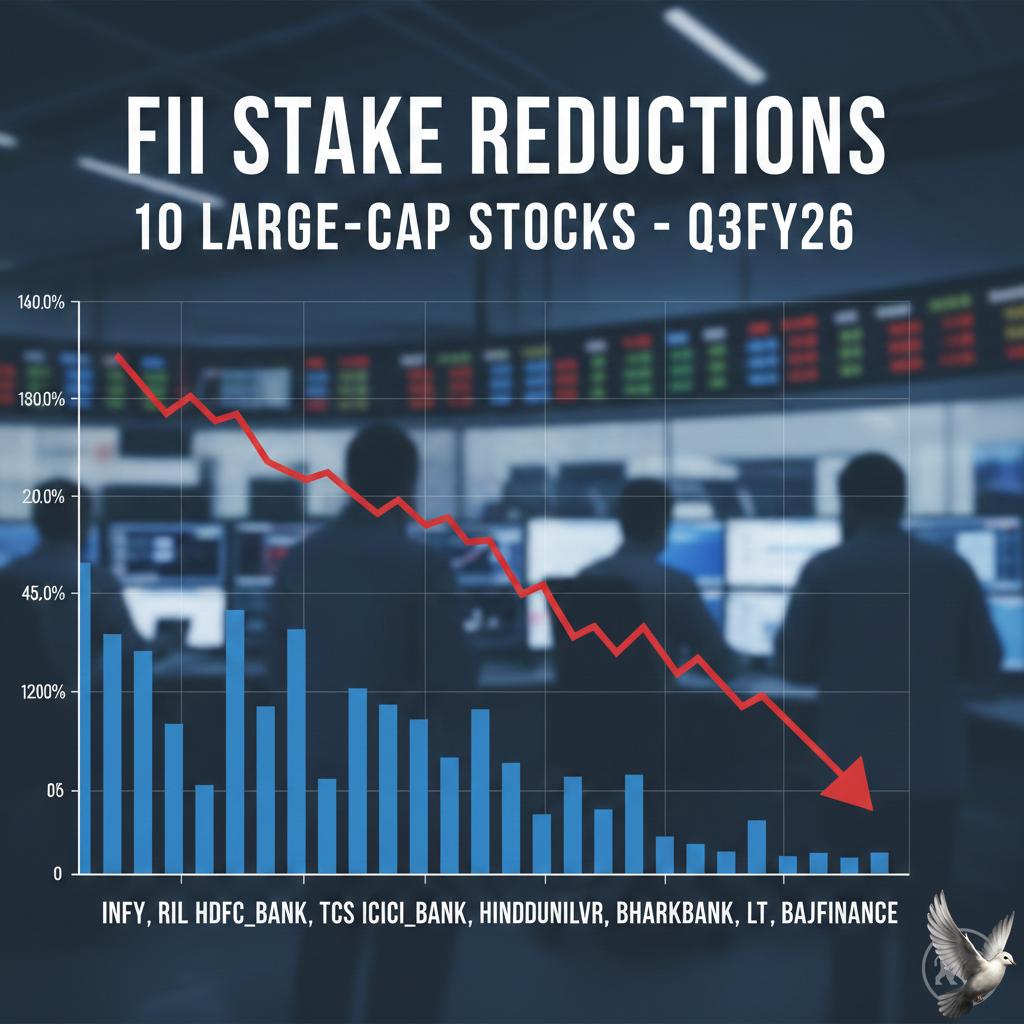
FII Stake Reductions in 10 Large-Cap Stocks in Q3FY26
💰 Global Market Brief: January 27, 2026
The global financial narrative is currently defined by a divergence between resilient economic growth, particularly in Emerging Markets (EM), and cautious, selective trading in Developed Market (DM) equities, all against the backdrop of an ongoing **AI investment supercycle**.
📈 Equity Market Performance and Sectoral Shifts
Indian benchmark indices showed a mixed yet cautious picture on January 27, 2026. The Nifty 50 opened near **25,063** and managed to hold in positive territory, indicating underlying stability. Conversely, the Bank Nifty slipped, reflecting persistent pressure and caution around banking stocks, which closed at **58,473.10** on Friday.
Sector rotation is a key theme. Technology, or Nifty IT, has shown significant relative strength, acting as a stabilizer for the broader market. This uplift is attributed to expectations of steady global tech spending and mildly favorable rupee weakness. In contrast, the financial sector is grappling with margin pressure and sensitivity to interest rate expectations.
On Friday, January 23, the Sensex had closed sharply lower at **81,537.70**, down **0.94%**, with the Nifty 50 settling at **25,048.65**, down **0.95%**. Monday's trading, however, saw a recovery, with the Sensex advancing **0.39%** to **81,857.48** and the Nifty rising **0.51%** to settle at **25,175.40**, driven by strength in banking, metal, and infrastructure stocks.
Key stock movements for January 27 saw Adani Enterprises surge nearly **5.3%**, with Axis Bank gaining over **5%** following strong quarterly earnings. Major losers included Mahindra & Mahindra, which fell over **4.25%**, and Asian Paints, down **2.8%**.
🌍 Global Economic and Policy Environment
The global economic outlook for **2026** is viewed as resilient, with the IMF projecting global growth at **3.3%**. This stability is supported by fiscal stimulus, accommodative financial conditions, and a massive wave of technology investment.
India's economic fundamentals remain robust. Real GDP growth was an impressive **8.2%** in Q2 of FY 2025-26. The country has solidified its position as the world's fourth-largest economy, surpassing Japan in **2025**.
Inflation remains a central focus. While global inflation is expected to moderate, it is predicted to remain "sticky," hovering around **3%** in some DM jurisdictions. In India, CPI inflation progressively softened to **0.71%** in November 2025 from **4.26%** at the start of the year, providing a favorable backdrop for consumption.
Money markets in India remain liquid, with the weighted average overnight rate recorded at **5.15%** on January 23, 2026. Domestic institutional investors continue to provide support to the equity markets, offsetting cautious flows from foreign institutional investors.
💡 Key Market Drivers and Trends
The relentless expansion of **Artificial Intelligence (AI)** is the single most important thematic driver. The AI supercycle is fueling record capital expenditures, with estimates suggesting **\$5 trillion to \$8 trillion** could be required over the next five years for AI infrastructure alone. This investment is prioritizing CapEx over M\&A in the short term, but is expected to accelerate dealmaking over the medium term.
Global equity research forecasts double-digit gains for both Developed and Emerging Markets in **2026**, primarily driven by robust earnings growth and the sustained AI theme. While this trend is broadly positive, it is also amplifying market polarization, concentrating gains in a small number of markets and sectors.
For traders, the current environment necessitates stock-specific strategies due to persistent intraday volatility and a lack of broad directional signals. Investment is focused on sectors showing relative strength, such as Technology and select Consumption stocks, while the cautious sentiment around financials requires careful positioning.