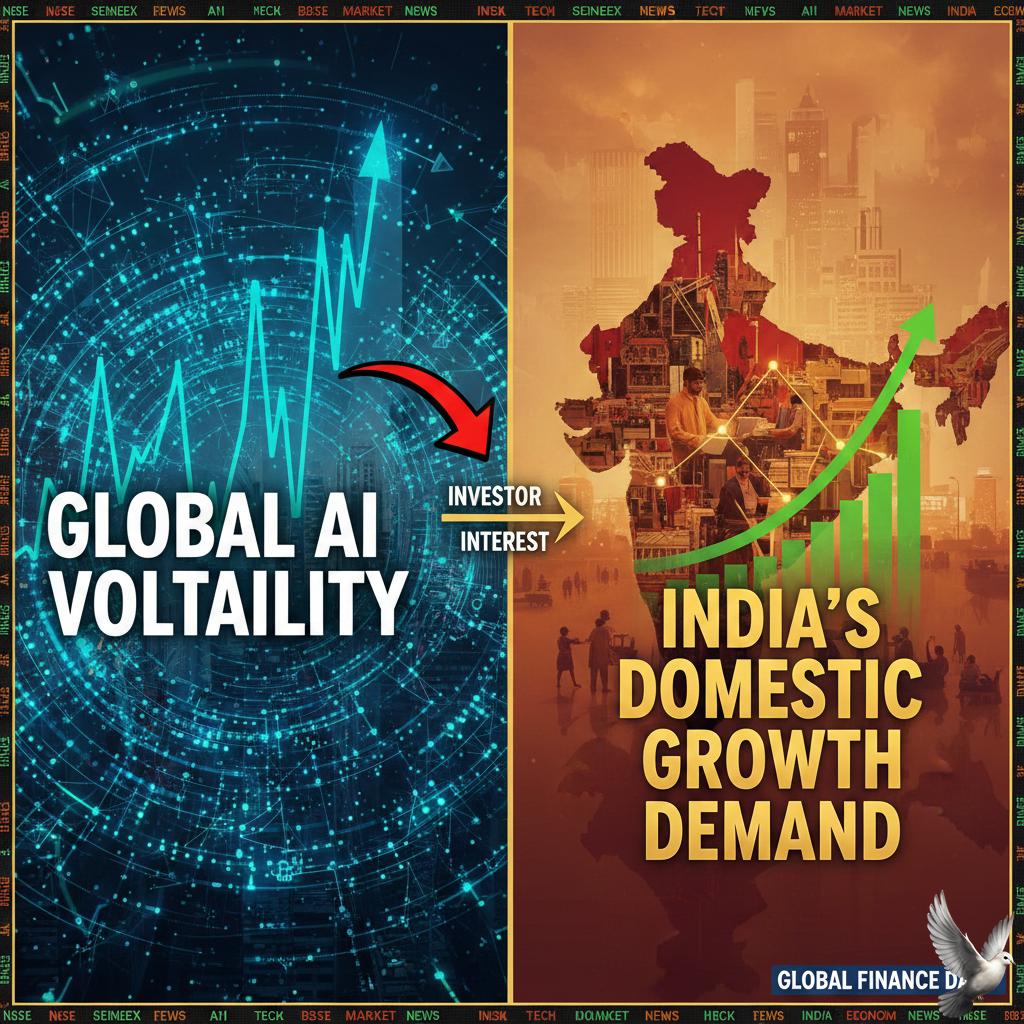
Global AI Volatility Drives Investor Interest Toward India’s Domestic Growth and Demand
Market Brief: India’s Growth Resilience
India’s economy is demonstrating exceptional strength as a global growth anchor. Real GDP expanded by **8.2%** in the second quarter of the current fiscal year, outpacing most major economies. The Reserve Bank of India has maintained an optimistic outlook, with full-year growth projections recently revised upward to **7.3%**.
Stock Market and Capital Flows
The equity markets reached significant milestones in February 2026. The Nifty 50 has recently stabilized near the **25,800** mark, while the BSE Sensex trades around the **83,700** level. Despite a period of volatility where foreign institutional investors (FIIs) net sold approximately **₹1,374 crore** in early February, domestic liquidity has provided a massive cushion.
Domestic Institutional Investors (DIIs) remained aggressive buyers, injecting nearly **₹11,500 crore** month-to-date. This internal capital pool, driven by a surge in systematic investment plans, has reduced the market's historical dependence on foreign outflows.
Currency and External Stability
The Indian Rupee has shown remarkable resilience against the US Dollar. Bolstered by a landmark trade agreement with the United States that lowered reciprocal tariffs to **18%**, the currency appreciated to **90.27** per dollar in early February.
Foreign exchange reserves reached an all-time high of **$701.4 billion** in January 2026. This provides the economy with a robust import cover of roughly **11 months**, shielding the domestic market from global currency shocks and ensuring stability for long-term investors.
Sector Performance and Trends
While the global technology sector navigates a significant shakeout in AI-related valuations, India’s focus has shifted toward high-growth industrial and financial segments.
Manufacturing GVA growth accelerated to **9.13%**, supported by the India Semiconductor Mission 2.0 and a **₹40,000 crore** allocation for electronic component production. Financial services also remain a primary driver, with the banking index outperforming broader benchmarks and gross non-performing assets (NPAs) hitting a multi-decadal low of **2.2%**.
Strategic Infrastructure Push
The Union Budget 2026-27 has committed a massive **₹12.2 lakh crore** to capital expenditure. This fiscal strategy prioritizes:
* **Infrastructure:** Expansion of Vande Bharat sleeper trains and new freight corridors.
* **Energy:** A **₹20,000 crore** Nuclear Energy Mission to support small modular reactors.
* **Consumption:** Private consumption now accounts for **61.5%** of GDP, the highest level in over a decade.
Investors are increasingly viewing India as a diversified alternative to speculative tech bubbles. The transition toward real-sector earnings—spanning metals, capital goods, and domestic consumption—is attracting patient capital looking for sustained, non-disrupted growth.