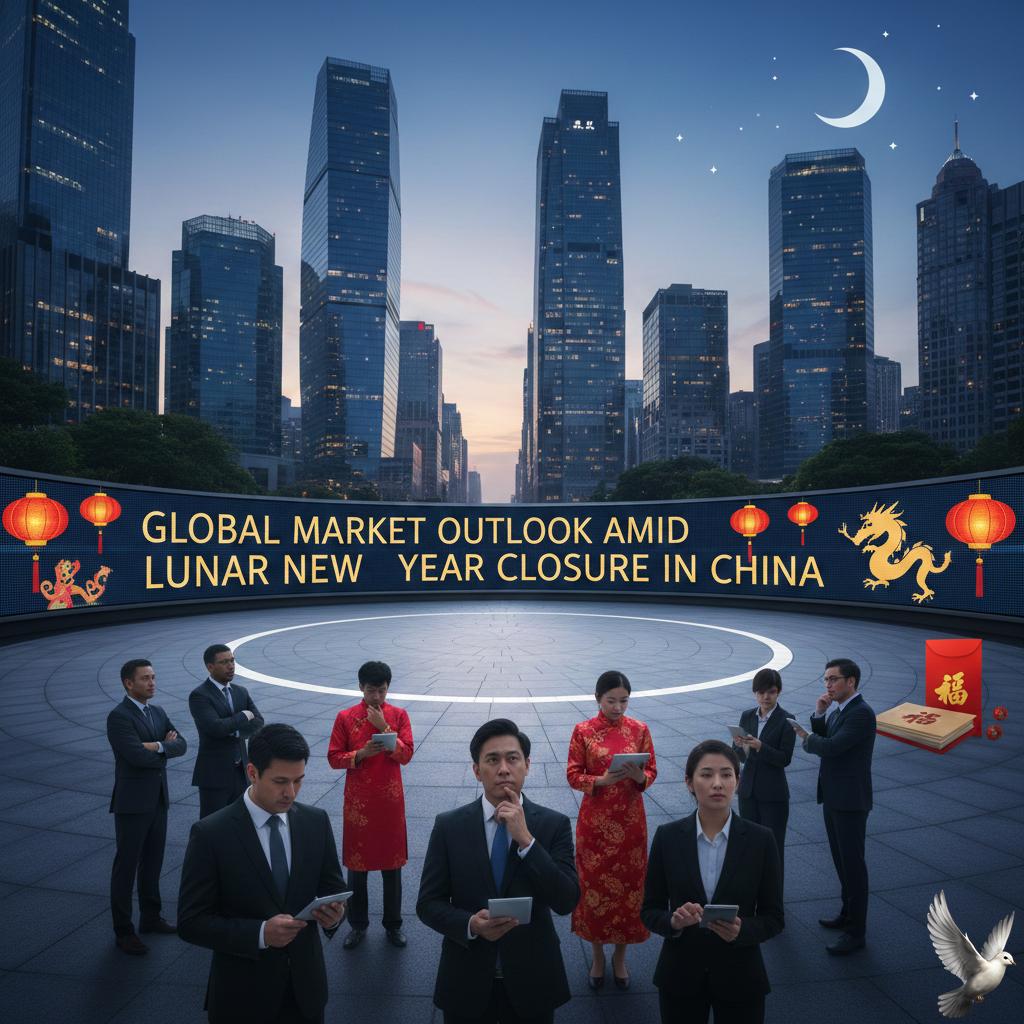
Global Market Outlook Amid Lunar New Year Closure in China
China’s financial markets have entered a scheduled pause for the Lunar New Year, welcoming the Year of the Horse. This period is traditionally defined by reduced liquidity as mainland exchanges remain closed for an extended nine-day holiday, the longest on record. While local trading is halted, the ripple effects are being closely monitored across global commodities and currency markets.
Domestic equity markets entered the break on a high note. The Shanghai Composite Index recently surged to 4,083.67 points, marking its highest level in a decade. This rally followed a stellar 2025 performance where the index gained over 18%. The CSI 300 Index closed its final pre-holiday sessions near 4,660.41, reflecting a year-on-year increase of approximately 18.3%. In Hong Kong, the Hang Seng Index maintained momentum around the 26,710 mark before the seasonal slowdown.
Economic indicators show a "two-speed" recovery. January inflation data revealed a cooling trend, with the Consumer Price Index (CPI) rising only 0.2% year-on-year. This softness was largely attributed to a 0.7% drop in food prices as the holiday timing shifted compared to the previous year. Conversely, the Producer Price Index (PPI) showed signs of recovery, narrowing its decline to -1.4% from -1.9% in December. This improvement was driven by a significant 16.1% spike in non-ferrous metal input prices.
The property sector remains the primary structural drag. Analysts have downgraded 2026 property sale forecasts, now predicting a decline of 10% to 14%. National primary home prices are expected to drop by another 2% to 4% this year. To counter this, the government has front-loaded approximately 62.5 billion yuan in special treasury bonds to stimulate consumer trade-ins and support domestic demand.
Monetary policy remains accommodative to navigate these headwinds. The People’s Bank of China (PBOC) has signaled a "moderately loose" stance for the remainder of 2026. Markets are pricing in a 50-basis point cut to the Reserve Requirement Ratio (RRR) and a 10-basis point reduction in interest rates during the first half of the year. The central bank is also focusing on liquidity management through government bond transactions to keep financing costs low.
Consumption is the bright spot of the holiday period. Passenger travel traffic is expected to rise by more than 5% year-on-year. To capitalize on this, authorities distributed 2.05 billion yuan in "New Year gift packages" including consumption vouchers and subsidies. Macau’s gaming sector and major e-commerce platforms like Alibaba and JD.com are positioned as the primary beneficiaries of this travel and spending surge.
Global investors are using this holiday lull to reassess portfolios. While Chinese A-shares trade at a valuation discount with a price-to-earnings ratio of 12.6x, the focus remains on whether the "Deepseek moment" in AI and semiconductor innovation can offset the ongoing property slump. External markets continue to watch the offshore Yuan, which recently hovered near a 32-month high at 7.01 per dollar, for signals of post-holiday sentiment.