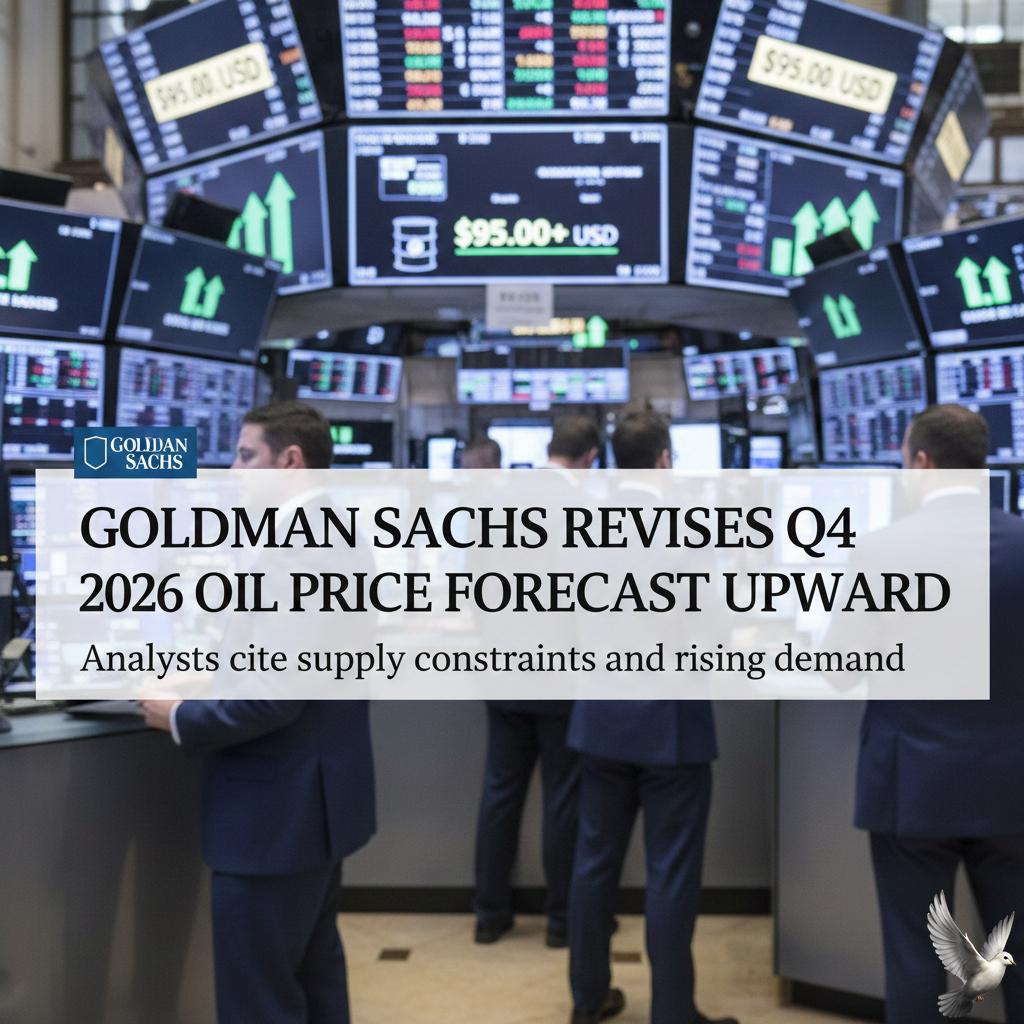
Goldman Sachs Revises Q4 2026 Oil Price Forecast Upward
The global oil market is currently navigating a period of heightened volatility, driven by shifting geopolitical risks and revised long-term supply forecasts.
As of February 23, 2026, benchmark prices have seen a slight retreat following a week of significant gains. Brent crude is currently trading at approximately **$71.00** per barrel, down about **1.05%** today. Similarly, West Texas Intermediate (WTI) has dipped to **$65.74**, a decline of **1.11%**. This softening follows a rally that pushed prices to six-month highs earlier in the month.
The immediate price pressure stems from a blend of diplomatic and trade factors. Risk aversion has surfaced following the announcement of new U.S. tariff hikes, raising concerns about global fuel demand. Simultaneously, the scheduled third round of nuclear talks between the U.S. and Iran in Geneva has slightly deflated the geopolitical risk premium, which was previously estimated at **$6** per barrel.
In a significant long-term shift, Goldman Sachs has revised its 2026 price projections upward. The bank now expects Brent to reach **$60** and WTI to hit **$56** per barrel by the fourth quarter of 2026. This is a **$6** increase from previous estimates, primarily justified by lower-than-expected stockpiles across OECD nations.
Inventory levels at major pricing centers have failed to accumulate as predicted, creating a tighter baseline for the coming year. While a global surplus is still anticipated for 2026, Goldman Sachs suggests this may be the final year of the current supply growth cycle.
OPEC+ strategy remains a critical pillar for market stability. The alliance recently reaffirmed its decision to pause production increases through the first quarter of 2026, citing seasonal demand weakness. However, there are growing indications from member nations like Saudi Arabia and the UAE that supply hikes could resume as early as April 2026 to reclaim market share.
Current data shows global oil production reached **106.6 million** barrels per day in January, with total 2026 output projected to rise by **2.4 million** barrels per day. Demand growth remains concentrated in non-OECD economies, with China and India expected to drive consumption increases of **0.2 million** and **0.3 million** barrels per day, respectively.
Market participants are closely watching the March 1 OPEC+ meeting, where a formal decision on production levels for the second quarter will be finalized. For now, the combination of low OECD inventories and persistent Middle East tensions provides a floor for prices, even as macroeconomic headwinds test the ceiling.
[Oil Market Outlook 2026](https://www.google.com/search?q=https://www.youtube.com/watch%3Fv%3DF_YF-L3kP0I)
This video provides a deep dive into the factors influencing 2026 oil price forecasts and the strategic production shifts expected from major global players.