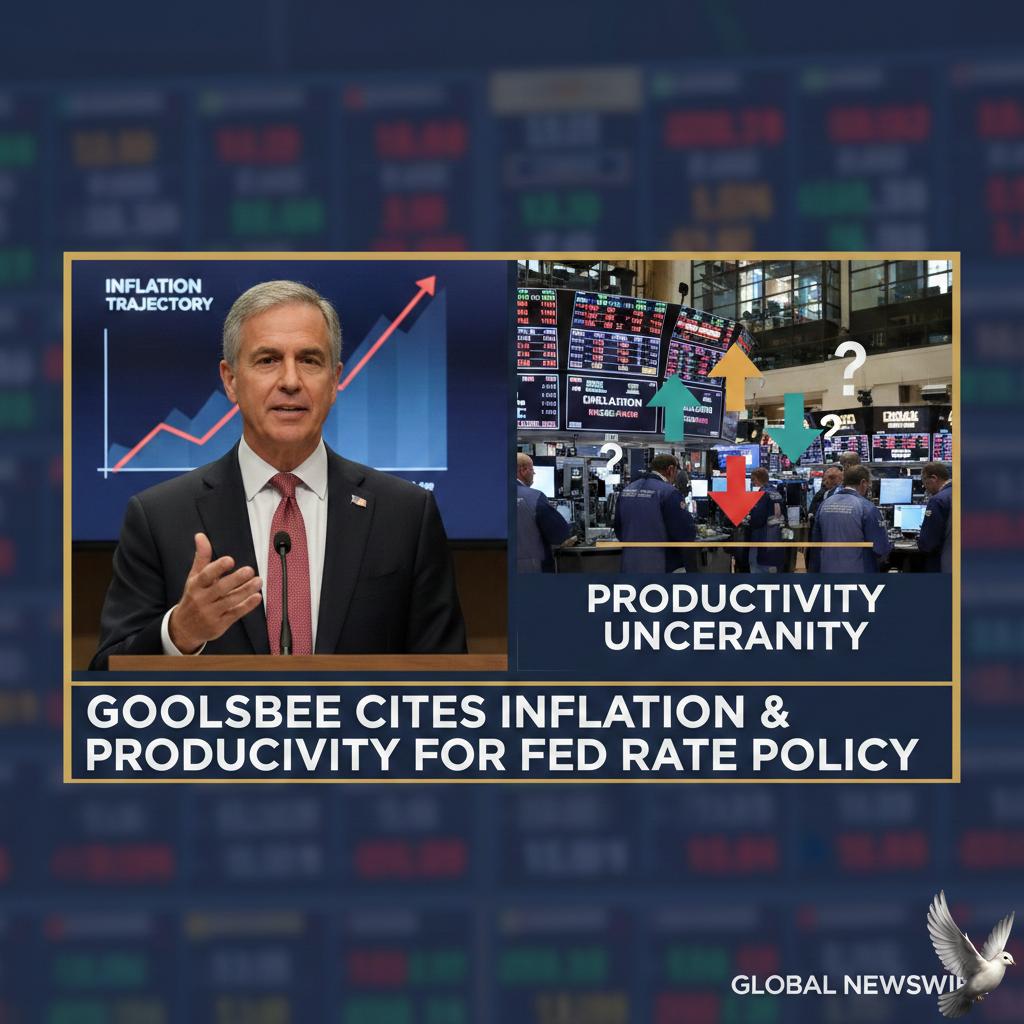
**Goolsbee Cites Inflation Trajectory and Productivity Uncertainty as Key Factors for Fed Rate Policy**
Chicago Fed President Austan Goolsbee is urging caution against premature interest rate cuts, even as the U.S. central bank navigates a complex economic landscape defined by lingering inflation and shifting market sentiment. While Goolsbee remains optimistic about potential rate reductions later in 2026, he warns that relying on expected productivity surges—specifically those linked to artificial intelligence—is a risky strategy for loosening monetary policy today.
As of late February 2026, the Federal Reserve has maintained the benchmark federal funds rate in a target range of 3.50% to 3.75%. This follow a period of stabilization after several cuts in 2025. Although annual inflation slowed to 2.4% in January 2026—the lowest level since 2021—it remains above the Fed's 2.0% target. Goolsbee emphasized that the central bank requires "tangible" evidence that price pressures are sustainably retreating before committing to further easing.
A core debate has emerged within the Fed regarding the "Greenspan moment" of the 1990s. Some officials, including nominees and governors, suggest that a productivity boom could allow for lower rates without stoking inflation. However, Goolsbee counters that the current situation is distinct because inflation has remained above target for several years. He argues that "front-loading" cuts based on unproven productivity gains could easily overheat the economy, leading to a significant downturn if those gains do not materialize as forecast.
Market reaction reflects this uncertainty. On February 24, 2026, U.S. equity markets saw sharp declines, with the Dow Jones dropping 1.66% to 48,804 and the S&P 500 falling 1.04% to 6,837. Investor anxiety is being driven by a combination of new 15% global tariff threats, AI-sector volatility, and concerns that the Fed may keep rates restrictive for longer than anticipated.
Fixed income markets show a rotation into safety, with the 10-year Treasury yield recently trading near 4.03% and the 2-year yield at 3.48%. Gold has surged as a haven asset, hitting a multi-month high of approximately $5,227 per ounce. Meanwhile, the labor market shows signs of cooling, with unemployment ticking up to 4.3% or 4.4% depending on recent readings, adding another layer of pressure to the Fed’s dual mandate of price stability and maximum employment.
The Federal Open Market Committee is scheduled to meet again in mid-March. While some strategists anticipate a potential cut by summer, the current consensus leans toward a "wait-and-see" approach. Goolsbee’s recent comments solidify this hawkish-leaning stance, making it clear that the bar for the next rate cut remains high until services inflation is fully "tamed" and the impact of trade policies on consumer prices becomes clearer.
[Understanding Fed Rate Decisions](https://www.youtube.com/watch?v=XDznxjCuQWY)
This video features Chicago Fed President Austan Goolsbee discussing the current interest rate outlook and the specific economic data the Fed is monitoring.
http://googleusercontent.com/youtube_content/0