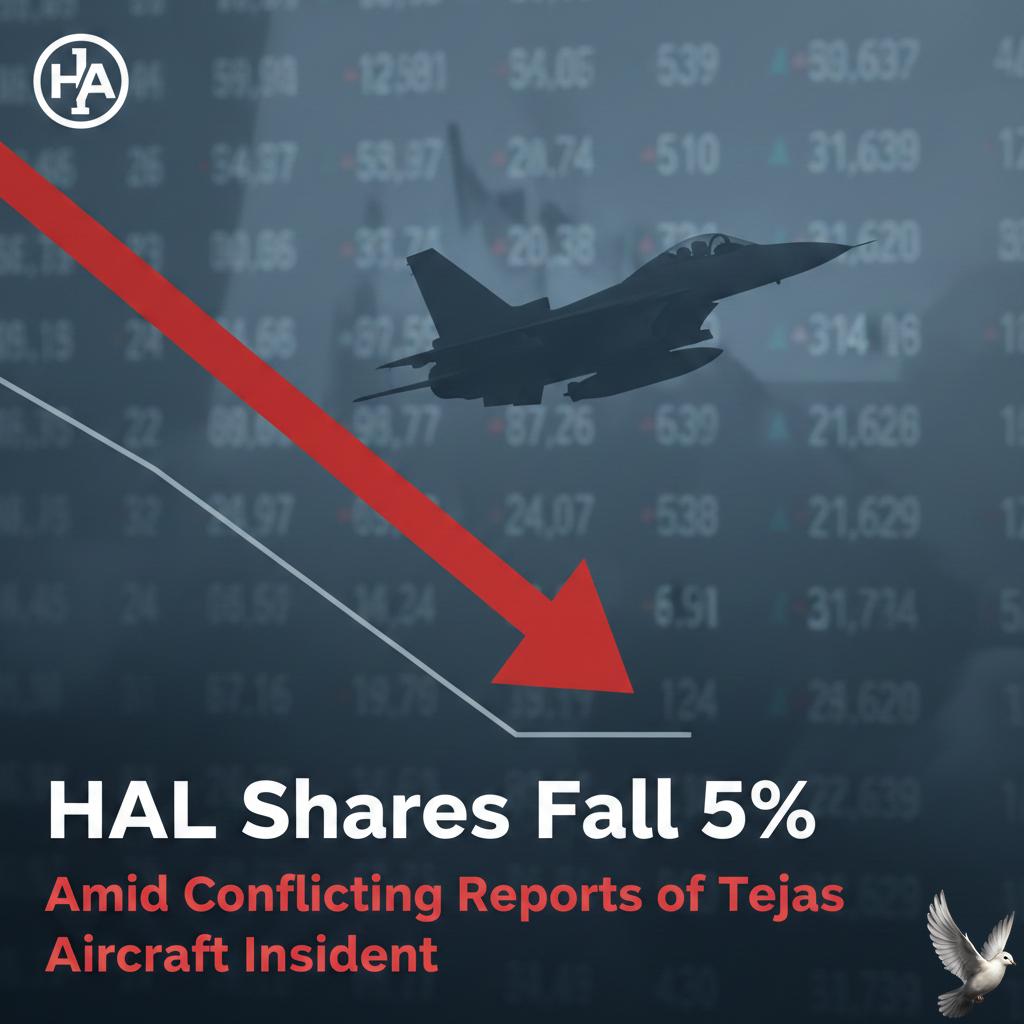
HAL Shares Fall 5% Amid Conflicting Reports of Tejas Aircraft Incident
HAL Market Update: Resilience Amid Technical Scrutiny
Hindustan Aeronautics Limited (HAL) shares experienced a volatile trading session on **February 23, 2026**, closing down approximately **4.23%** at **Rs 3,993.80**. During intraday trading, the stock touched a low of **Rs 3,975.80** as markets reacted to reports concerning the LCA Tejas fighter jet program.
Clarification on Tejas Incident
The company issued a formal regulatory filing to address media reports of an aircraft crash. HAL clarified that no crash occurred; instead, a "minor technical incident on ground" took place involving a Tejas jet overshooting a runway due to a suspected brake failure.
While the pilot ejected safely as a precaution, the airframe sustained structural damage. HAL emphasized that the Tejas maintains one of the highest safety records globally among contemporary fighter aircraft. The incident is currently being analyzed in coordination with the Indian Air Force (IAF) to ensure a speedy resolution.
Performance and Valuation Metrics
Despite recent price pressure, HAL’s financial fundamentals remain robust. The company recently reported its **Q3 FY26** results, highlighting significant growth across key indicators:
* **Net Profit:** **Rs 1,866.68 crore**, marking a **29.65%** year-on-year increase.
* **Revenue:** **Rs 7,698.80 crore**, up **10.66%** from the previous year.
* **Operating Margin:** Stable at **24.30%**, reflecting consistent operational efficiency.
* **Order Book:** Currently valued at approximately **Rs 1,90,000 crore**, providing revenue visibility through **2032**.
The stock is currently trading nearly **22%** below its 52-week high of **Rs 5,166.00**. Analysts note that at a price-to-earnings (P/E) ratio of roughly **30x**, HAL remains one of the more attractively valued entities within the Indian defense sector compared to peers.
Sector Trends and Headwinds
The broader defense sector has faced a "reset" following the **2026 Union Budget**, which allocated **Rs 7.85 lakh crore** to defense. While this represents a **15%** year-on-year increase, the market had priced in even more aggressive capital expenditure, leading to a period of profit-taking across the industry.
Ongoing execution risks remain a point of focus for investors. Deliveries of the **Tejas Mk-1A** variant have faced delays, primarily due to global supply chain constraints regarding aero engines. However, new contracts—including **Rs 62,370 crore** for additional jets and **Rs 25,000 crore** for Su-30MKI engines—continue to bolster the long-term pipeline.
Strategic shifts into civilian MRO (Maintenance, Repair, and Overhaul) and commercial space manufacturing are expected to diversify revenue streams, reducing the company's historical dependency on pure military procurement cycles.