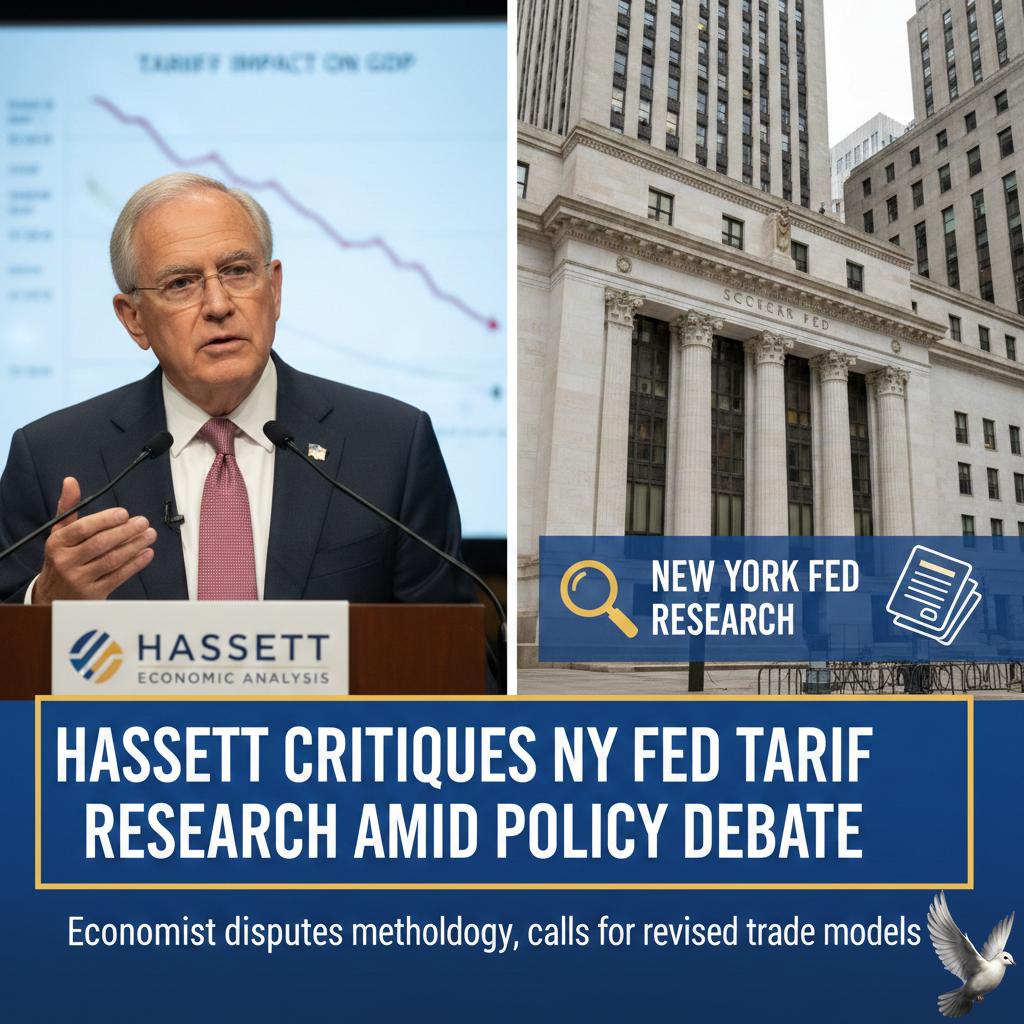
**Hassett Critiques New York Fed Tariff Research Amid Policy Debate**
Market Brief: US Import Tariffs and Domestic Cost Dynamics
The domestic economic landscape is shifting as recent data confirms that the burden of massive import tax increases is falling almost entirely on American shoulders. While the administration has historically argued that foreign exporters would absorb these costs, a landmark report from the New York Fed released in February 2026 reveals a different reality.
Key data points show that U.S. firms and consumers bore 94% of the tariff burden during the first eight months of 2025. By November, this figure adjusted slightly to 86%, yet the overarching trend remains clear: the domestic economy is footing the bill for trade policy shifts.
The average effective tariff rate on U.S. imports surged from a mere 2.6% at the start of 2025 to 13.5% by early 2026. This is the highest level of import taxation recorded since 1946. The Treasury Department reported collecting $287 billion in customs duties and fees in 2025 alone, a staggering 192% increase compared to the previous year.
At the household level, the impact is becoming tangible. Analysts estimate that the current tariff structure resulted in a $1,000 cost increase per U.S. household in 2025, with that figure projected to rise to $1,300 in 2026. These costs are primarily driven by "pass-through" pricing, where importers raise retail prices to maintain margins.
Sector performance shows significant price divergence. Personal Consumption Expenditure (PCE) for core goods rose 1.5% through late 2025, while durable goods—those most exposed to international supply chains—saw even sharper climbs. Imported durable goods prices are currently 3.1% above their pre-2025 trends.
Global trade flows are also reconfiguring. China’s share of U.S. imports dropped below 10% for the first time in decades as businesses moved sourcing to Mexico and Vietnam to mitigate tax exposure. However, even with these shifts, the cost of domestic-affected goods has risen, as local producers often raise prices in tandem with their newly expensive foreign competitors.
While the administration points to robust GDP growth of 4.3% in late 2025 as evidence of a successful "Buy American" strategy, the New York Fed research suggests these gains may be tempered by long-term productivity losses. The central bank's findings have been echoed by other international bodies, including the Kiel Institute, which found that foreign exporters absorbed only 4% of the total tax burden.
Looking ahead, market volatility remains tied to the legal and political status of these measures. With roughly $168 billion in potential refunds pending a Supreme Court decision on emergency tariff powers, businesses are navigating a high-stakes environment where the cost of entry for foreign goods has become a permanent fixture of the domestic price index.