How Long-Term Economic Indicators, Valuation Metrics, and Historical Trends Shake Up the Coming Market Cycle
Global equity markets are moving through a phase of historically elevated valuations, driven heavily by concentrated capital allocation in the technology sector. The S&P 500 continues to trade at a premium, carrying a forward price-to-earnings multiple of roughly **21 times**. This valuation rests within the upper **13%** of its historical range over the past **40 years**, underscoring a high-conviction, risk-on environment.
A massive driver behind these elevated metrics is the continuous capital deployment into artificial intelligence infrastructure. The largest cloud computing and technology companies are projected to spend a collective **$670 billion** in capital expenditures. This massive infrastructure investment is expected to fuel approximately **40%** of the S&P 500 earnings-per-share growth, prompting a hyper-focused rally where a small basket of mega-cap technology firms commands outsized weight.
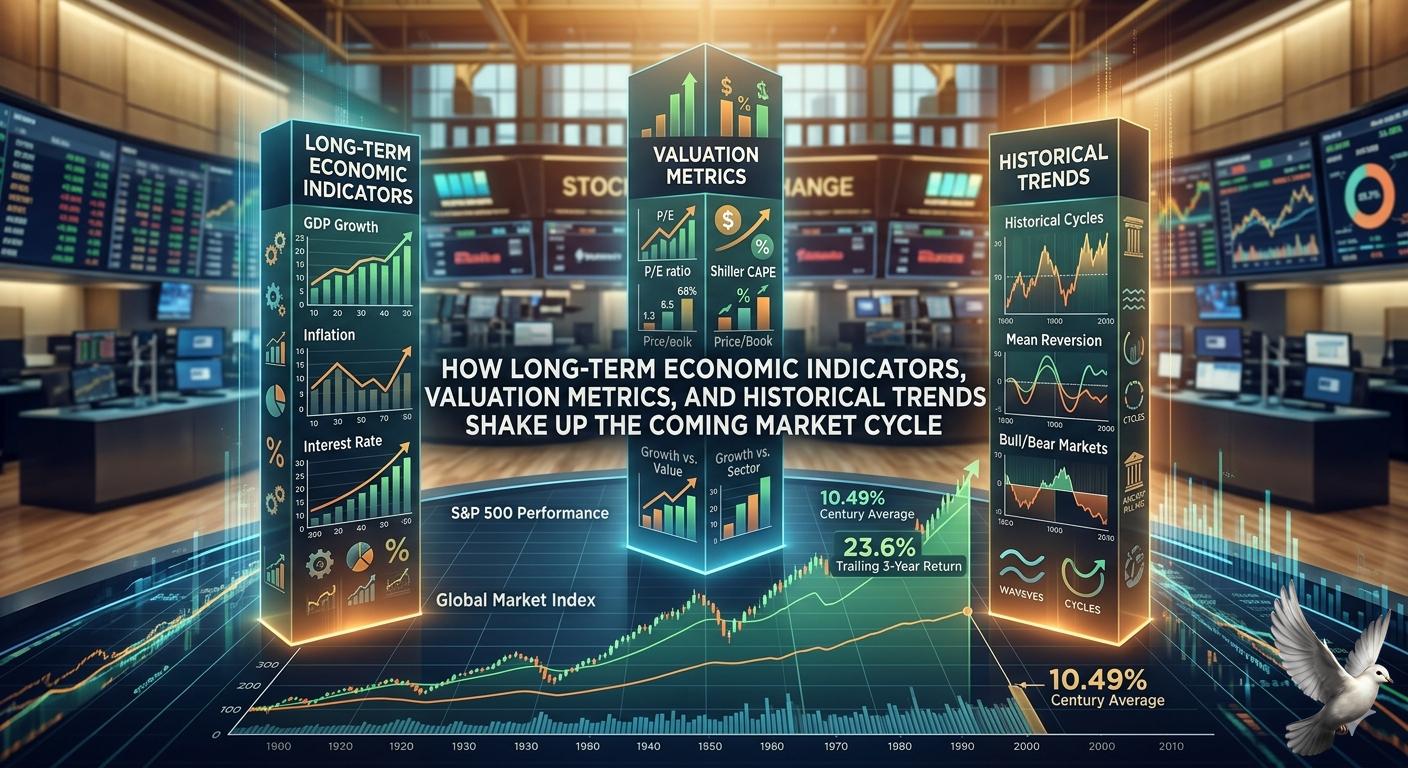
However, this valuation divergence has triggered a renewed focus among institutional investors on the mechanics of mean reversion and value-oriented asset allocation. Historically, the S&P 500 has delivered an annualized return of **10.49%** over the last century. In stark contrast, trailing three-year annual returns have surged to **23.6%**, creating an overextended performance gap that typically precedes long-term corrections back toward historical averages.
This extreme performance disparity has created unique opportunities outside the primary U.S. indexes. While the MSCI World Growth Index has significantly outperformed its value counterpart over a **10-year** horizon with a **295.6%** return compared to **166.5%**, the gap has narrowed dramatically. Over a **5-year** lookback period, global growth and value indices are neck-and-neck, returning **63.2%** and **62.4%** respectively.
Geographically, a major structural shift is taking place. When stripping out U.S. mega-cap tech stocks, value investing has emerged as the clear leader across international regions, outperforming growth in Europe, Asia, Latin America, and the broader emerging markets. In particular, sectors heavily represented in value benchmarks, such as financials, defense, and industrials, are drawing capital as steeper yield curves support earnings expectations.
As a result, asset managers are managing expectations downward for passive benchmarks over the next decade. Long-term forecasting models project the Global Market Index to achieve an annualized return of just over **7%**, a noticeable deceleration from its **9%** annualized trailing ten-year performance. This shifting climate underscores the importance of portfolio discipline and contrarian strategies as cyclical rotations begin to test the persistence of growth-heavy portfolios.