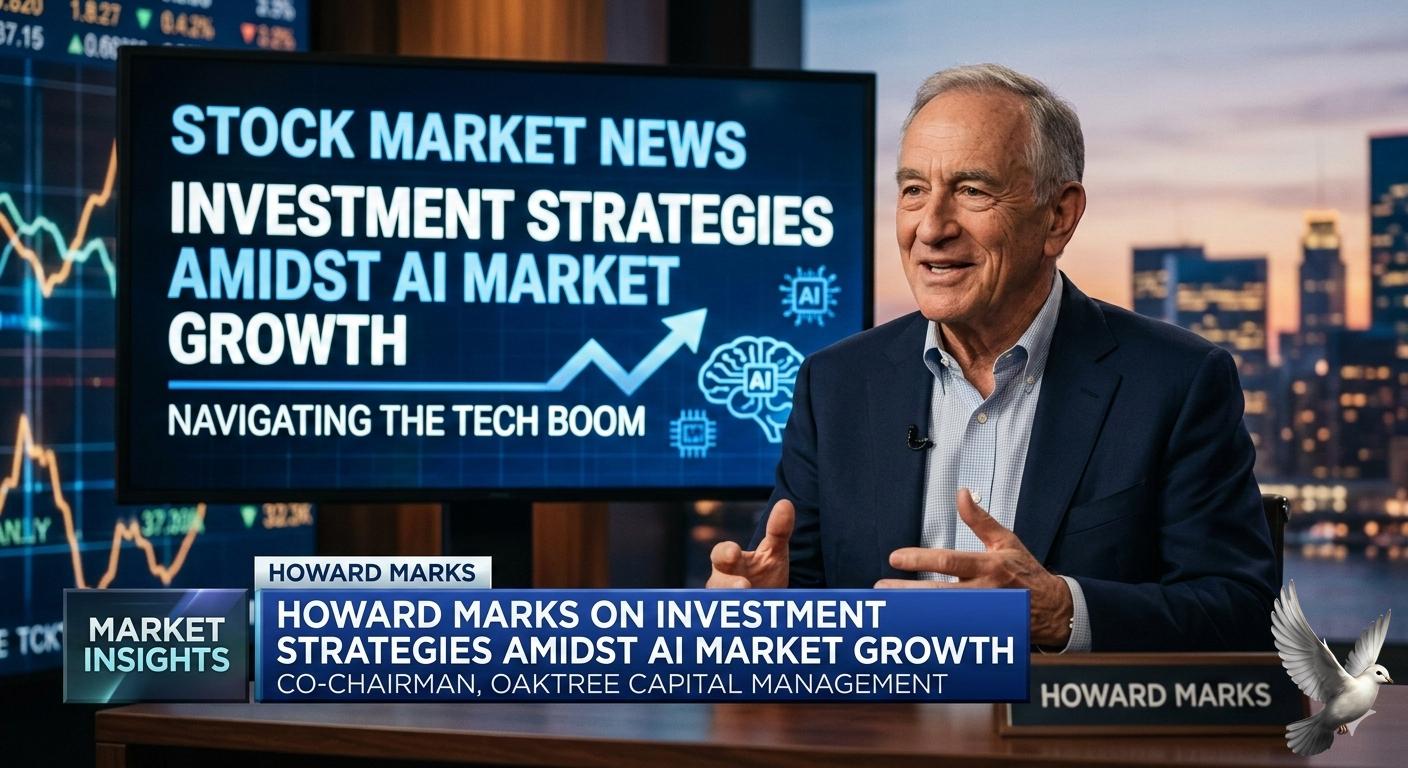
Howard Marks on Investment Strategies Amidst AI Market Growth
Market Brief: AI Investment Landscape
The artificial intelligence sector has reached a critical inflection point where technical capability is no longer in doubt, but market profitability remains a central debate. Billionaire investor **Howard Marks** recently reinforced this sentiment, characterizing AI as a "real" and revolutionary technology capable of reshaping global labor. However, he remains cautious on the investment outlook, noting that current valuations for some startups resemble "lottery tickets" rather than guaranteed returns.
Market Performance and Volatility
February 2026 has been defined by a sharp divergence between record-breaking financial results and cooling investor enthusiasm. **Nvidia**, the industry bellwether, reported a staggering **$68.1 billion** in quarterly revenue—a **73%** year-over-year increase. Despite these historic figures, its stock price fell by over **5.5%** following the announcement, wiping out roughly **$260 billion** in market capitalization as investors questioned the sustainability of massive infrastructure spending.
Broader indices have felt the pressure of this "AI paradox." In early February, the **Nasdaq Composite** saw a pull-back of over **1%** in a single day, while the **S&P 500** continues to hover near the **7,000** mark. This volatility highlights a growing market rotation away from "builders"—the companies providing chips and data centers—toward "users" who can demonstrate clear AI-driven revenue growth.
Infrastructure vs. Monetization
Global spending on AI is projected to exceed **$2.02 trillion** in 2026, a **36%** annual increase. A significant shift is occurring in how this capital is deployed. Expenditure is moving from speculative model training toward **inference**, which focuses on meeting the actual demand for active AI applications.
* **Hyperscaler Capex:** Major tech firms are on track to spend **$527 billion** on capital expenditures this year.
* **Infrastructure Growth:** Software frameworks required to scale autonomous agents are seeing an **83%** growth rate.
* **Economic Impact:** Analysts estimate that AI-related investments contributed roughly **1%** to U.S. GDP growth over the past year.
Strategic Transition to Agentic AI
The market is transitioning from simple generative tools to **Agentic AI**—systems capable of independently executing complex workflows in finance, HR, and legal sectors. While efficiency gains are widespread, the "hard truth" of 2026 is the difficulty of monetization. Companies are moving away from "AI moonshots" to focus on cost minimization and error elimination.
The Investor Dilemma
Howard Marks suggests a balanced approach is mandatory in this environment. While the potential of AI is likely underestimated in the long term, current market prices do not necessarily reflect "bargains." The focus has shifted from whether a company uses AI to how it translates that usage into the bottom line. Success is now measured by **outcome-aligned services** rather than the mere adoption of new tools.