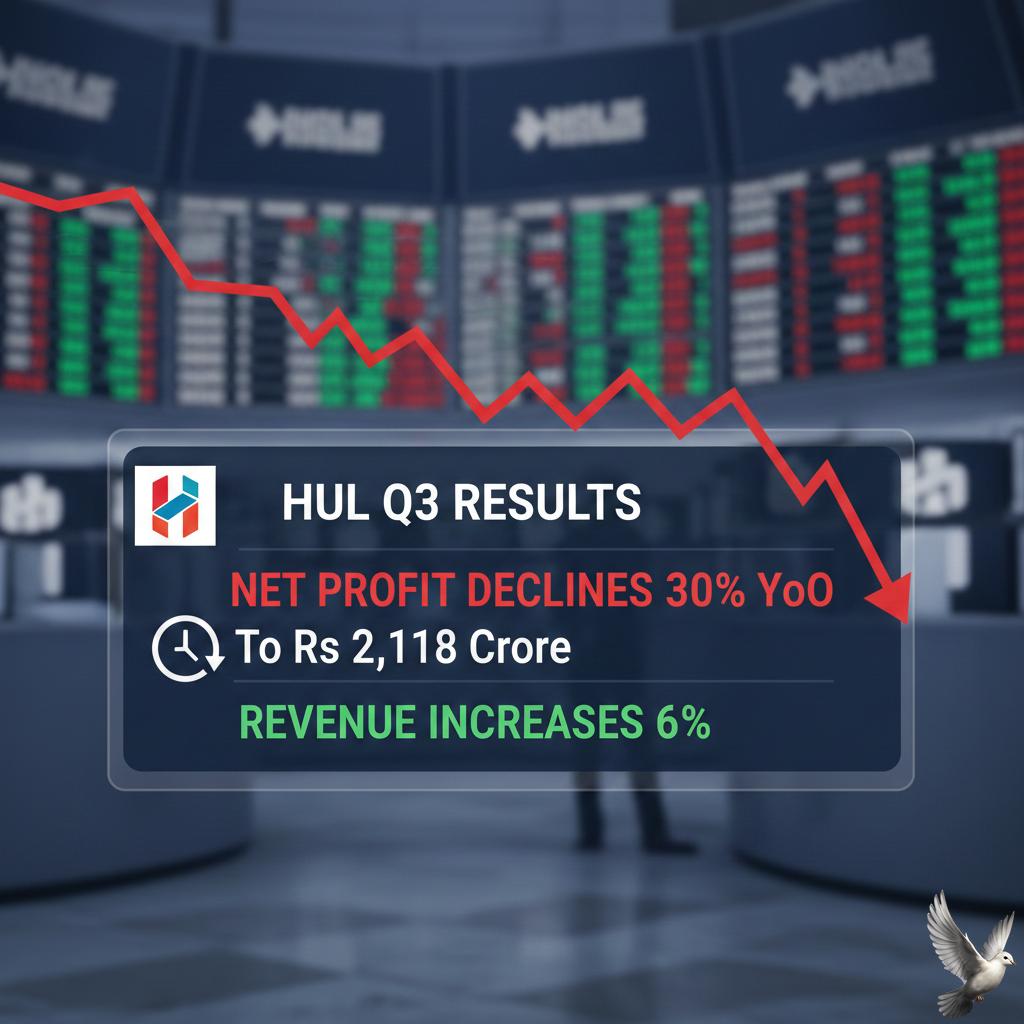
HUL Q3 Results: Net Profit Declines 30% YoY to Rs 2,118 Crore While Revenue Increases 6%
Hindustan Unilever Limited (HUL) has demonstrated financial resilience in a complex economic landscape, reporting a revenue of 16,441 crore for the third quarter. This represents a 5.6% year-on-year increase from 15,556 crore. The company’s performance highlights its ability to maintain steady growth despite fluctuating consumer sentiment and a challenging input cost environment.
As of February 12, 2026, HUL’s stock is trading at approximately 2,417.60, showing a year-to-date return of 6.61%. The company maintains a massive market capitalization of 5.68 lakh crore, reinforcing its position as the leading force in India’s FMCG sector. Investor focus remains sharp on the stock's 52-week range, which has fluctuated between 2,136.00 and 2,750.00.
Operational highlights show a strategic shift toward high-growth segments. The recent acquisition of a 90.5% stake in the skincare brand Minimalist for 2,955 crore marks a significant expansion into the premium Beauty & Wellbeing category. Additionally, the demerger of the ice cream business, specifically the Kwality Wall’s brand, into a separate listed entity is expected to unlock further shareholder value.
The broader FMCG sector is currently navigating the impact of the GST 2.0 reforms implemented in late 2025. These reforms slashed rates on essential goods from 18% to 5%, a move that HUL has leveraged to pass on price benefits to consumers. This tax transition has stimulated volume growth, particularly in rural markets where demand is expanding at nearly double the rate of urban centers.
Segment-wise performance remains varied but robust. The Home Care division led the charge with a 6% sales increase, supported by strong demand for fabric wash and household cleaning products. While Beauty & Wellbeing saw more modest growth, the integration of new digital-first brands is expected to bolster margins in the coming quarters.
Key economic indicators suggest a favorable outlook for the remainder of the 2026 fiscal year. With India’s real GDP growth peaking at 8.2% and household disposable income projected to rise to 34.1 in 2026, the environment for consumption is strengthening. HUL’s debt-free balance sheet and focus on premiumization position it to capitalize on this recovery, even as it manages volatility in raw material costs like palm oil and crude derivatives.