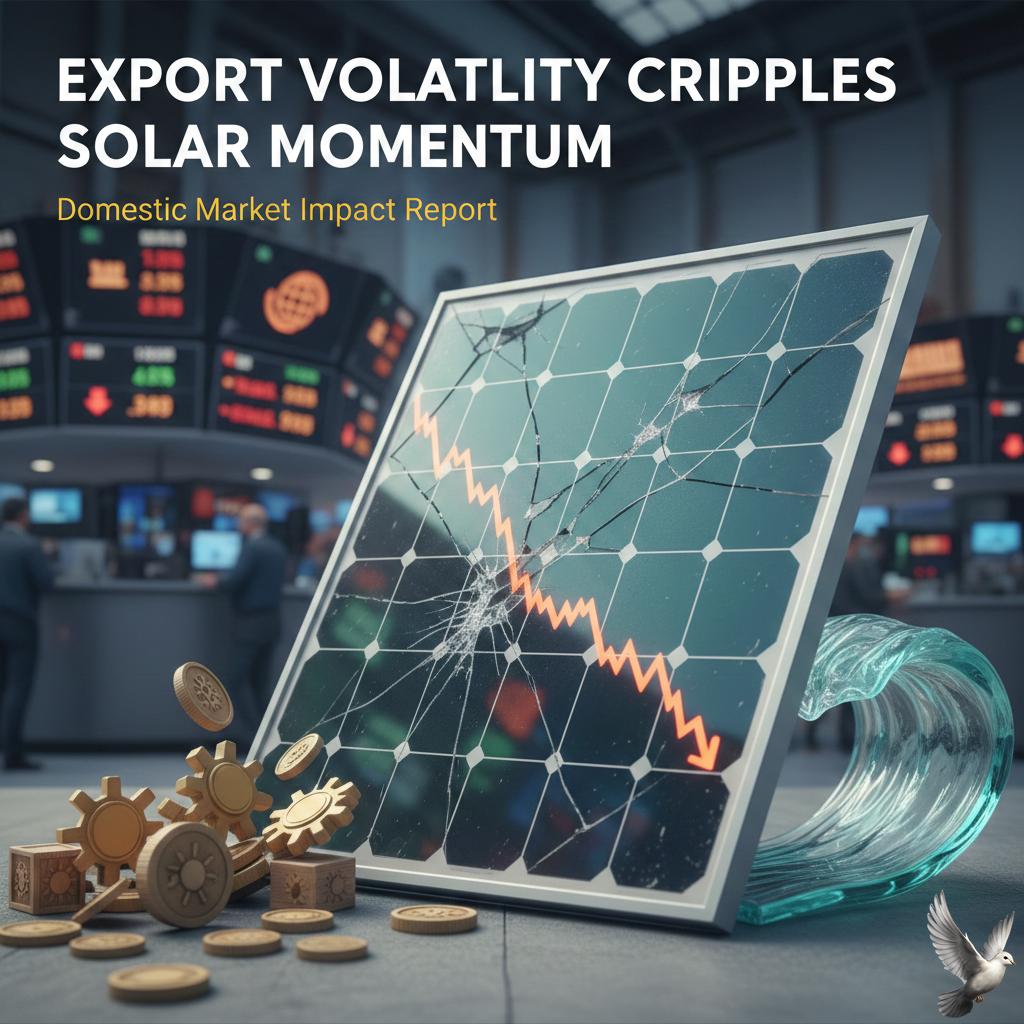
Impact of Export Volatility on Domestic Solar Market Momentum
The U.S. Department of Commerce has officially issued a preliminary countervailing duty (CVD) of 125.87% on solar cells and modules imported from India. This decision, announced on February 24, 2026, aims to offset alleged government subsidies that Washington claims allow Indian manufacturers to undercut American producers.
The impact on the Indian solar sector has been immediate. Major industry players saw significant stock volatility following the news, with Waaree Energies and Premier Energies experiencing intraday drops of up to 15% and 18% respectively.
This duty represents a severe barrier for an export-driven industry that shipped approximately $792 million worth of solar goods to the U.S. in 2024—a nine-fold increase from 2022. Analysts estimate that under these new rates, a $100 solar panel could cost as much as $226 upon entering the U.S. market, making many existing contracts commercially unviable.
Domestic supply dynamics are shifting rapidly in response. India currently possesses over 140 GW of module manufacturing capacity, a figure expected to reach 165 GW by March 2027. With the U.S. market becoming increasingly restricted, exporters are likely to redirect unsold inventory back into India.
This influx of supply is expected to exert downward pressure on domestic module prices. While this benefits local project developers and helps India reach its target of 500 GW of non-fossil energy by 2030, it poses a challenge to the profitability of domestic manufacturers already grappling with oversupply.
To mitigate these trade barriers, leading Indian firms are pivoting toward localized U.S. production. Waaree Energies is aggressively expanding its American manufacturing capacity, with plans to reach 4.2 GW by the end of FY2027. This move is designed to service existing U.S. order books while diversifying supply chains away from Indian cells subject to the 126% tariff.
The final determination for these CVD investigations is scheduled for July 6, 2026. Until then, Indian manufacturers are exploring alternative markets in Europe and Africa to reduce their 90% plus reliance on the U.S. market.
Industry analysts suggest that the sector's long-term resilience will depend on scaling domestic deployment to absorb excess capacity and successfully exporting capital to build manufacturing units directly within high-tariff regions.