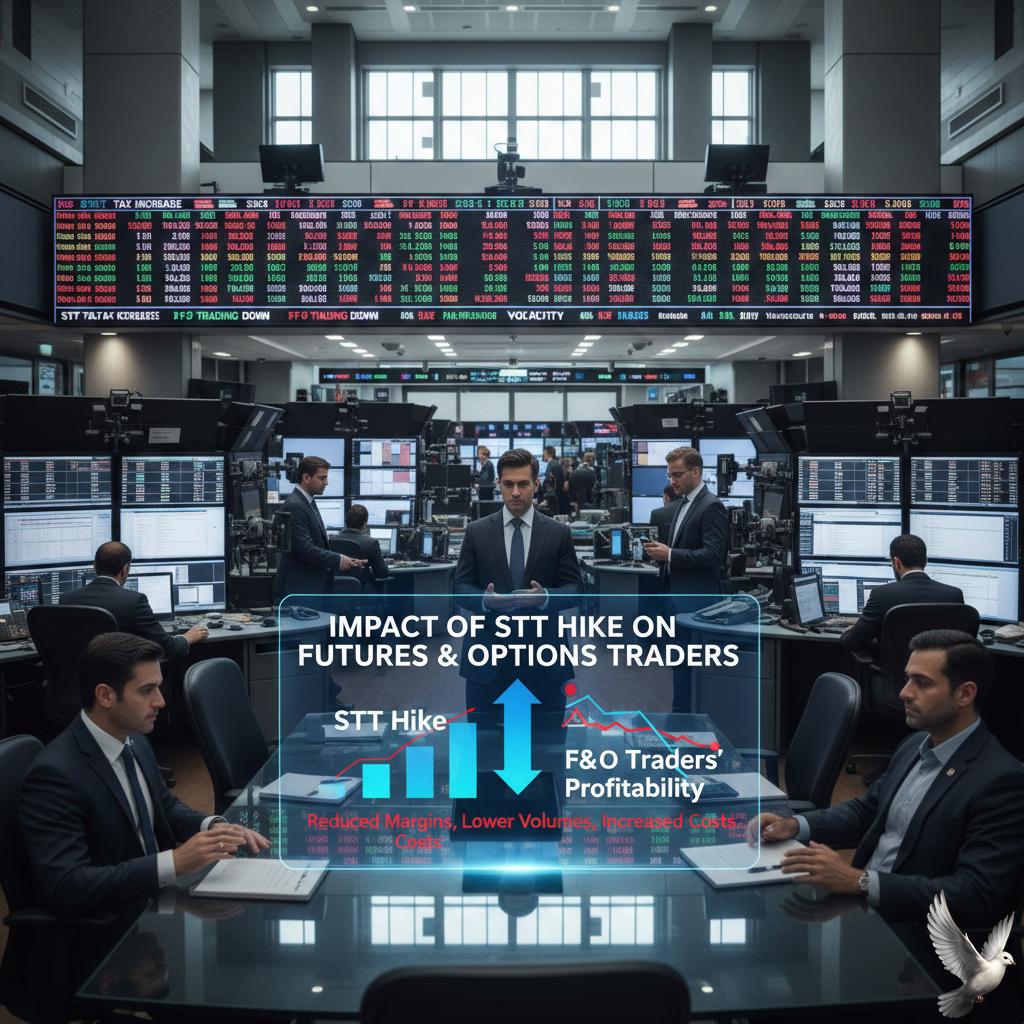
Impact of STT Hike on Futures and Options Traders
**Union Budget 2026: Derivative Tax Hike Triggers Market Sell-Off**
**Date:** February 2, 2026
The Union Budget 2026-27, presented on **February 1, 2026**, delivered a significant policy shift for India's capital markets with a sharp increase in the Securities Transaction Tax (STT) on derivative instruments. The announcement, intended to curb excessive speculative activity, led to an immediate negative reaction across benchmark indices and brokerage sectors during the special Sunday trading session.
**Policy Update: STT Revisions**
Finance Minister Nirmala Sitharaman announced a steeper tax structure for the Futures and Options (F&O) segment, effective from the next financial year.
* **Futures:** STT raised to **0.05%** from the previous **0.02%**.
* **Options:** STT on options premium increased to **0.15%** from **0.10%**.
The revisions aim to moderate the "unchecked explosion" of retail participation in derivatives, which regulators have flagged as a systemic risk. The move effectively raises the breakeven point for traders, making high-frequency and scalping strategies significantly more expensive.
**Market Reaction: Sharp Correction**
Indian equity markets witnessed their worst Budget-day performance in six years. The benchmark indices erased early gains to close deep in the red, reflecting widespread risk-off sentiment.
* **Sensex:** Plunged **1,547 points** (**-1.88%**) to close at **80,723**.
* **Nifty 50:** Shed **495 points** (**-1.96%**) to end below the psychological 25,000 mark at **24,825**.
* **Wealth Erosion:** Approximately **₹10 lakh crore** of investor wealth was wiped out in a single session.
**Sector Impact: Brokerages and Exchanges Hit**
Stocks of market intermediaries bore the brunt of the sell-off, as higher transaction costs are expected to dampen trading volumes—a key revenue driver for these firms.
* **BSE Ltd:** Tanked **10.04%**.
* **Angel One:** Slid **9.96%**.
* **Groww (Billionbrains Garage Ventures):** Dropped approximately **8.7%**.
**Outlook: Liquidity and Foreign Flows**
The tax hike has renewed concerns regarding liquidity and foreign investor participation in India's derivatives market, one of the largest globally by volume. Analysts warn that the increased friction costs could temper Foreign Institutional Investor (FII) flows, particularly from high-frequency trading desks.
While the government clarified that the intent is volume moderation rather than revenue maximization, the immediate market sentiment remains fragile. Participants are now assessing whether the higher costs will drive a structural shift from short-term speculative trading toward long-term delivery-based investing.