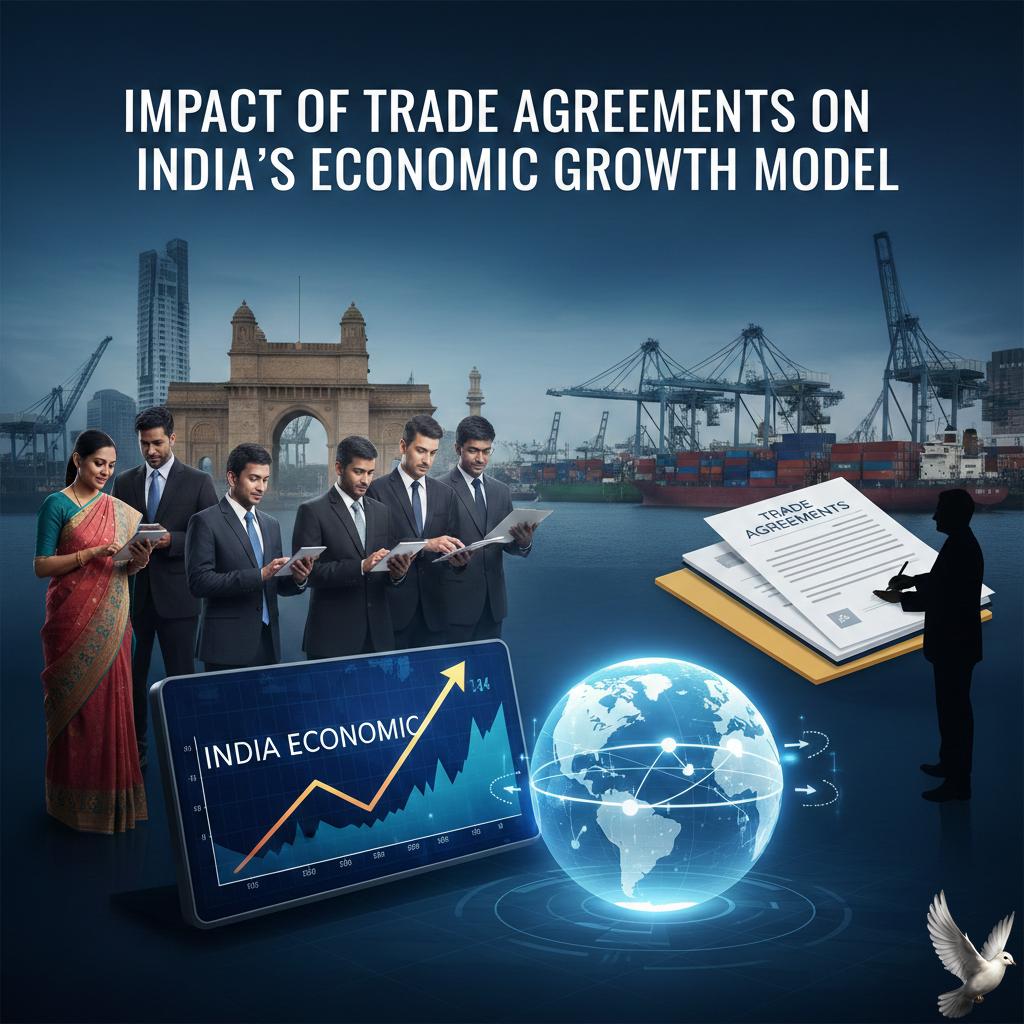
Impact of Trade Agreements on India’s Economic Growth Model
India’s trade landscape has entered a transformative era characterized by high-speed global integration and a series of landmark free trade agreements. The nation is successfully transitioning from a domestic-demand-driven economy to a globally competitive manufacturing and services hub. Recent data underscores this shift as total exports reached a historic high of **$825.25 billion** in the last fiscal year, maintaining a growth momentum of **6%** despite global volatility.
The recent finalization of the India-European Union Free Trade Agreement in January 2026 marks a historic milestone. This "deal of the century" provides duty-free access for over **99%** of Indian exports by value. It specifically targets labor-intensive sectors such as textiles and leather, where immediate duty elimination replaces previous tariffs of up to **16%**. Similarly, the newly implemented pact with the UK aims to double bilateral trade to **$120 billion** by 2030, offering Indian firms an estimated **₹4,000 crore** in annual savings through simplified social security contributions.
Strategic management of the trade balance has led to a significant narrowing of the current account deficit, which moderated to approximately **0.7%** of GDP. This improvement is largely fueled by a powerhouse services sector, which grew by over **13%** to reach **$387.54 billion**. On the merchandise front, electronic goods have emerged as a primary driver with a staggering **39%** growth rate, signaling India’s rising prominence in the global technology supply chain.
In North America, a recent interim trade framework with the United States has successfully reduced tariffs on Indian goods from **50%** to **18%**. This reset restores competitiveness for gems, jewelry, and pharmaceuticals while removing previous penalties related to energy sourcing. To maintain this momentum, the government has launched the **₹25,060 crore** Export Promotion Mission to streamline trade compliance and digitalize the export ecosystem through 2031.
Foreign investment is increasingly tied to these trade milestones. The agreement with the EFTA bloc (Switzerland, Norway, Iceland, and Liechtenstein) includes a unique binding commitment of **$100 billion** in foreign direct investment and the creation of **1 million** jobs over the next 15 years. These inflows are shifting toward high-value manufacturing and renewables, positioning India as a stable alternative in the reconfiguration of global industrial networks.
[India's International Free Trade Agreements](https://www.youtube.com/watch?v=5zWbEZ73lYw)
This video provides a breakdown of India's evolving trade strategy and its growing influence as a trusted economic partner through new agreements and manufacturing reforms.
http://googleusercontent.com/youtube_content/0