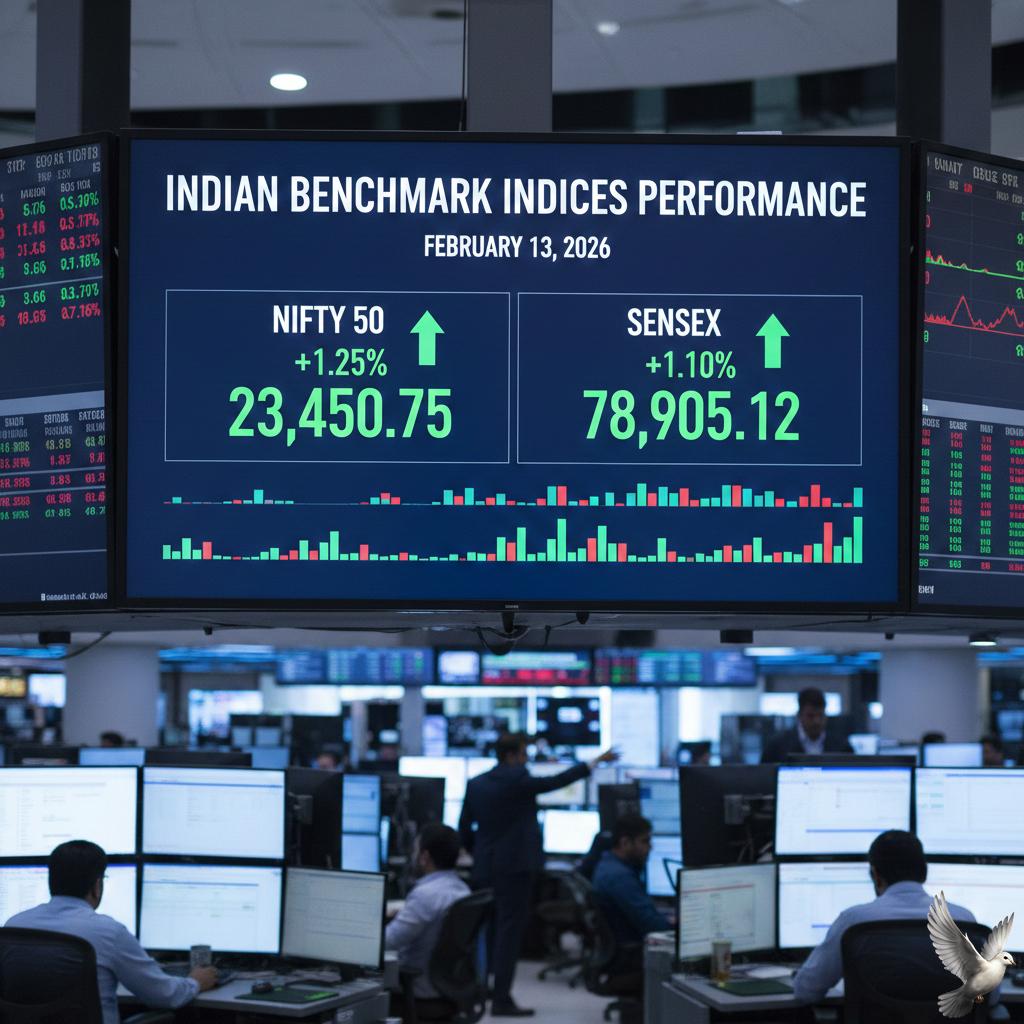
Indian Benchmark Indices Performance on February 13, 2026
Market Overview February 2026
The global economy is navigating a period of decelerating growth, with projections holding at **2.6%** for the year. The United States remains a primary anchor with **1.5%** to **2.0%** expansion, though momentum is softening compared to previous cycles. China is expected to moderate to a **4.4%** – **4.6%** growth rate as domestic property challenges persist and global trade maps reconfigure toward regional hubs.
Equity markets are currently defined by a "Great Rotation." Investors are shifting capital away from hyper-growth technology leaders into "real economy" sectors. Value-oriented categories like Industrials, Materials, and Consumer Staples are seeing increased inflows as the market broadens beyond the narrow leadership of 2025.
Benchmark Indices and Sector Shifts
The **S&P 500** is currently treading water, trading near the **6,832** level as of mid-February. While the index has achieved a **52-week high of 7,002**, recent sessions have shown high volatility and a flat year-to-date return. This stability at the index level masks a significant internal churn.
Information Technology has faced pressure, falling roughly **3.8%** recently as "AI fatigue" sets in. Large-cap tech firms like Alphabet have seen single-day drops of **2%** following massive bond sales intended to fund the intensifying infrastructure race. Conversely, Global Small Caps have emerged as a bright spot, surging over **5.4%** earlier this quarter.
Energy and Commodities
Energy markets are experiencing downward pressure due to a global supply surplus. **Brent Crude** recently settled lower at **$67.52** per barrel, a daily decline of over **2.7%**. **WTI Crude** followed a similar trajectory, closing at **$62.84**.
The International Energy Agency has lowered its 2026 demand growth forecast to **850,000 barrels per day**, down from previous estimates of **930,000**. While geopolitical tensions in the Middle East provide a potential price floor, rising inventories—which increased by **8.5 million barrels** last week—continue to weigh on the outlook.
Monetary Policy and Interest Rates
Central banks are entering a period of divergent policy. The **U.S. Federal Reserve** is expected to maintain a terminal rate between **3.0%** and **3.25%**, with markets pricing in at least two rate cuts later this year. In contrast, the **Reserve Bank of Australia** became the first major mover of the year, hiking its cash rate to **3.85%** to combat persistent **3.8%** inflation.
The **Reserve Bank of India** has opted for stability, holding its repo rate at **5.25%** for the first review of 2026. This "neutral" stance is supported by a robust growth outlook of **7.4%** and a breakthrough trade deal with the U.S. that reduced tariffs on Indian imports from **50%** to **18%**.
Technology and AI Capex
The technology sector is locked in a massive capital expenditure cycle. The top five U.S. hyperscalers are projected to spend over **$700 billion** on AI infrastructure in 2026, a staggering **60%** increase over previous years. This demand is creating a "supercycle" for semiconductors, with global chip revenues expected to hit **$975 billion**.
However, this spending is creating bottlenecks. A shortage of memory chips is forecasted to drive up prices, potentially causing a **5%** to **9%** contraction in the global PC and smartphone markets as production costs rise. Enterprise IT spending is nevertheless expected to surpass **$6 trillion** for the first time this year.