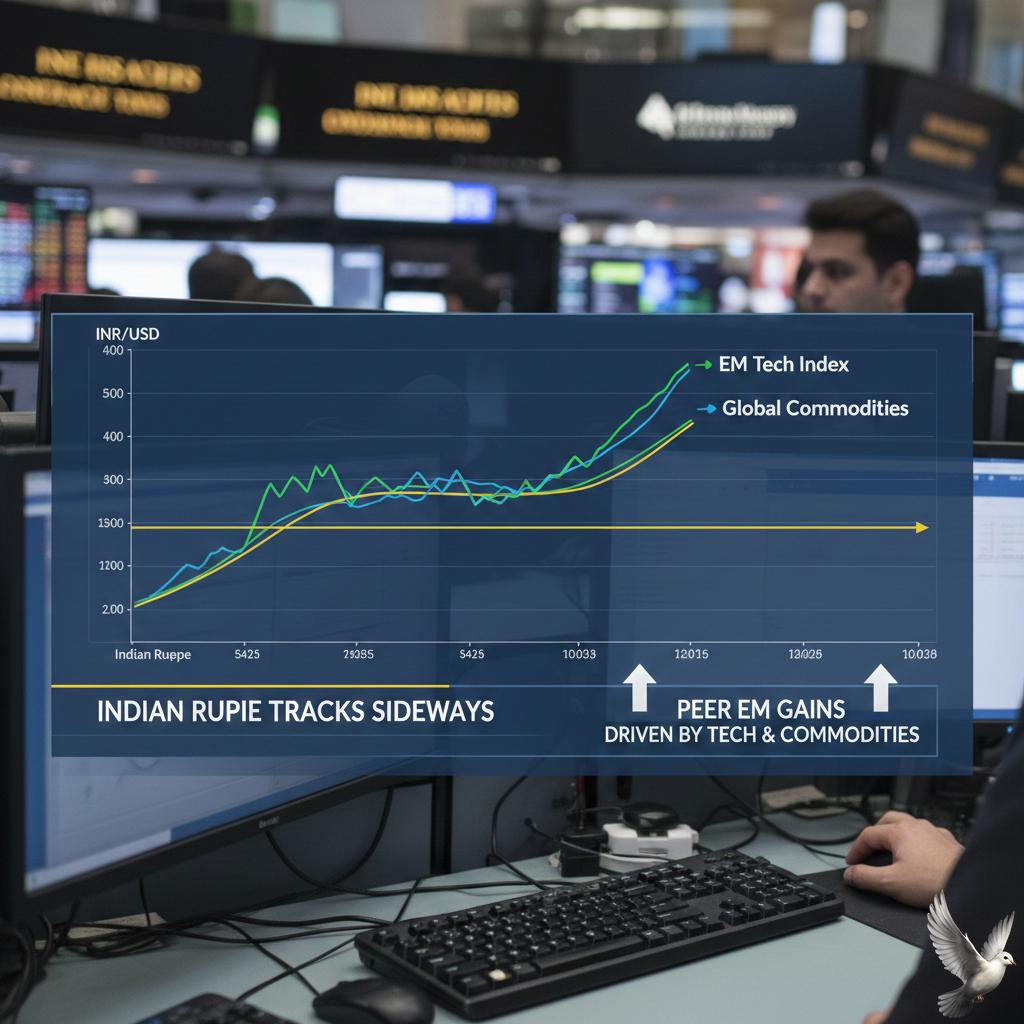
Indian Rupee Tracks Sideways as Peer Emerging Market Gains Driven by Tech and Commodities Diverge
The Indian rupee remains in a tight range as of late February 2026, currently trading near **90.94** against the U.S. dollar. While a slight softening of the dollar index to **97.12** has provided brief breathing room, the currency continues to punch below its weight. It has faced a year-to-date decline of approximately **2.0%**, significantly lagging behind its emerging market peers.
Central bank activity is the primary anchor for the currency at these levels. The Reserve Bank of India recently intervened to defend the psychologically critical **91.00** mark. Market dealers report that the central bank is actively selling dollars to curb excessive volatility, even as importers capitalize on any minor rupee gains to fulfill their dollar requirements.
The equity market is currently navigating a period of sharp sectoral divergence. The **BSE Sensex** and **Nifty 50** have seen notable pressure, with the Sensex recently dropping over **1,060 points** in a single session. This volatility is largely driven by a massive sell-off in the technology sector. The **Nifty IT** index plummeted nearly **5.0%** recently, as investors weigh the disruptive impact of artificial intelligence on traditional service models.
Global investors are shifting their focus toward markets with heavy exposure to commodities and high-growth tech hardware. In India, this has led to a rotation out of IT and into defensive and cyclical pockets. Sectors such as **Energy**, **Metals**, and **FMCG** have shown relative resilience. Specifically, the **Nifty Bank** index has risen by **1.64%** recently, supported by strong performance in public sector banks.
Capital flows reflect a "debt-led" recovery in investor sentiment. While secondary market equities saw a net outflow of **4.55 billion INR** in mid-February, the debt market attracted over **51 billion INR** in a single week. This suggests that while stock valuations and tech disruption cause caution, India’s fixed-income opportunities remain a significant draw for foreign portfolio investors.
The near-term outlook remains cautious. Analysts expect the rupee to fluctuate between **90.50 and 92.00** as the market balances strong domestic GDP growth, projected at **7.4%**, against a widening merchandise trade deficit that reached **34.68 billion USD** in January. Equity performance is expected to remain volatile until there is greater clarity on global trade policies and the long-term margins of the technology sector.