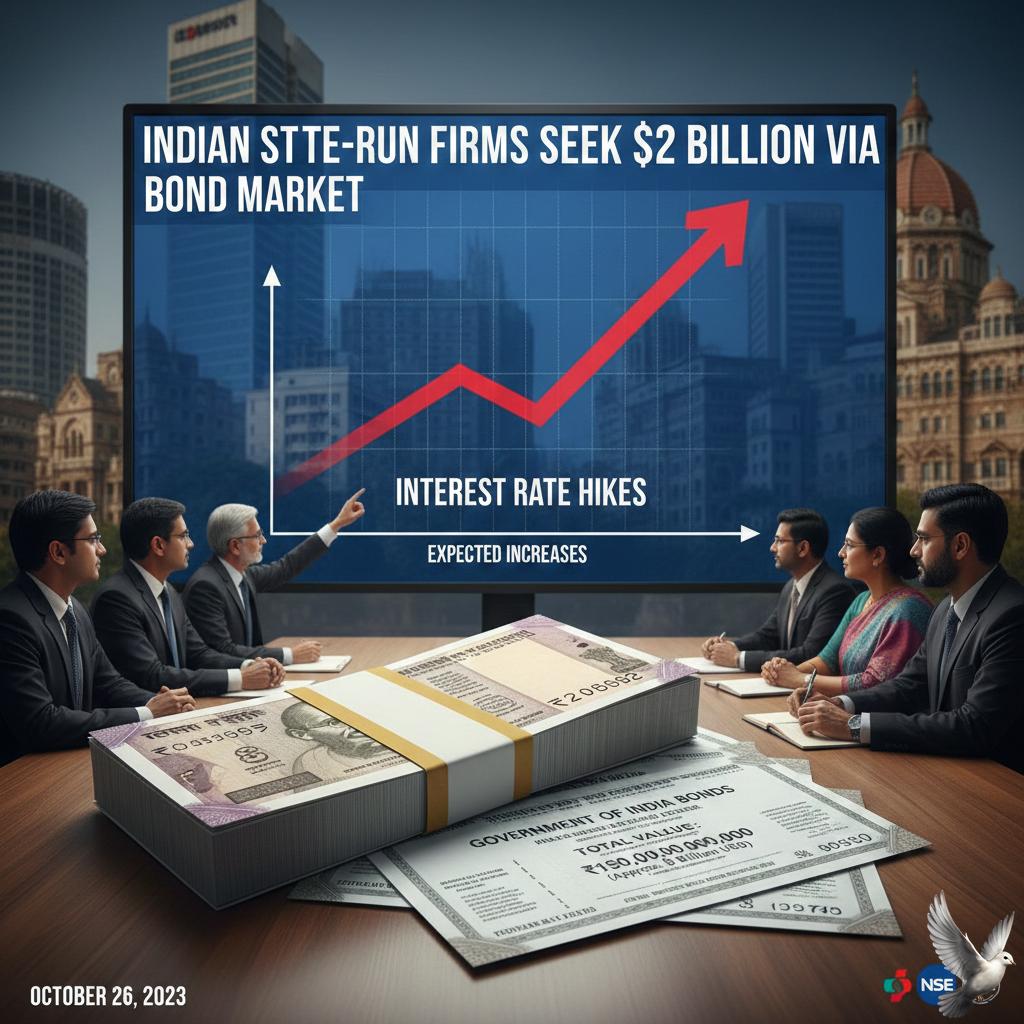
Indian State-Run Firms Seek $2 Billion via Bond Market Amid Expected Interest Rate Hikes
The Indian corporate bond market is entering a phase of tactical pragmatism. Market leaders are no longer waiting for a significant drop in borrowing costs, choosing instead to lock in financing at current levels. This shift comes as the realization takes hold that yields are unlikely to soften materially in the immediate future.
The benchmark 10-year Government Securities (G-Sec) yield is currently hovering around 6.73%, remaining resilient despite recent policy shifts. This benchmark serves as the floor for corporate debt pricing. While the Reserve Bank of India (RBI) initiated a 25-basis-point cut to the repo rate in late 2024—bringing it to 5.25%—the central bank maintained a status quo in its February 2026 meeting. This "higher for longer" stance on liquidity has effectively capped any aggressive rally in bond prices.
Issuance activity remains robust despite these elevated rates. State-run giants and private conglomerates are actively tapping the primary market, with weekly issuances frequently exceeding 125 billion rupees. This volume is notably higher than the historical weekly average of 50 to 100 billion rupees. Companies have accepted the current yield environment as the "new normal," prioritizing capital access over the gamble of waiting for cheaper debt.
The appetite for longer-duration paper is also growing. A recent 50-year government bond auction was oversubscribed by four times, signaling deep institutional interest from insurance companies and pension funds. In the corporate sector, triple-A rated 3-year bonds are currently pricing near 7.85%, while state government securities have seen cut-off yields jump to 7.63%—the highest levels seen in nearly two years.
Corporate balance sheets are better positioned to absorb these costs than in previous cycles. The net debt-to-EBITDA ratio for top-tier Indian firms has improved significantly, falling to approximately 1.2x. This deleveraging provides a safety buffer, allowing firms to fund expansion through a mix of debt and internal accruals without straining interest coverage ratios, which currently stand at a healthy 5.8%.
Looking ahead, the market expects a shallow rate-cut cycle. With inflation projected to settle within the 2% to 6% target band, the focus has shifted toward liquidity management. Investors are increasingly favoring short-to-medium duration products, where the risk-reward profile remains most attractive. The underlying message is clear: the era of waiting for "perfect" rates has ended, replaced by a steady stream of strategic issuances.