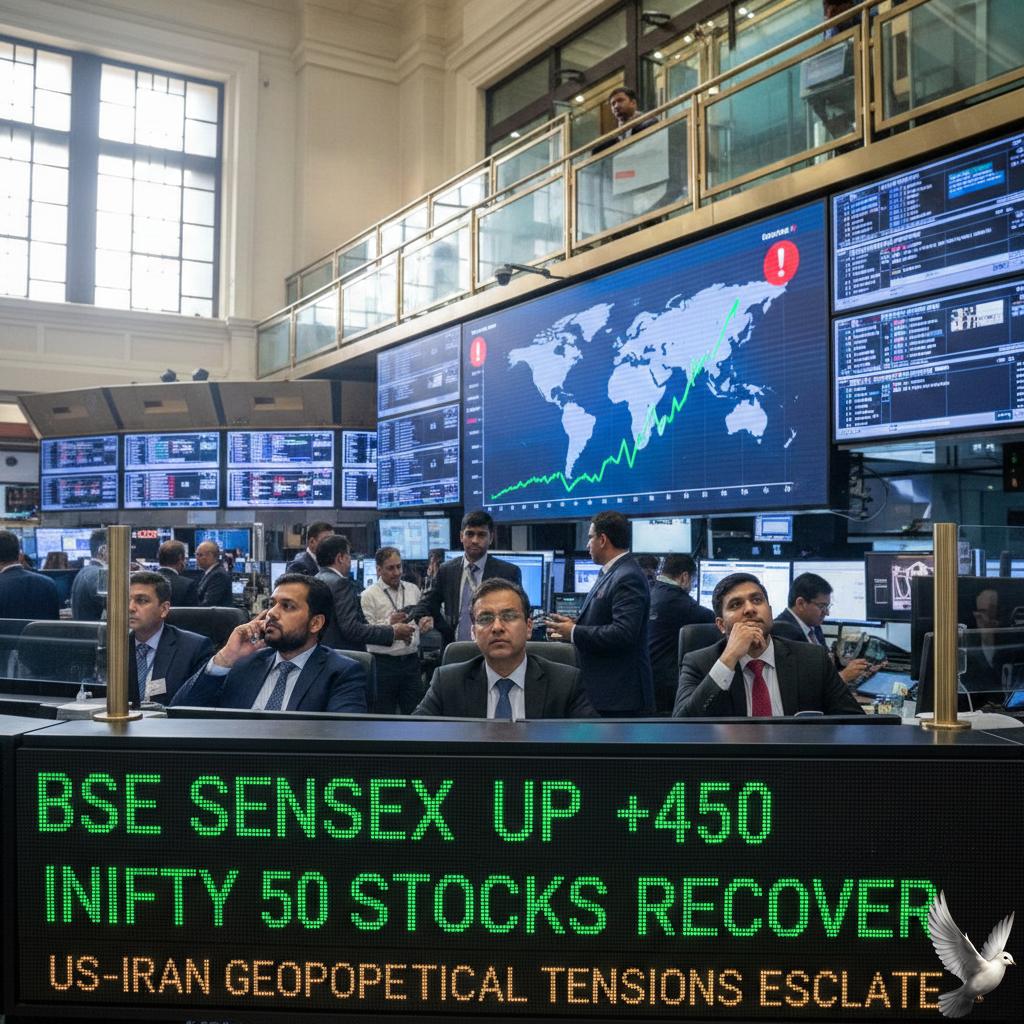
Indian stocks recover amid escalating US-Iran geopolitical tensions
Market Brief: Indian Equities Recover Amid Geopolitical Volatility
Indian benchmark indices staged a resilient recovery during the final session of the week, successfully reclaiming a significant portion of the losses incurred in previous days. The market sentiment shifted positively as broad-based buying in heavyweights offset earlier concerns regarding global instability.
Benchmark Performance
The S&P BSE Sensex gained **316.57 points**, representing a **0.38%** increase, to settle at **82,814.71**. This recovery followed a volatile start where the index initially dipped by nearly **292 points**. At its intraday peak, the Sensex surged by over **633 points**, reaching a high of **83,132.08**.
The NSE Nifty 50 followed a similar trajectory, climbing **116.90 points** or **0.46%** to close at **25,571.25**. Out of the 50 constituent stocks, **36** ended the day in positive territory, signaling a healthy recovery across various sectors. On a weekly basis, the Sensex added **0.22%**, while the Nifty saw a marginal gain of **0.39%**.
Sectoral Highlights
The banking and metal sectors were the primary drivers of the Friday rebound. Notable gainers included NTPC, which rose **2.64%**, and Larsen & Toubro, which advanced **2.33%**. Other top performers featured Hindalco, up **3.21%**, alongside Bharat Electronics and Tata Steel.
In contrast, the IT sector remained a laggard throughout the day, experiencing continued selling pressure. Major technology stocks like Tech Mahindra, Infosys, and HCL Technologies featured among the session's top losers, reflecting a more cautious outlook on global tech spending.
Energy and Geopolitical Impact
Crude oil prices remained elevated near a six-month high, driven by intensifying tensions between the United States and Iran. Brent crude futures hovered around **$71.99 per barrel**, while U.S. West Texas Intermediate (WTI) traded near **$67.05**. These levels represent a weekly gain of approximately **6%** for Brent and over **5%** for WTI.
The military buildup in the Middle East and the potential for supply disruptions in the Strait of Hormuz—a conduit for **20%** of global oil supply—have injected a significant risk premium into energy markets. This surge in input costs has placed visible pressure on domestic oil marketing companies like BPCL and HPCL.
Economic Indicators
Internal economic data provided some structural support to the indices. The HSBC India Composite PMI rose to **59.3** in February 2026, marking its highest level since last November. This growth was fueled by strong factory output and improved hiring, even as input costs reached a 15-month peak.
While the domestic manufacturing and services sectors remain in expansion territory, the overall market breadth remained slightly negative, with **2,265** shares declining against **1,917** advances on the BSE. This suggests that while large-cap heavyweights are stabilizing, the broader market continues to exercise caution.