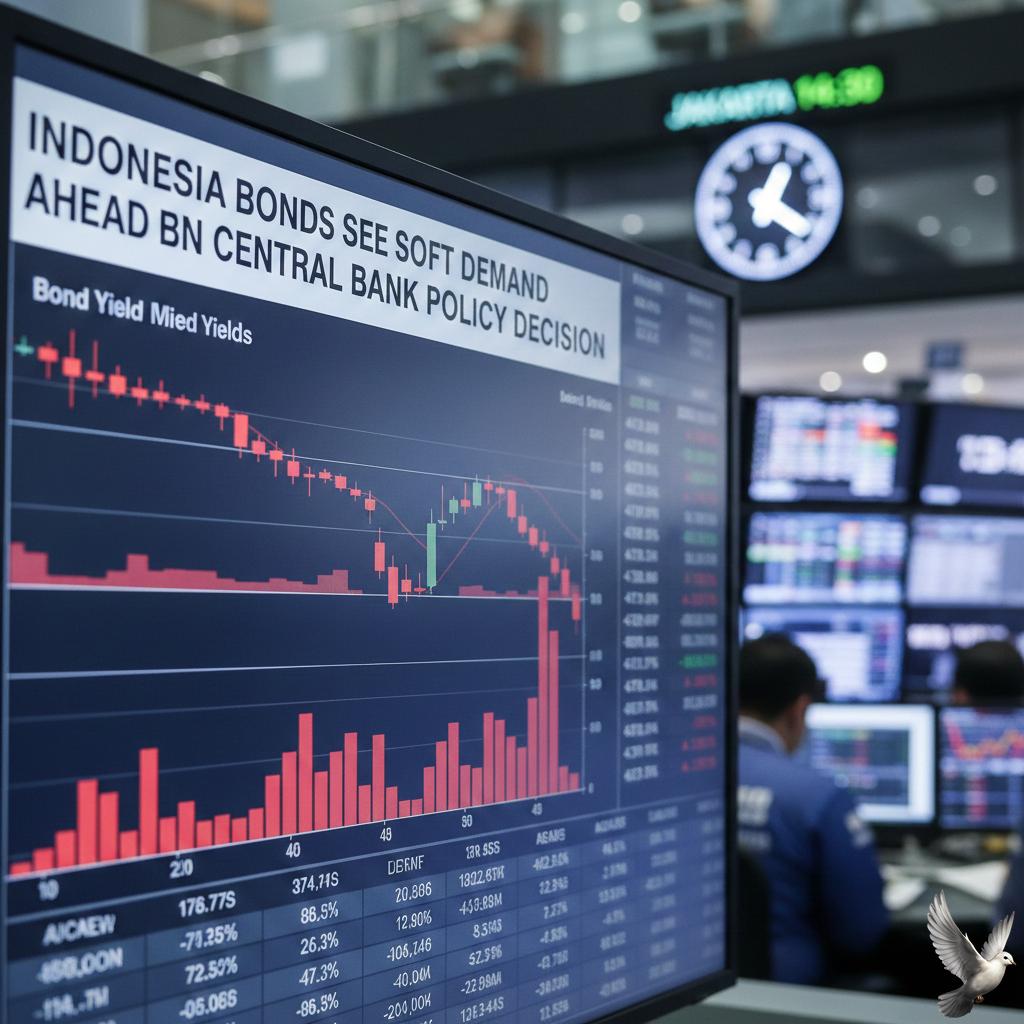
Indonesia Bonds See Soft Demand Ahead of Central Bank Policy Decision
The Indonesian bond market is currently navigating a period of cautious sentiment as global and domestic pressures intersect. Recent auction data shows that demand has cooled, with investors adopting a "wait and see" approach despite government efforts to meet ambitious 2026 budget targets.
In the primary market, the February 2026 auctions have seen a notable dip in bid-to-cover ratios. During the latest Government Bonds (SUN) auction, the indicative target was set at 33 trillion IDR, while analysts estimated incoming bids would reach between 70 trillion and 80 trillion IDR. This reflects softer demand compared to previous months, partly exacerbated by seasonal factors and broader macroeconomic uncertainty.
The 10-year benchmark bond yield is currently trading around the 6.42% level, reflecting a slight tightening compared to earlier peaks above 6.47%. However, volatility remains a key theme. The yield environment is being pulled by two opposing forces: a global shift toward lower rates and local fiscal concerns that keep risk premiums elevated.
Credit sentiment has been tested by recent institutional updates. Moody’s recently revised Indonesia’s sovereign outlook from "Stable" to "Negative," citing concerns over a narrowing revenue base and the fiscal impact of large-scale social programs. This has been paired with a warning from MSCI regarding market accessibility, which has contributed to capital outflows.
The Indonesian Rupiah has faced significant pressure, recently crossing the 16,800 IDR per USD threshold. This depreciation has forced Bank Indonesia to prioritize currency stability over growth support. The central bank recently held its benchmark interest rate steady at 4.75%, signaling a pause in its easing cycle to defend the currency and anchor inflation, which hit 3.55% in January.
Internal policy shifts are also under the microscope. The appointment of new leadership within Bank Indonesia has raised questions regarding the institution's future independence. While government officials have dismissed these concerns, international investors remain sensitive to any perceived shifts in the central bank’s autonomy.
Despite these hurdles, the government successfully raised 12 trillion IDR in a recent Sharia bond (Sukuk) auction, exceeding its 11 trillion IDR target. This suggests that while overall demand is softer, there is still a baseline of liquidity for specific high-quality instruments.
Looking ahead, the market will focus on the execution of the 2026 State Budget, which targets a narrowed fiscal deficit of 2.5% of GDP. Achievement of this goal relies on an optimistic 13% growth in tax revenue and 5.4% economic growth, both of which will be closely monitored by ratings agencies and bondholders alike.