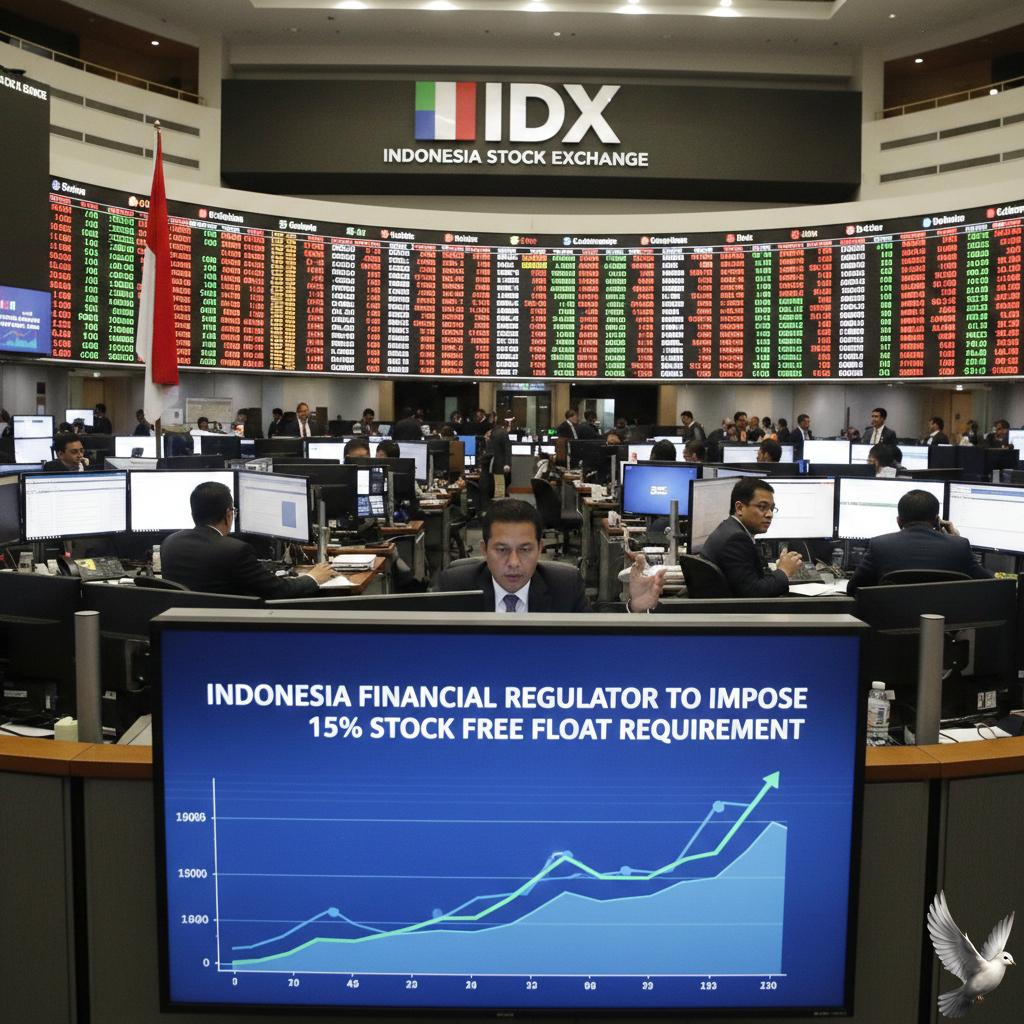
Indonesia Financial Regulator to Impose 15% Stock Free Float Requirement
**Indonesia Market Brief: Regulatory Overhaul Amid MSCI Pressure**
**Context & Recent Developments**
Indonesia’s financial landscape is undergoing a critical regulatory shift following a severe market correction in late **January 2026**. The **Financial Services Authority (OJK)** and the **Indonesia Stock Exchange (IDX)** are fast-tracking reforms to address transparency concerns raised by index provider **MSCI**, which recently froze its rebalancing for Indonesian securities.
**Market Impact**
* **Sharp Decline:** The **Jakarta Composite Index (JCI)** experienced extreme volatility, plunging approximately **7–8%** in late January, triggering multiple trading halts.
* **Current Levels:** As of **January 29, 2026**, the JCI hovered near **8,167 points**, erasing previous gains as foreign capital outflows accelerated.
* **Sector Hit:** Heavyweight stocks anticipated for MSCI inclusion, such as **Bumi Resources** and **Petrosea**, saw double-digit declines, reflecting acute investor anxiety over potential investability downgrades.
**Regulatory Response**
* **New Float Requirement:** To align with international standards, the IDX is raising the minimum free float requirement for listed companies from **7.5%** to **15%**. This measure aims to increase liquidity and reduce stock manipulation risks.
* **Transparency Measures:** The **OJK** and **KSEI** (Central Securities Depository) have begun publishing granular share ownership data, specifically distinguishing between strategic and public holdings to satisfy MSCI’s visibility demands.
* **Oversight:** OJK Chairman **Mahendra Siregar** has taken a direct role in overseeing these reforms, emphasizing a "quick and effective" resolution to restore confidence.
**Outlook & Deadlines**
The stakes remain high. **MSCI** has set a review deadline for **May 2026**. Failure to demonstrate significant improvement in market accessibility could result in Indonesia being downgraded from **Emerging Market** to **Frontier Market** status. Such a reclassification would likely trigger substantial passive fund outflows, estimated by analysts to be in the range of **$2–$5 billion**.
Authorities remain optimistic that the expedited reforms will satisfy global stakeholders before the next index review cycle.
***
**Next Step**