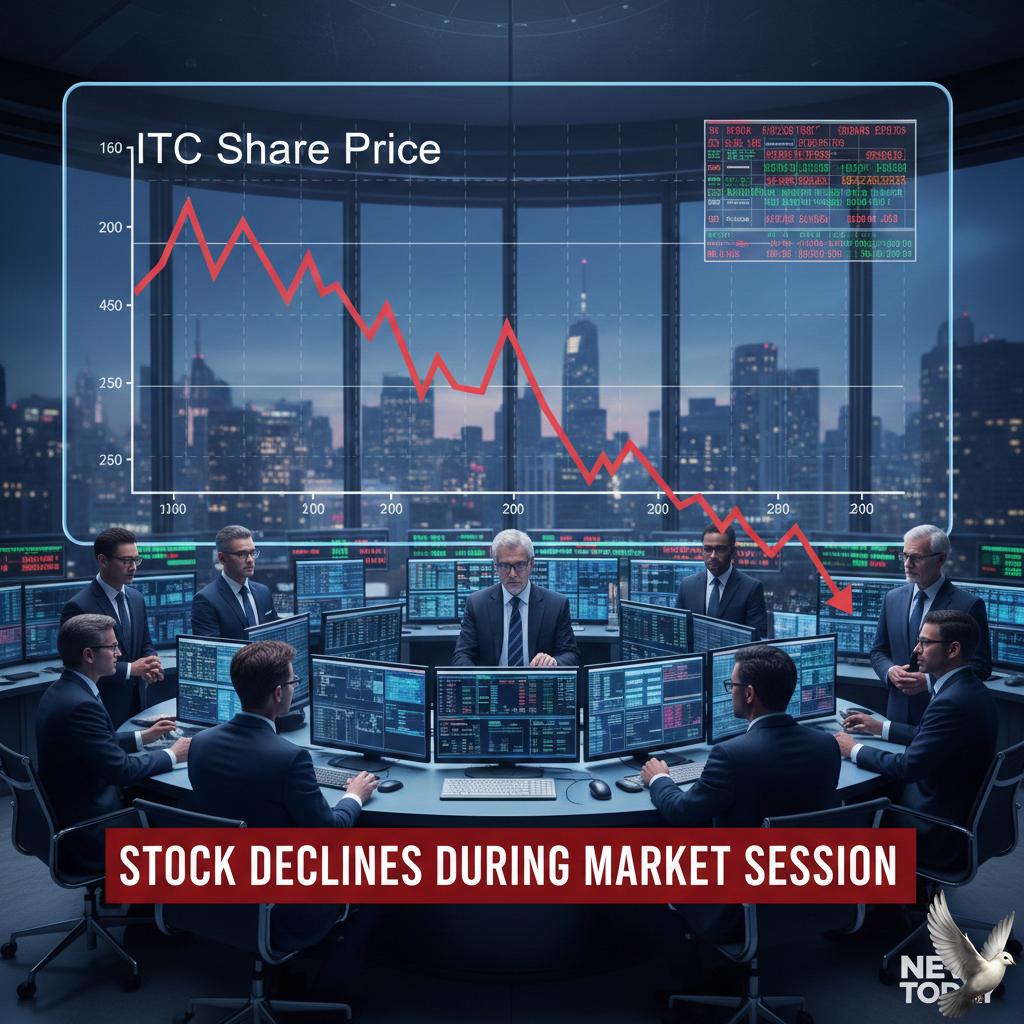
ITC Share Price Performance: Stock Declines during Market Session
Global Market Brief: February 2026
The global economy enters mid-February 2026 showing a projected growth rate of **3.3%**. Despite this resilience, a "divergence" theme is taking hold. While the U.S. labor market remains stable with unemployment falling to **4.4%**, trade policy shifts and uneven tariffs are beginning to reshape export competitiveness globally.
Monetary Policy and Interest Rates
The U.S. Federal Reserve has adopted a hawkish pause to start the year. The target interest rate range remains at **3.50% to 3.75%** following three consecutive cuts in late 2025.
Recent Consumer Price Index (CPI) data shows year-over-year inflation at **2.7%**. While this is an improvement, it remains above the Fed's **2%** target. Markets currently price in low odds for a cut in March, with most analysts expecting only one to two additional reductions totaling **50 basis points** by the end of 2026.
Equity Market Performance
U.S. equity-index futures are showing signs of risk aversion. S&P 500 futures fell **0.3%** and Nasdaq 100 futures slipped **0.6%** ahead of the Tuesday session. This follows a period of volatility where investors have begun rotating capital away from software companies at risk of AI-driven "cannibalization."
In contrast, semiconductor hardware remains a primary growth engine. The global chip market is projected to reach **$975 billion** in 2026, a **25%** year-on-year increase. High-performance logic and memory chips are leading this surge, with some hardware giants reporting record gross margins near **49.1%**.
Energy and Commodities
Energy markets are currently dominated by a supply-demand imbalance. Brent crude futures are trading near **$67.75** per barrel, while West Texas Intermediate (WTI) sits around **$62.89**.
Analysts expect oil prices to decline toward an average of **$58** per barrel for the full year 2026 as global production from non-OPEC+ sources—specifically Brazil, Guyana, and Argentina—outpaces demand growth. However, a geopolitical risk premium of **$5 to $7** remains embedded in prices due to tensions in the Persian Gulf.
Gold has seen a recent pullback after a sharp rally. Comex gold futures are trading at approximately **$5,021.99** per ounce. The metal is caught between a firmer U.S. dollar, which exerts downward pressure, and continued geopolitical uncertainty, which provides a floor for prices.
Key Economic Indicators
* Global Projected GDP Growth: **3.3%**
* U.S. Federal Funds Rate: **3.50% - 3.75%**
* U.S. Unemployment Rate: **4.4%**
* S&P 500 Index Level: **~6,836**
* Spot Gold: **~$5,021/oz**
* Brent Crude: **~$68/bbl**
Trade dynamics are notably shifting. New tariff structures have made certain imports, like South African wine, **17%** more expensive relative to 2024, while others, such as Italian rice, have become **12%** cheaper. This uneven trade landscape is forcing a massive reallocation of market shares across global value chains.