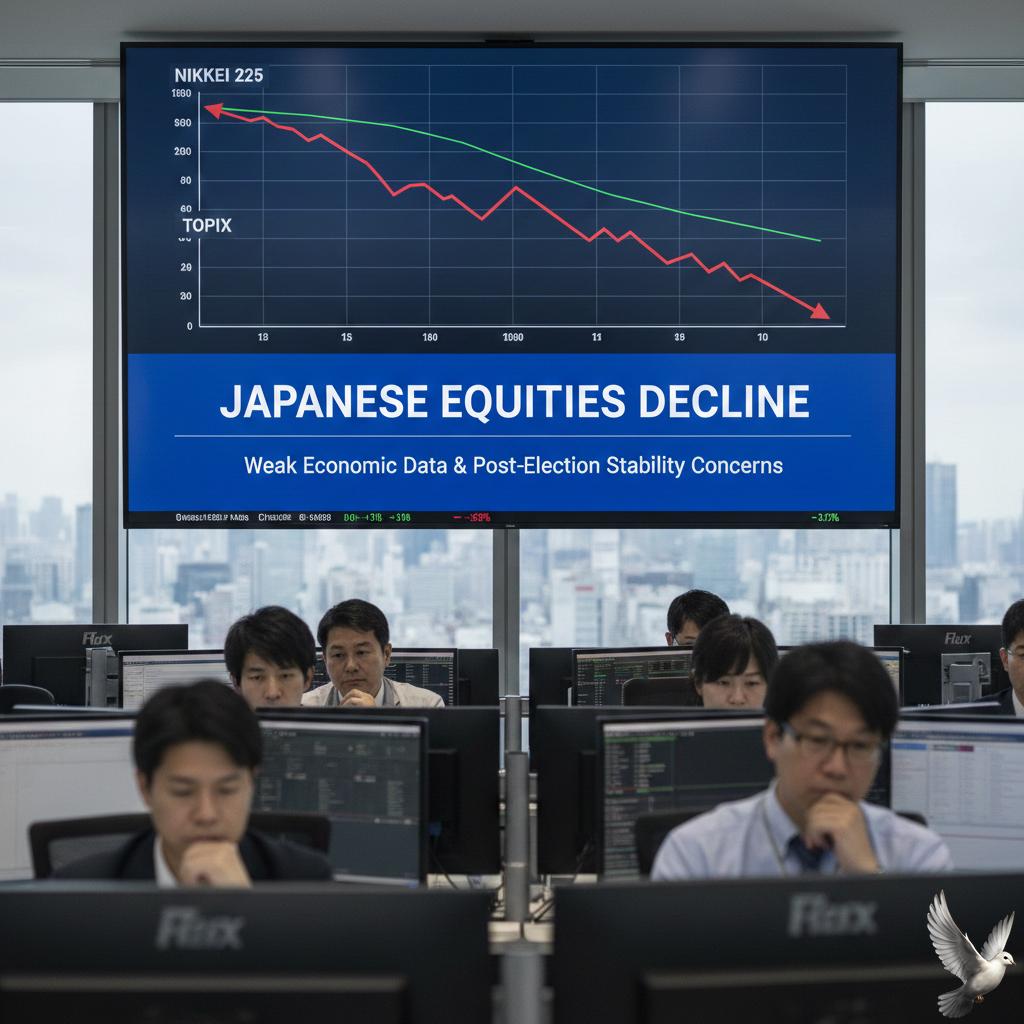
Japanese Equities Decline Amid Weak Economic Data and Post-Election Stability
Japanese equity markets closed with mixed results on Monday, February 16, 2026, as investors processed fresh economic data showing a fragile return to growth. The Nikkei 225 index ended the session at 56,948.05, eking out a marginal gain of 0.01% after a volatile day of trading.
The broader Topix index faced heavier pressure, sliding 0.8% to 3,921.44. Market sentiment was primarily dampened by preliminary Gross Domestic Product (GDP) figures for the October–December quarter. Japan's economy grew at an annualized rate of 0.2%, successfully avoiding a technical recession following a revised 2.6% contraction in the previous period. However, this recovery fell significantly short of the 1.6% growth that many analysts had anticipated.
On a quarter-on-quarter basis, the economy expanded by 0.1%. While private consumption showed slight resilience with a 0.1% increase, other critical drivers remained sluggish. Capital spending grew by only 0.2%, missing the 0.8% forecast, while exports dipped by 0.3% as global trade tensions and U.S. tariffs on automotive shipments continued to weigh on the manufacturing sector.
The disappointing growth data has complicated the outlook for monetary policy. The Bank of Japan (BOJ) currently maintains a policy rate of 0.75% after hiking in late 2025. While central bank officials have signaled a desire to normalize rates further toward a neutral range of 1.0% to 2.5%, the current economic weakness provides ammunition for Prime Minister Sanae Takaichi’s administration to advocate for continued monetary easing.
Recent surveys indicate that 60% of Japanese firms oppose further rate hikes this year, citing concerns over rising borrowing costs and lower profitability. Market participants are now closely watching the upcoming spring wage negotiations, as sustainable growth and future rate adjustments are seen as heavily dependent on real wages turning positive.
In currency markets, the Japanese yen weakened by approximately 0.3%, trading near 153.25 against the U.S. dollar. This follows a period of strength where the yen had gained nearly 3% last week. The current softening of the currency is attributed to a combination of the weak GDP print and a slight rebound in the U.S. dollar, though thin liquidity due to market holidays in the United States and China limited the overall volume of trade.
Despite the immediate headwinds, some institutional investors remain focused on the "Buy Japan" theme. Long-term confidence has been bolstered by the recent landslide election victory for the ruling Liberal Democratic Party, which removed significant fiscal uncertainty. Record share buybacks and ongoing corporate governance reforms continue to provide a structural floor for Japanese equities.