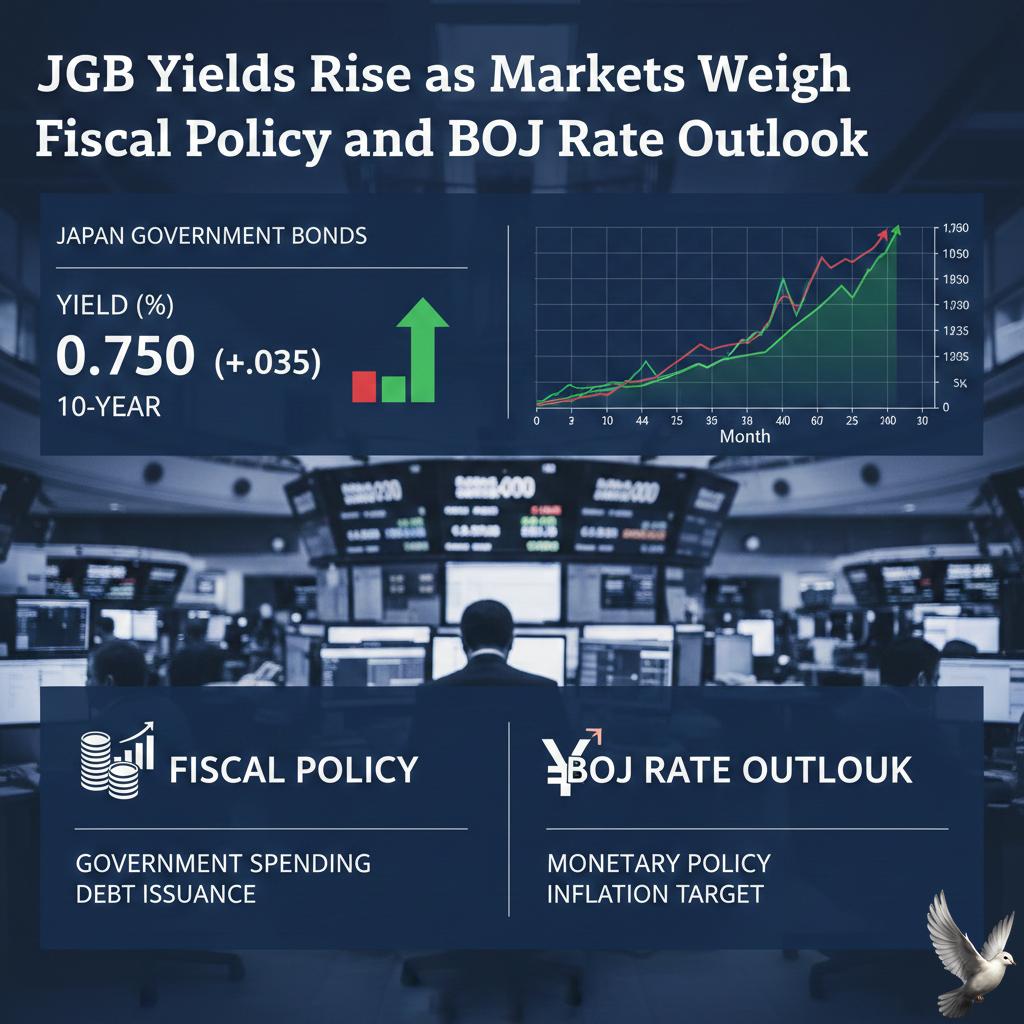
JGB Yields Rise as Markets Weigh Fiscal Policy and BOJ Rate Outlook
Japanese government bond (JGB) markets have entered a period of heightened volatility, marked by a significant sell-off in January 2026 that pushed yields to multi-year highs. The benchmark 10-year JGB yield recently touched 2.23%, a surge of approximately 100 basis points from the previous year, as investors priced in a more aggressive tightening cycle and fiscal expansion.
Market sentiment is currently driven by a tug-of-war between ambitious government spending and the Bank of Japan’s (BoJ) normalization path. Prime Minister Sanae Takaichi’s administration has proposed a record 122.3 trillion yen budget for fiscal 2026. While the government has signaled it will seek non-debt revenues to fund tax cuts on food, the Ministry of Finance warns that annual bond issuance could surge 28% by 2029 due to rising debt-servicing costs.
The Bank of Japan remains on a path toward higher rates, with the current policy rate sitting at 0.75%. Inflation has persistently exceeded the 2% target for nearly four years, reaching 3.1% in recent months. Analysts expect the central bank to hike rates again in April 2026, with some forecasting up to three increases this year to bring the policy rate toward a neutral stance by 2027.
The super-long end of the curve has faced the most intense pressure. Yields on 40-year bonds briefly exploded to 4.0% in late January—a psychological level not seen in three decades—before retreating slightly to 2.18% in mid-February as global bond markets stabilized. This retreat followed reassurances that the BoJ would maintain a flexible approach to bond-buying operations to prevent market dysfunction.
The Japanese yen has become a central factor in policy calculations. Trading around the 153 level per dollar, the currency has seen volatile swings. While the yen rallied nearly 3% in early February on safe-haven demand, it remains vulnerable to the wide interest rate gap between Japan and the United States. BoJ officials are closely monitoring the yen’s impact on import-driven inflation, which could accelerate the timing of the next rate hike.
Institutional investors are beginning to recalibrate as real interest rates turn positive for the first time in two decades. Higher domestic yields are expected to encourage Japanese banks and insurers to shift a portion of their 5 trillion dollar foreign asset holdings back into JGBs. However, the transition is proving painful for regional lenders, who are already recognizing mark-to-market losses on their existing bond portfolios.
Economic growth remains a complicating factor. Fourth-quarter GDP expanded by just 0.1%, falling short of the 0.4% forecast. Weak consumer spending highlights the strain high inflation is placing on households, even as nominal wages rise at a historic pace. This "soft" data provides the BoJ with a reason to remain gradual in its tightening, even as fiscal pressures urge a faster move toward higher rates.