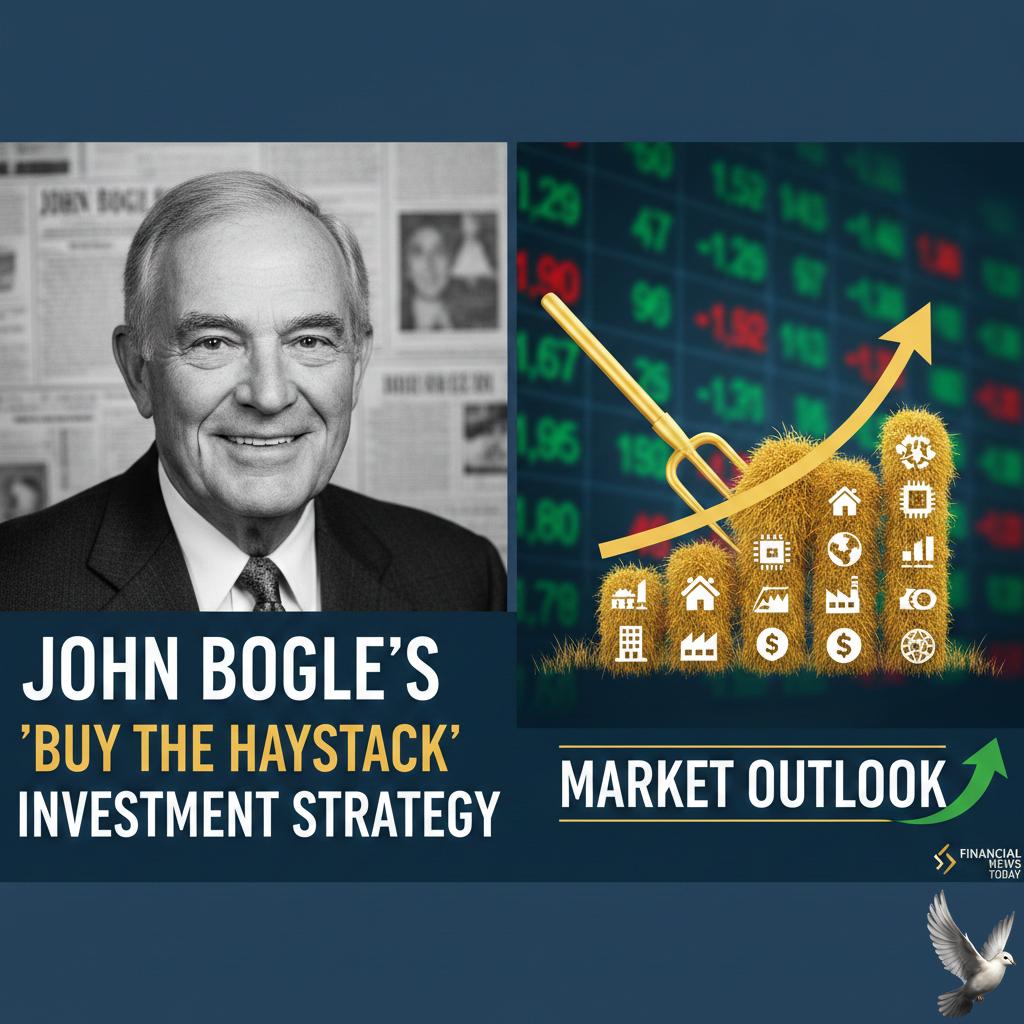
John Bogle's "Buy the Haystack" Investment Strategy and Market Outlook
The philosophy of John Bogle remains a cornerstone of modern wealth management, especially as market volatility persists in 2026. By owning the entire market through index funds, investors avoid the pitfalls of individual stock picking and benefit from the structural growth of the global economy.
As of late February 2026, the S&P 500 has climbed to record levels, closing near **6,946.13**. This reflects a year-to-date gain of approximately **1.5%** to **2%**, following a robust **17%** return in 2025. Wall Street analysts currently forecast a full-year return for 2026 of nearly **12%**, driven by resilient corporate earnings and a pivot toward artificial intelligence integration.
Diversification is a critical shield against company-specific risks. In the current regime, the top 10 holdings of the S&P 500—led by firms like Nvidia (**7.9%**) and Apple (**6.8%**)—account for a significant portion of market movement. An index-based approach ensures you capture these leaders without the risk of over-exposure to a single failure.
High costs are a silent destroyer of wealth. Recent data shows a widening gap between passive and active management fees. Vanguard has reduced its asset-weighted average expense ratio to just **0.06%**, with some total market ETFs as low as **0.03%**. In contrast, many actively managed funds still carry fees between **0.50%** and **1.5%**, which can significantly erode compounding returns over decades.
Inflation and interest rates continue to shape the investment landscape. With U.S. core inflation hovering around **3%**, the real return on investments is under pressure. Indexing provides a behavioral advantage by encouraging long-term discipline. This "buy-and-hold" strategy helps investors stay the course even during periods of "sticky" inflation or Federal Reserve policy shifts.
The current market environment proves that while specific sectors may fluctuate, the broader market indices tend to rise over time. For the average investor, the most reliable path to wealth creation is not found in seeking the next "winner," but in maintaining a low-cost, diversified portfolio that tracks the inevitable growth of the entire market.