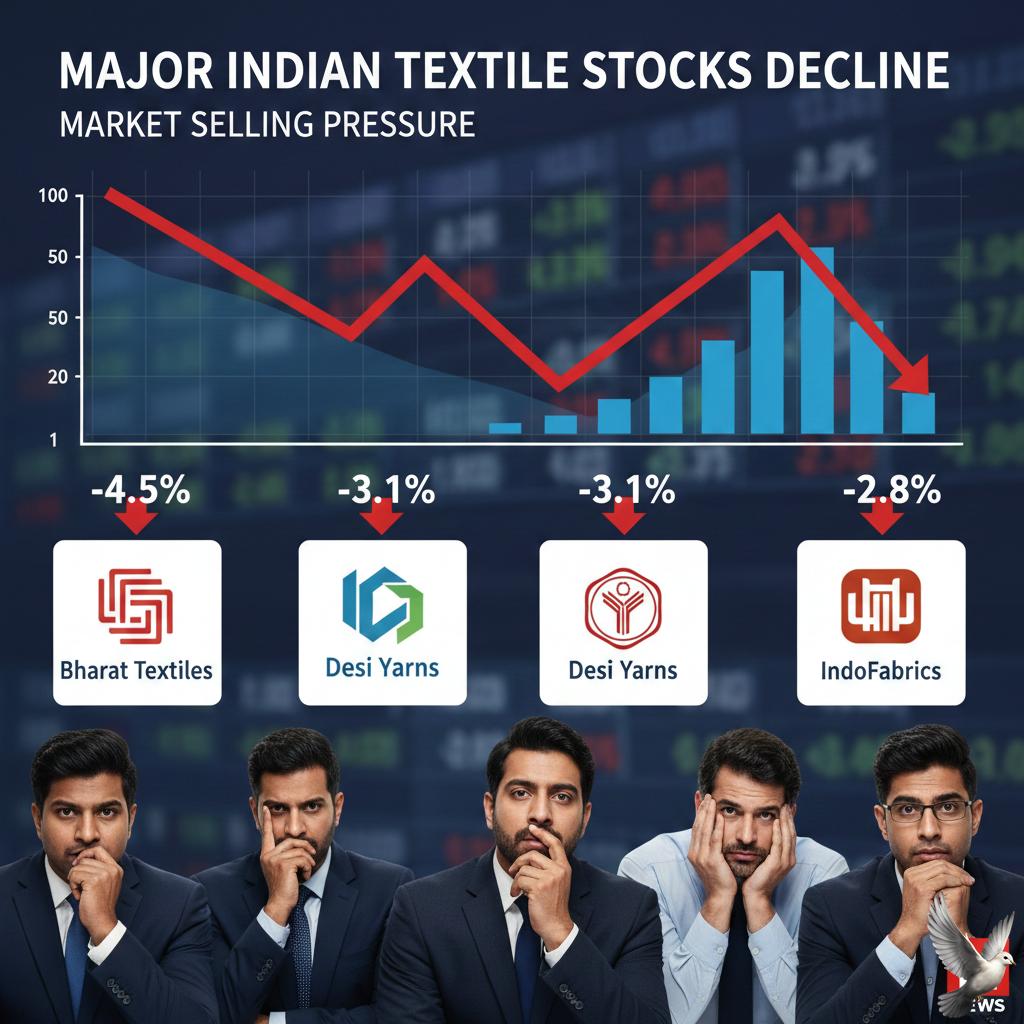
Major Indian Textile Stocks Decline Amid Market Selling Pressure
Indian Textile Market Update: February 10, 2026
Indian textile and apparel stocks experienced a sharp sell-off during Tuesday's trading session. The downturn followed the formalization of a landmark trade agreement between the United States and Bangladesh, which significantly alters the competitive landscape in the North American market.
Market Reaction and Stock Performance
Selling pressure intensified across the sector, with leading export-oriented companies witnessing declines between **3% and 6%**.
* **Gokaldas Exports** led the losses, falling **6%** to hit a day low of **₹792**.
* **Pearl Global Industries** dropped **6%** to **₹1,692**.
* **Welspun Living** plummeted **5%** to **₹137**.
* **KPR Mill** declined **4.5%**, reaching a session low of **₹935**.
* **Nitin Spinners** and **Vardhman Textiles** both saw valuations erode by approximately **3%**.
This correction follows a period of optimism where several of these stocks had gained up to **19%** over the past week due to India's own interim trade discussions with the U.S.
The U.S.-Bangladesh Trade Pact
The primary trigger for the sell-off is the "Agreement on Reciprocal Trade" signed between Washington and Dhaka. This deal provides a multi-layered advantage to Bangladeshi exporters that directly challenges Indian market share.
Under the new terms, the U.S. has reduced the general reciprocal tariff on Bangladeshi goods to **19%**, down from a previous high of **37%**. More critically, the agreement establishes a mechanism for **0% duty-free access** on specific garments and textiles, provided they are manufactured using U.S.-sourced cotton or man-made fibers.
In contrast, Indian textile exports currently face a reciprocal tariff of **18%**. While this is slightly lower than Bangladesh's general rate, the zero-duty exemption for U.S.-input products gives Bangladesh a decisive pricing edge in high-volume categories.
Strategic Shifts and Outlook
Analysts note that the deal creates a double-edged sword for the Indian industry. Beyond direct apparel competition, the agreement incentivizes Bangladesh to shift its raw material sourcing.
By tying duty-free status to U.S. cotton, the pact may reduce Bangladesh's reliance on Indian cotton yarn and fiber. Bangladesh is currently one of the world's largest importers of cotton, and a shift toward U.S. suppliers could impact India's upstream spinning and ginning sectors.
Despite the immediate market volatility, the Indian government continues to focus on long-term structural buffers. This includes the finalized Free Trade Agreement with the European Union, which aims to provide zero-duty access to a **$263.5 billion** import market, and the ongoing **₹10,683 crore** PLI scheme intended to boost domestic manufacturing scale.
However, for the immediate term, investor sentiment remains cautious as the industry recalibrates for a more aggressive price war in the U.S. apparel segment, which remains India’s largest export destination.