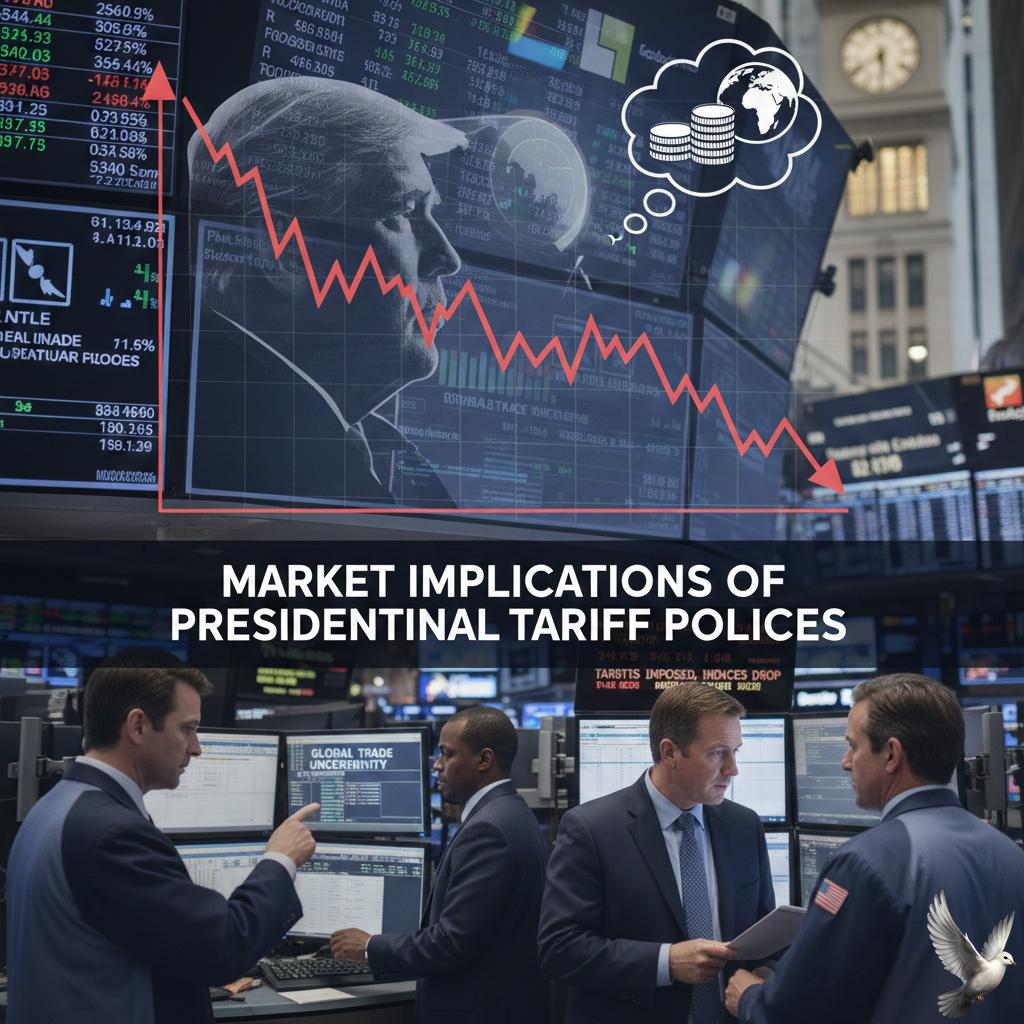
Market Implications of Presidential Tariff Policies
In a major legal shift on February 20, 2026, the U.S. Supreme Court struck down President Trump’s sweeping global tariff regime. In a 6-3 ruling, the Court determined that the executive branch overstepped its authority by using the International Emergency Economic Powers Act (IEEPA) to impose broad trade duties.
Chief Justice John Roberts authored the majority opinion, clarifying that the power to levy taxes and tariffs is a constitutional authority belonging exclusively to Congress. The ruling effectively voids the "reciprocal" tariffs of 10% to 50% that had been applied to nearly all trading partners since early 2025.
**Immediate Market Impact**
The decision triggered an immediate reaction in financial markets. Major indices surged following the news:
- The Dow Jones Industrial Average rose 0.3% to **49,521.49**
- The S&P 500 gained 0.6% to reach **6,901.67**
- The Nasdaq Composite jumped 1.0% to **22,914.91**
Analysts view the ruling as a potential hedge against inflation, which had accelerated in early 2026. Prior to the verdict, the effective U.S. import tariff rate was projected to peak at **13%** to **14%**. The removal of these duties is expected to ease the core personal consumption expenditures index, which had seen a **0.5 percentage point** increase due to tariff costs.
**Global Trade Dynamics**
Before the ruling, global trade growth was projected to slow to just **0.6%** in 2026. The decision provides a reprieve for key exporters. Canada and Mexico, previously facing a **25%** duty, and India, which saw tariffs on its goods reduced to **18%** just weeks ago, are now assessing the legal path for duty refunds.
The U.S. Census Bureau reported a trade deficit of **$70.3 billion** in December 2025, and while the ruling may not shrink this gap immediately, it removes the immediate threat of escalating costs for U.S. consumers who were absorbing nearly **77%** of tariff expenses.
**Political and Legal Next Steps**
The White House characterized the ruling as a "disgrace" and signaled the use of alternative trade laws, such as Section 301 of the Trade Act of 1974, to maintain trade pressure. However, these tools are more limited in scope and require specific investigations into unfair trade practices.
The focus now shifts to the U.S. Customs and Border Protection and the Court of International Trade. Importers are bracing for a complex refund process, as the Supreme Court did not provide a specific mechanism for returning the billions of dollars already collected under the illegal mandates.