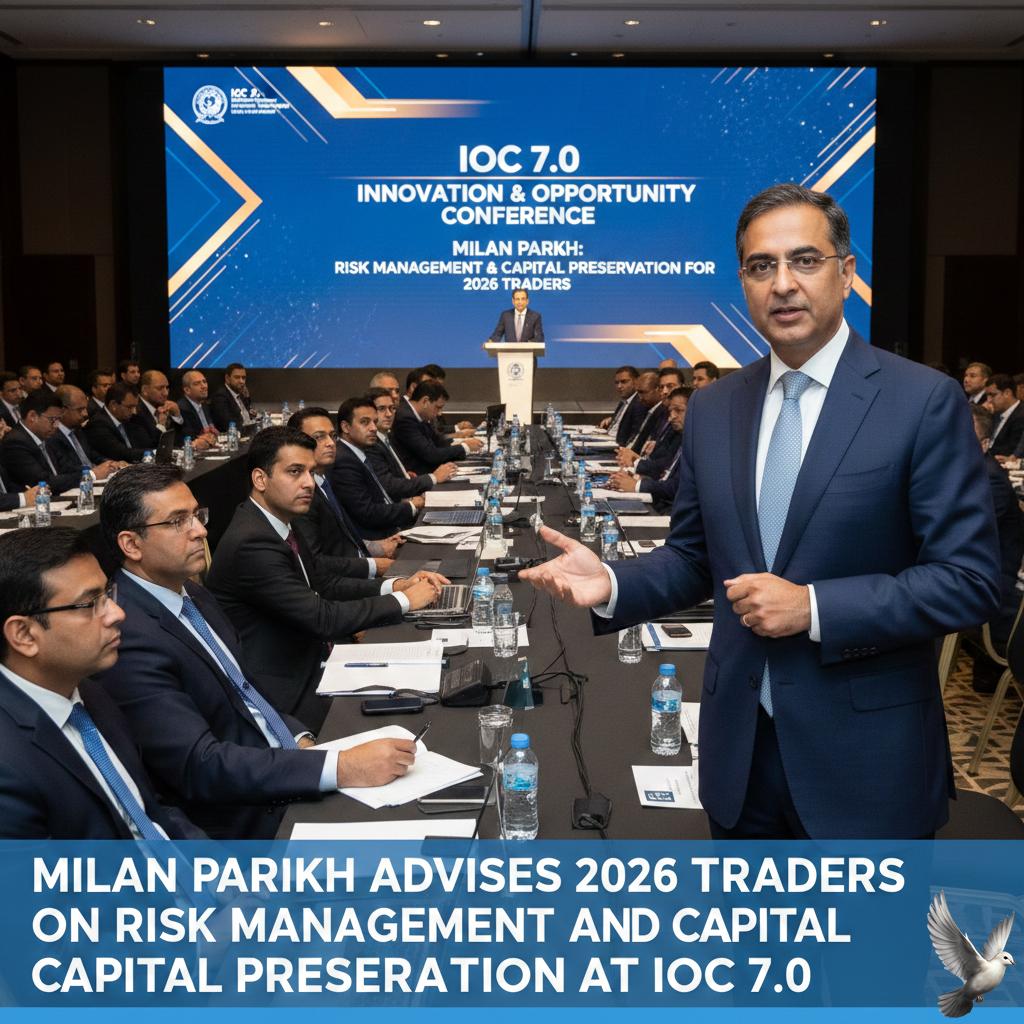
Milan Parikh Advises 2026 Traders on Risk Management and Capital Preservation at IOC 7.0
Market Brief: 2026 Strategic Trading Outlook
The Indian equity landscape is navigating a period of heightened volatility as February 2026 progresses. Global geopolitical tensions and shifting trade dynamics have introduced significant uncertainty, even as domestic fundamentals show resilience.
On February 13, 2026, the **Nifty 50** closed at **25,471.10**, marking a decline of **336.10 points (1.30%)**. Simultaneously, the **S&P BSE Sensex** dropped over **1,000 points** to settle at **82,626.76**. This correction, largely led by the IT and metal sectors, resulted in a single-day erosion of **7.02 lakh crore** in investor wealth.
Risk Management and Wealth Preservation
Market veteran Milan Parikh, speaking at the **Indian Options Conclave (IOC 7.0)**, emphasizes a "capital-first" approach for the current year. The core directive for traders is to avoid risking a lifetime of accumulated wealth for speculative short-term gains.
A critical benchmark suggested for 2026 is to strictly **cap losses at one year's profits**. This strategy is designed to ensure that even a significant market downturn does not jeopardize the core principal or long-term financial security.
The Gen Z Influence and Digital Shift
The trading ecosystem is undergoing a structural transformation driven by a massive influx of **377 million Gen Z** participants. This cohort is characterized by a preference for data-led insights over market sentiment.
Recent data indicates that **48% of Gen Z** are already active in the stock markets, with **92%** favoring **Systematic Investment Plans (SIPs)** for wealth creation. Monthly SIP inflows have now crossed the **29,000 crore** mark, reflecting a deepening financialization of Indian household savings.
Technology and Market Infrastructure
Technology remains the primary catalyst for market accessibility. The rise of fractional shares, commission-free trading, and advanced algorithmic platforms has democratized the field.
Professional clearing services and in-house developed trading applications are streamlining operations, allowing for faster execution and better risk monitoring. However, as technology lowers entry barriers, the "tuition fee" of the market—learning through practical experience—remains a constant for all participants.
Economic Indicators and Sentiment
The broader economic context provides a mixed backdrop. India's retail inflation rose to **2.75%** in January 2026 under the newly revised **2024 base series**. While this remains below the RBI's **4% target**, it suggests a benign but watchful inflationary environment.
Institutional flows show a tug-of-war; while **Foreign Portfolio Investors (FPIs)** were net sellers of over **7,300 crore** in recent sessions, **Domestic Institutional Investors (DIIs)** provided a cushion with net purchases exceeding **5,500 crore**.
Traders are advised to maintain a disciplined framework, prioritizing structured learning and verified data over social media trends. The focus for the remainder of Q1 2026 should be on margin preservation and process-driven execution rather than chasing high-volatility breakouts.