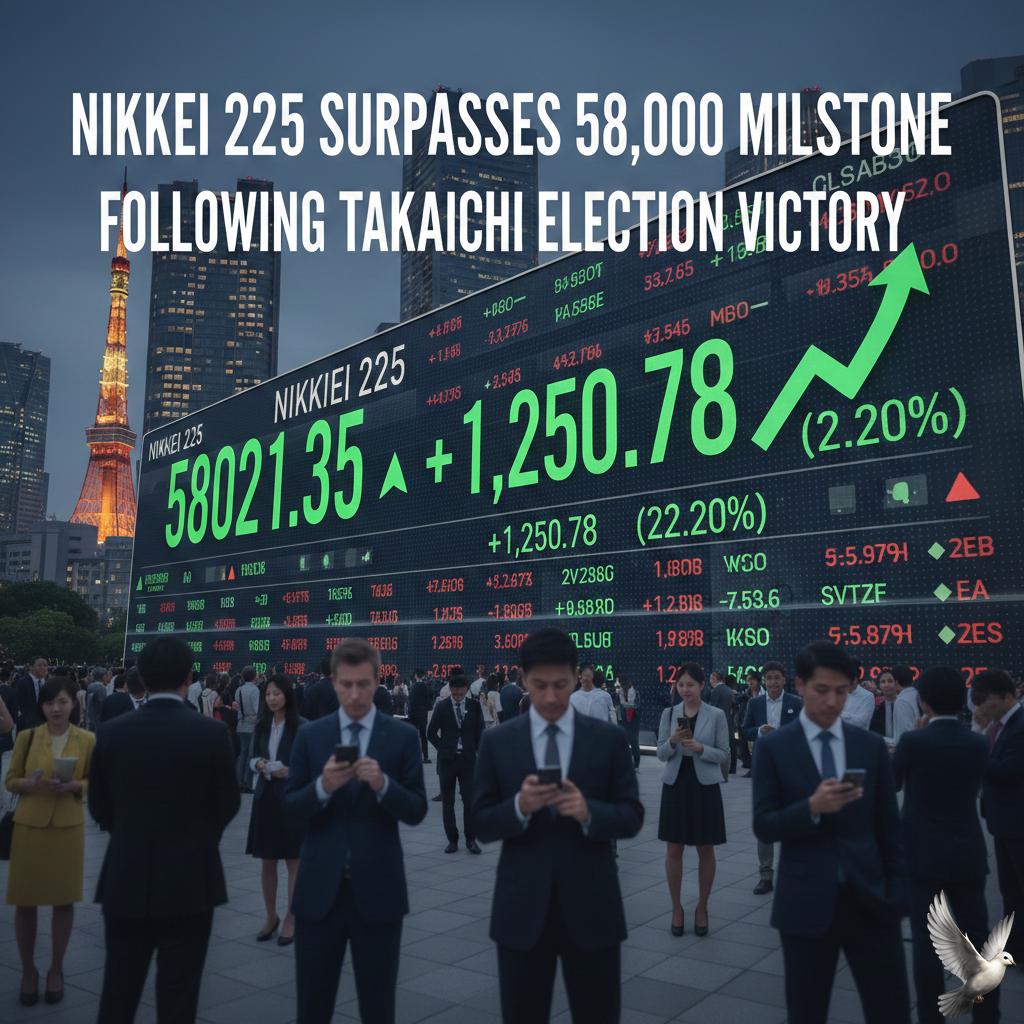
Nikkei 225 Surpasses 58,000 Milestone Following Takaichi Election Victory
The Japanese equity market continues its historic ascent, with the benchmark Nikkei 225 Index hitting an unprecedented milestone today, February 12, 2026. After a public holiday, investors returned to push the index past the psychological barrier of 58,000 for the first time in history.
The Nikkei 225 surged to an intraday high of 58,015.08 before settling slightly lower at 57,685.97. This movement marks a significant 15% gain for the index since the beginning of 2026. The broader Topix Index also demonstrated strength, climbing 0.45% to reach 3,872.76, further solidifying the record-breaking trend.
Market sentiment is currently dominated by the "Takaichi Trade." Following a landslide victory for Prime Minister Sanae Takaichi in the recent general election, traders are betting on a regime of expansionary fiscal policy. The Prime Minister’s agenda—focused on increased government spending and targeted tax cuts—has provided a powerful mandate for growth that is resonating with both domestic and international investors.
Corporate earnings are providing additional tailwinds. Furukawa Electric led gainers with a 4.5% rise, while SoftBank Group climbed 2.9% ahead of its earnings release. These gains reflect a broader rotation of global capital into Japanese markets, as investors seek attractive valuations and a stable political environment compared to other major economies.
In the currency markets, the Japanese Yen has shown unexpected resilience. Despite strong U.S. labor data and rising Treasury yields, the Yen strengthened to the 153 range against the U.S. Dollar. This move follows a "bull flattening" of the Japanese yield curve and reassurances from the government that fiscal stimulus will be managed without excessive new bond issuance.
Macroeconomic indicators suggest a steady trajectory for the remainder of the year. Core inflation is projected to hover near the 2% target, while real GDP growth for 2026 is forecast at approximately 1%. The Bank of Japan remains on a path toward policy normalization, with analysts expecting the short-term interest rate to reach 1% by the end of the year.
The combination of political stability, robust corporate performance, and a shift in global portfolio allocations has positioned Tokyo as a primary engine of growth in the Asian region. As the Nikkei enters uncharted territory above 58,000, the focus remains on the implementation of the new administration’s economic stimulus and its impact on long-term fiscal sustainability.