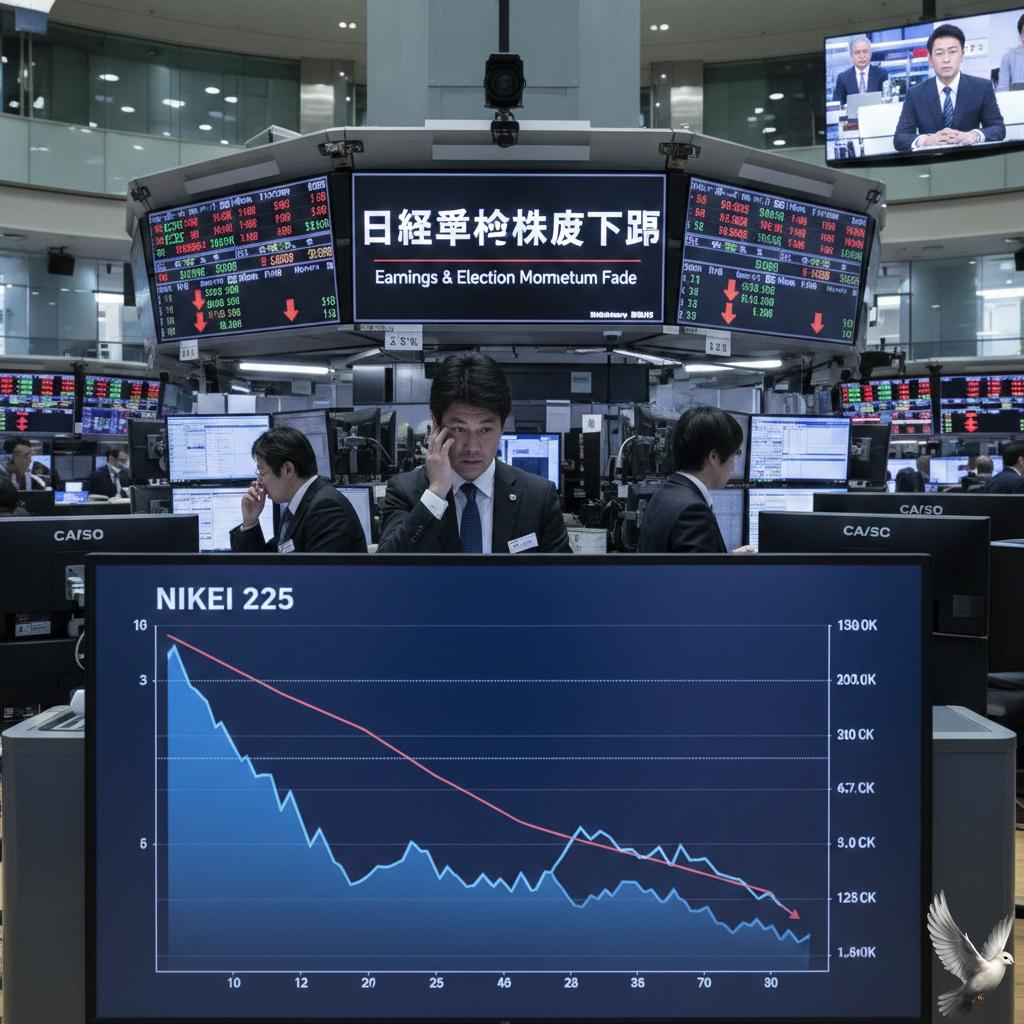
Nikkei Declines as Earnings and Election Momentum Fade
Japan's equity markets faced a challenging session on Tuesday, as the Nikkei 225 share average retreated for the fourth consecutive day. The index fell 0.42% to close at 56,566.49, marking a period of cooling momentum following the post-election rally that characterized the start of the month.
The downward pressure was primarily driven by a lack of fresh trading catalysts and a general trend of profit-taking. Investors appear to be recalibrating their positions as the corporate earnings season draws to a close and the initial "euphoria" surrounding Prime Minister Sanae Takaichi’s victory begins to fade.
Technology and defense sectors were the primary laggards during today's trading. SoftBank Group saw a significant decline of 5.1%, weighed down by its exposure to global tech volatility and investor skepticism regarding high-growth valuations. In the defense sector, Mitsubishi Heavy Industries and Kawasaki Heavy Industries dropped 2.8% and 4.4% respectively, reflecting a broader retreat from names that had previously benefited from geopolitical hedging.
On the macroeconomic front, the Bank of Japan remains a central focus. Governor Kazuo Ueda indicated that the central bank will maintain its path of gradual policy normalization, with the short-term interest rate currently sitting around 0.5% to 0.75%. Market participants are closely monitoring the yen, which has stabilized near 153.17 per dollar, as policy divergence between Japan and other major economies continues to influence export-heavy sectors.
While the market is currently in a corrective phase, some underlying fundamentals remain resilient. Japan’s nominal GDP recently surpassed the 600 trillion yen milestone for the first time, growing at 2.9% in the latest annual figures. Additionally, corporate profits across several industries continue to show long-term improvement, even if the immediate pace of gains has moderated.
Investor sentiment is now shifting toward a more cautious "wait-and-see" approach. With the Nikkei down roughly 1.9% over the last four sessions, the market is searching for new support levels. High-profile individual stocks showed mixed results: Tokyo Electron gained 1.47% on selective chip-sector strength, while financial giants like Mizuho and Sumitomo Mitsui saw declines of over 1.8% as the rotation out of cyclical stocks persisted.
The outlook remains tied to upcoming U.S. economic data and further clarity on domestic fiscal spending. For now, the transition from election-driven optimism to a fundamentals-based environment has introduced a period of heightened volatility for Tokyo traders.