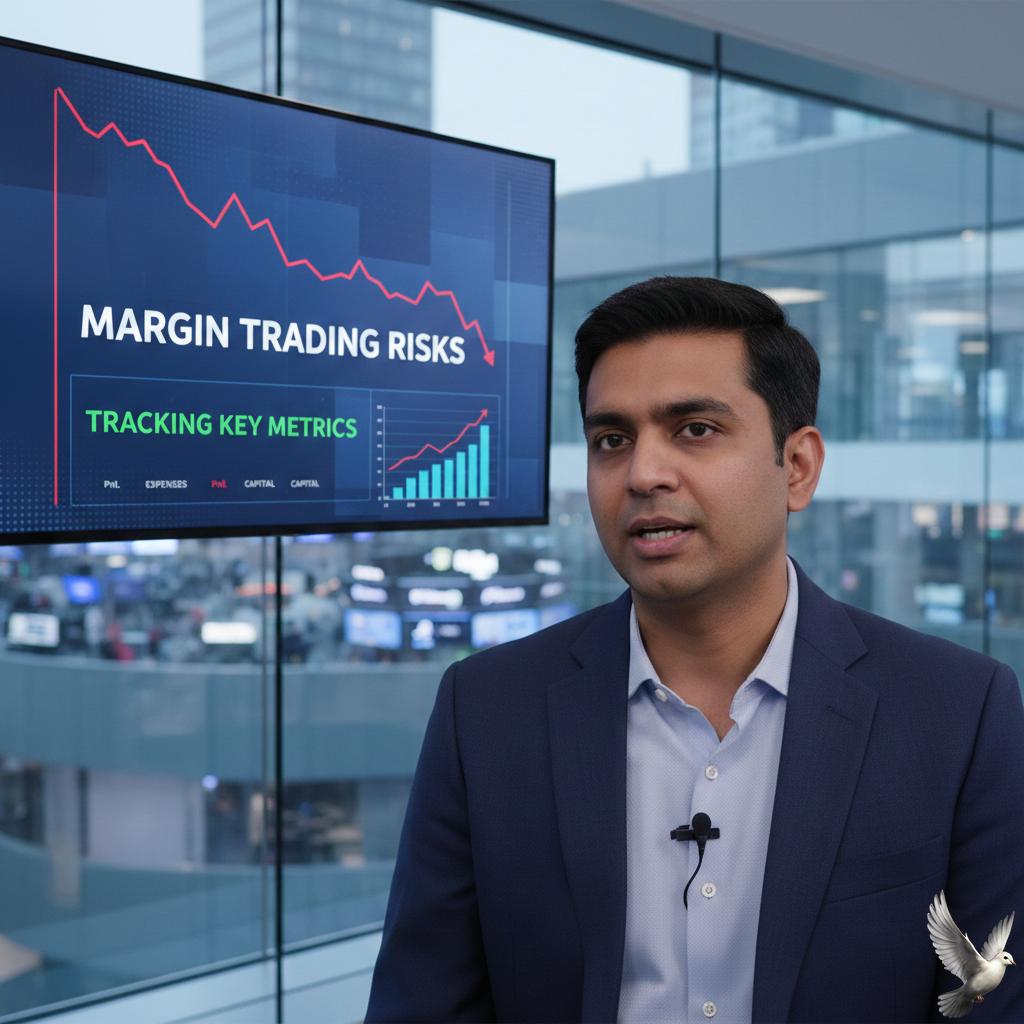
Nithin Kamath on the Risks of Margin Trading and the Importance of Tracking Key Metrics
Market Brief: The Rising Cost of Leverage
The Margin Trading Facility (MTF) in India has seen an explosive five-fold growth since 2019, with the total book value now exceeding **₹1.10 lakh crore**. While retail participation remains high, a critical shift in the regulatory and cost landscape is fundamentally altering the math for leveraged traders.
Hidden Costs and Breakeven Pressure
Nithin Kamath has issued a fresh caution to investors who focus solely on interest rates while ignoring the compounding effect of brokerage and taxes. In a leveraged trade, every cost is magnified because the investor's actual capital contribution is only a fraction of the total trade value.
Current market data shows that for a typical **₹11 lakh** trade, the points required to break even can more than quadruple depending on the frequency of trades and the fee structure. For short-term traders, brokerage alone can be the difference between a minor profit and a net loss.
Regulatory Squeeze and Liquidity Risks
The Reserve Bank of India has introduced a major policy shift effective **April 1, 2026**. Banks are now mandated to provide credit to market intermediaries only on a **100% fully collateralised** basis. This move is expected to:
* Reduce overall system leverage
* Increase capital blockage for brokers
* Raise the cost of bank guarantees significantly
Under the new framework, equity shares used as collateral will face a minimum haircut of **40%**, further tightening the available liquidity for active traders.
Current Market Benchmarks
As of **February 18, 2026**, market indicators reflect a cautious but stable environment:
* **Sensex:** **83,428.13**
* **Nifty 50:** **25,722.40**
* **10-Year G-Sec Yield:** **6.67%**
* **USD/INR:** **90.67**
Institutional activity remains mixed, with Foreign Portfolio Investors (FPIs) buying approximately **₹995 crore** in the latest session, while Domestic Institutional Investors (DIIs) showed marginal buying of **₹187 crore**.
Strategy for Leveraged Positions
With the structural risks of MTF rising, the "breakeven math" has become more punishing. Traders are encouraged to treat leverage as a high-precision tool rather than a capital substitute.
Success in the current high-cost environment requires capturing larger price moves to offset the interest—which typically ranges between **10% and 18% annually**—and the inevitable friction of statutory taxes and brokerage fees.