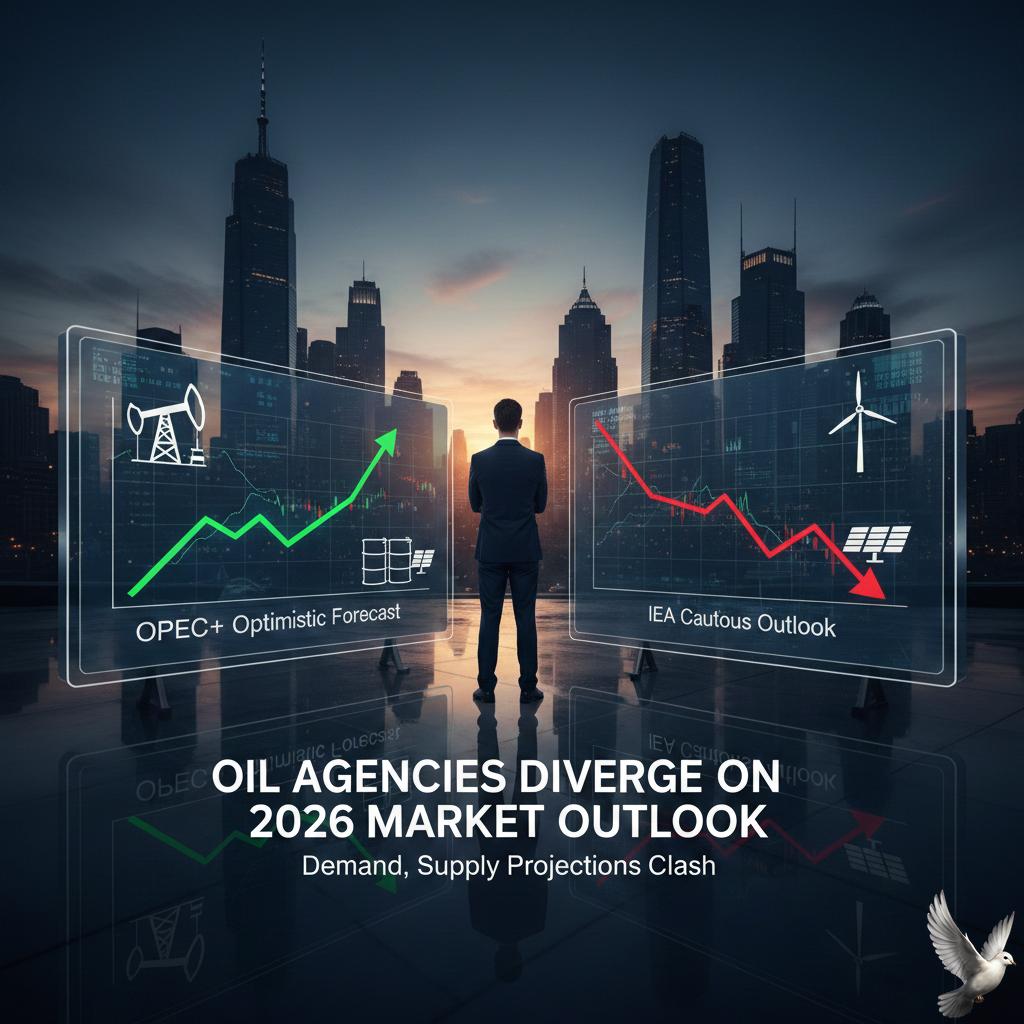
Oil Agencies Diverge on 2026 Market Outlook
**Global Oil Market: A Clash of Forecasts**
**Forecast Divergence**
The global oil market is currently defined by a stark disagreement between major forecasting agencies regarding the supply-demand balance for 2026. The gap between the most bearish and bullish outlooks has widened to historic levels, creating significant uncertainty for traders and policymakers.
The International Energy Agency (IEA) projects a massive oversupply, estimating a surplus exceeding 3.7 million barrels per day (bpd) for the year, potentially topping 4 million bpd in the first half of 2026. This bearish view is driven by surging output from the Americas and decelerating global demand growth.
Similarly, the U.S. Energy Information Administration (EIA) forecasts a substantial overhang, predicting supply will outstrip demand by approximately 2.8 million bpd. Both agencies point to a structural shift where supply growth from non-OPEC+ nations outpaces the world’s appetite for crude.
In sharp contrast, OPEC maintains a far more optimistic stance. Their latest estimates suggest a much tighter market, with the surplus averaging only about 600,000 bpd. This divergence of over 3 million bpd between the IEA and OPEC assessments represents one of the largest forecasting gaps in recent history.
**Price Action and Market Sentiment**
Current market pricing appears to favor the bearish sentiment. As of late January 2026, benchmark prices remain subdued, reflecting the market's anxiety over the looming inventory builds.
* **Brent Crude** is trading near **$65.74** per barrel.
* **WTI Crude** hovers around **$60.83** per barrel.
Both benchmarks are down roughly 16% to 17% compared to year-ago levels. The persistent downward pressure underscores the market's focus on the incoming wall of supply rather than geopolitical risk premiums, which have largely eroded despite ongoing tensions in Eastern Europe and the Middle East.
**Supply Dynamics: The Non-OPEC Surge**
The core driver of the predicted surplus is robust production growth outside the OPEC+ alliance. The United States, Brazil, Guyana, and Canada are pumping record volumes, adding approximately 1.5 million bpd to global supply. This flood of new oil is hitting the market just as consumption growth hits a structural slowdown.
**Demand Weakness**
On the demand side, the IEA and EIA cite "subdued" growth prospects, forecasting annual increases of less than 800,000 bpd for both 2025 and 2026. Key factors include:
* **China's Economic Shift:** The world's largest oil importer is seeing slower industrial demand.
* **Electrification:** Rapid adoption of electric vehicles (EVs) is displacing gasoline consumption in major markets.
* **Efficiency Gains:** The petrochemical sector remains the primary driver of growth, while transport fuel demand stagnates.
**OPEC+ Strategic Response**
Faced with these bearish headwinds, the OPEC+ alliance has adopted a defensive posture. In early January 2026, the group confirmed it would pause planned production increases through the first quarter of the year.
Member nations, led by Saudi Arabia and Russia, are maintaining current output cuts until at least March 2026 to prevent a price collapse. This disciplined approach aims to drain excess inventories, though the sheer scale of non-OPEC expansion limits the group's ability to dictate price floors as effectively as in previous years.
**Summary Outlook**
The market is caught in a tug-of-war. If the IEA's surplus of 4 million bpd materializes, prices could face further downward corrections, potentially testing the $50 range. However, if OPEC's tighter view proves accurate—supported by resilient demand or unexpected supply disruptions—the current bearish positioning could unwind rapidly. For now, the weight of evidence points to a well-supplied market entering a period of significant inventory accumulation.